Zardari and Shehbaz: Parliament must decide new provinces
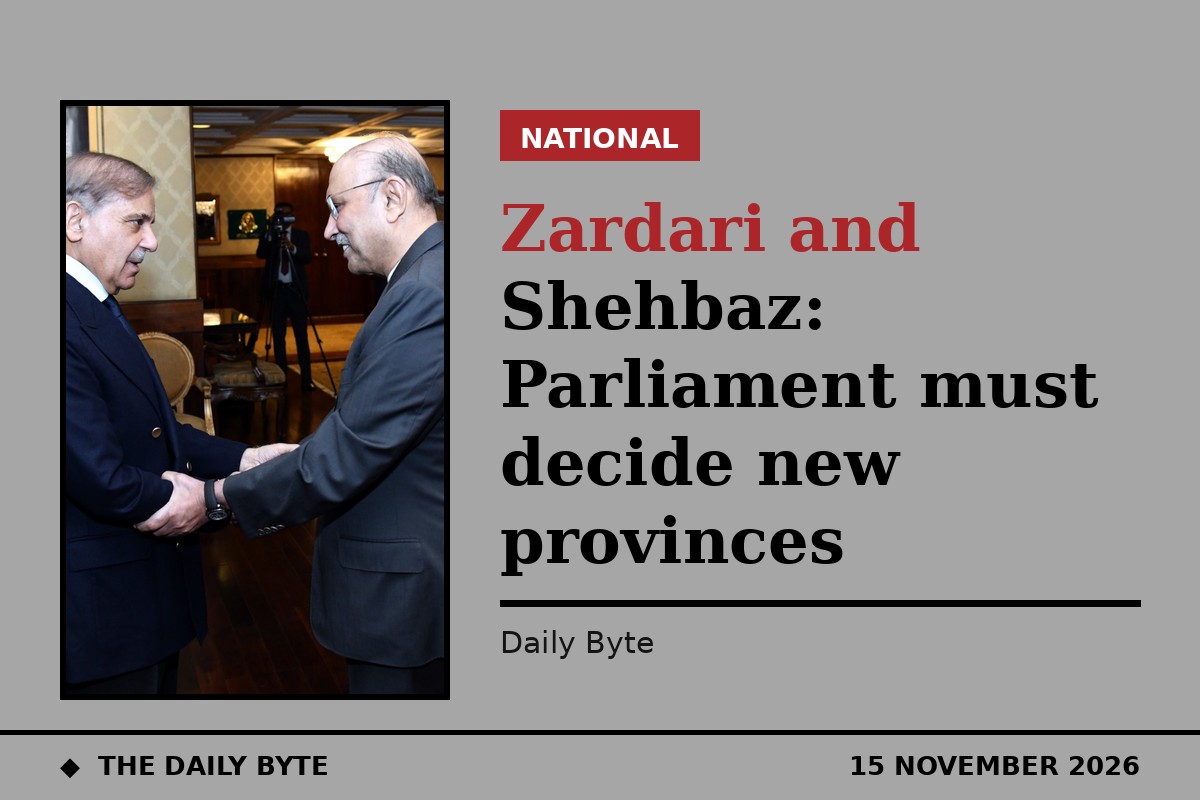
President Asif Ali Zardari and Prime Minister Shehbaz Sharif met in Lahore on Saturday, 14 November, as the debate over creating new provinces gathered pace, with the two leaders discussing how any referendum on the issue would have to go through Parliament.
The meeting was held at the prime minister's residence in Model Town, Lahore, two days after Interior Minister Mohsin Naqvi floated the idea of a referendum to settle the question of smaller provinces and discussed it with President Zardari in Nawabshah.
According to Pakistan Muslim League-Nawaz (PML-N) sources quoted by The News, the two leaders discussed the legal and constitutional process for holding a referendum on the creation of more provinces. The sources said the federal government has already prepared the procedure for a referendum under Clause 6 of Article 48 of the Constitution, under which the prime minister can seek Parliament's permission for a referendum on an issue of national importance.
Joint session named as the decision point
The sources said approval to hold the referendum would be taken from a joint session of Parliament. If the government failed to secure a majority there, it could approach the Federal Constitutional Court to determine the referendum's constitutional and legal status.
The proposal under discussion would create 12 provinces in total, dividing Punjab into four, Khyber Pakhtunkhwa and Balochistan into three each, and Sindh into two. Any change to provincial boundaries requires a constitutional amendment, which needs a two-thirds majority in Parliament.
President Zardari made clear that the Pakistan Peoples Party's position remains aligned with the Sindh Assembly's unanimous resolution opposing the division of Sindh. The PPP, which governs Sindh, holds reservations about splitting its home province.
Balochistan resolution and the Senate timetable
The sources said a resolution on creating new provinces is expected to be presented in the Balochistan Assembly in the coming weeks, and that progress on the issue has been deemed necessary before the Senate elections expected in the first week of March 2027.
The PML-N has adopted a wait-and-see approach, the sources said: it will watch what the PPP and the Pakistan Tehreek-e-Insaf (PTI) do. If both parties support the plan, the PML-N will too, and if the PPP backs out, the PML-N may join it. A debate within the PTI has also begun for and against smaller provinces, but the party has not yet given a clear indication of whether it will support the proposed constitutional amendment.
The meeting also discussed the ongoing operation against terrorism in Khyber Pakhtunkhwa and Balochistan, and the power-sharing formula in Khyber Pakhtunkhwa on the pattern of Punjab.
What the official statement said
The Prime Minister's Office statement on the meeting did not mention the referendum discussion. It said the two leaders held detailed discussions on the country's overall political, economic and security situation, that the prime minister briefed the president on his recent visit to Turkiye and his participation in the 31st Conference of the Parties (COP31), and that both leaders reaffirmed their commitment to working together for economic stability and development.
National Assembly Speaker Sardar Ayaz Sadiq, former prime minister Raja Pervaiz Ashraf, Senator Saleem Mandviwalla, Law Minister Azam Nazeer Tarar, the prime minister's adviser Rana Sanaullah and MNA Hamza Shehbaz were also present at the meeting.
For now, no referendum rules, draft amendment or timetable have been published. The joint-session route remains a plan described by unnamed party sources rather than a decision on the public record, and any referendum would still need Parliament's approval first.