Zelenskyy Asks US to Clarify Article 5 Guarantee
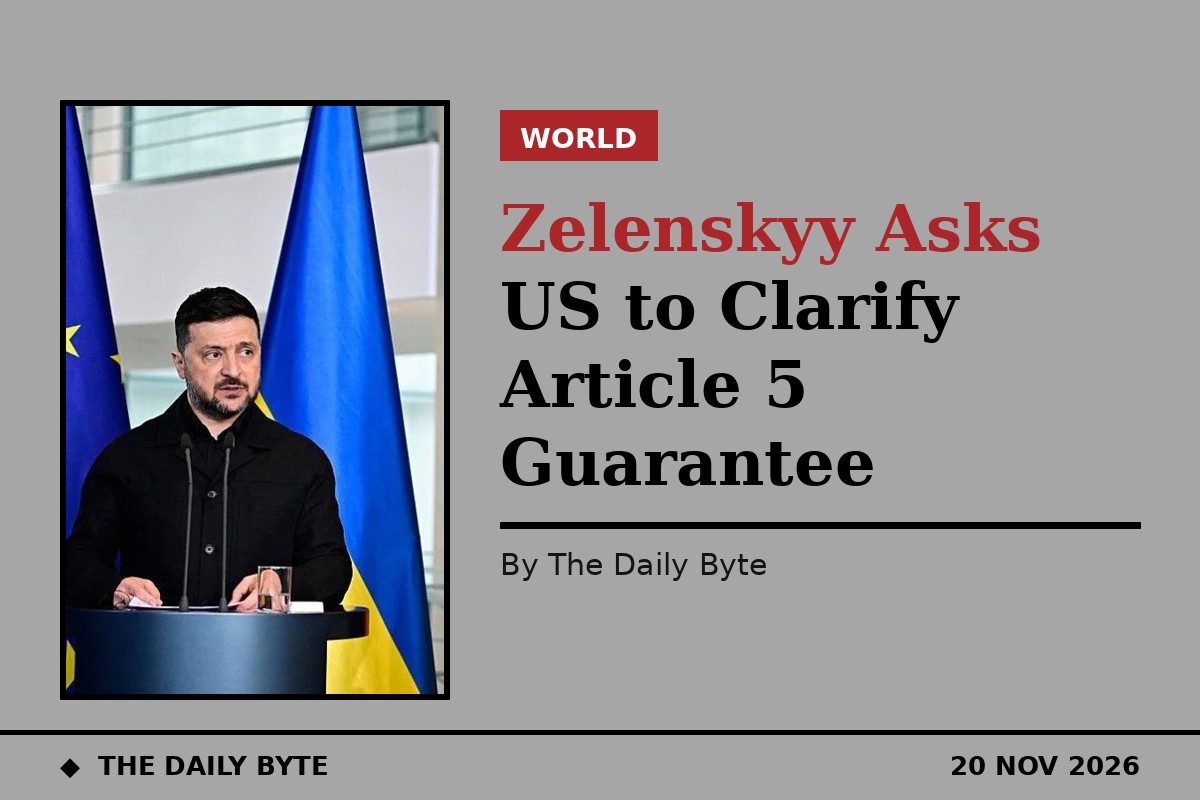
Ukrainian President Volodymyr Zelenskyy has demanded that the United States spell out exactly what an Article 5-like security guarantee for his country would mean in practice, warning that a fresh Russian attack is a matter of "when", not "if".
"I'm not sure we have a common acceptance of Article 5," Zelenskyy said on Thursday evening, after a meeting of the Coalition of the Willing in Berlin. "What does it mean?"
The question Washington has not answered
Zelenskyy pressed the point at a news conference that followed the Berlin talks, asking whether the guarantee would involve American soldiers on Ukrainian soil or US bases in the country. "What about American soldiers?" he said. "Do you have an answer on it? Me not. For today. I don't know the answer."
According to his account, the American side has ruled out deploying US troops to Ukraine, while describing the proposed arrangements as bilateral guarantees similar to those the United States provides to Israel and some other partners. Zelenskyy questioned what such a promise would be worth without an American military presence, pointing to US bases, aircraft and naval forces that help protect partners in the Middle East.
"What will partners do?" he asked. "What happens if — sorry to be sceptical — not if, but when [Russians] will try to do it again? What will they do?" He said the answer had to be clear "not only to partners [but also] to people, societies, investors" who would come to Ukraine after the war. "All these people, they need clear answers."
What Kushner offered in Berlin
The argument followed an offer from US special envoy Jared Kushner, who took part in the Berlin meeting and said President Donald Trump was "open" to providing an Article 5-like commitment to a post-war Ukraine. "From an American perspective, giving an Article 5-like security guarantee is a really, really big deal," Kushner said, adding that it had to be in America's interest and part of a broader security package.
Kushner also claimed that Russia had become "comfortable" with the concept, while conceding that there was "a lot of scepticism and disbelief" about it in Moscow. He said the Russian intention was "to not have another war in the future" and argued for restarting dialogue between Europe and Russia, with incentives and deterrence to make any agreement hold.
Moscow contradicted that account on Friday. Deputy Foreign Minister Sergei Ryabkov said any form of NATO-like guarantee for Kyiv was unacceptable, calling it "quasi-membership" of the alliance, and said the issue could only be discussed once Kyiv accepted that it would not join NATO.
The Berlin declaration
The Berlin meeting ended with a declaration signed by Germany, France and the United Kingdom that referred, without using the Article 5 label, to "a legally binding commitment, subject to national procedures, to take measures to restore peace and security in the case of a future armed attack by Russia". French President Emmanuel Macron said on Thursday that Russia's "maximalist" demands warranted revisiting "the question of Ukraine's NATO accession".
Zelenskyy said full NATO membership would make the position clearer, since Ukraine would automatically benefit from the alliance's real Article 5 clause, under which an attack on one member is treated as an attack on all. Membership has long been Kyiv's goal and a red line for Moscow, and allies remain divided over it.
The Donbas question
Zelenskyy also disclosed that US negotiators had for the first time raised the idea of Ukraine joining NATO in exchange for withdrawing from the Donbas region it still controls. He said he had not changed Kyiv's position on territorial concessions, but would put such a proposal to a referendum if it carried security guarantees, placed no limits on the size of Ukraine's military and included money to rebuild the country. He stressed that any eventual agreement would have to exclude recognition of occupied Ukrainian territory as Russian.
For Kyiv, the guarantee is the central question of the peace talks: what, exactly, would stop Russia from attacking again. Until Washington and its European partners answer that in detail, Zelenskyy made clear, he will keep asking.