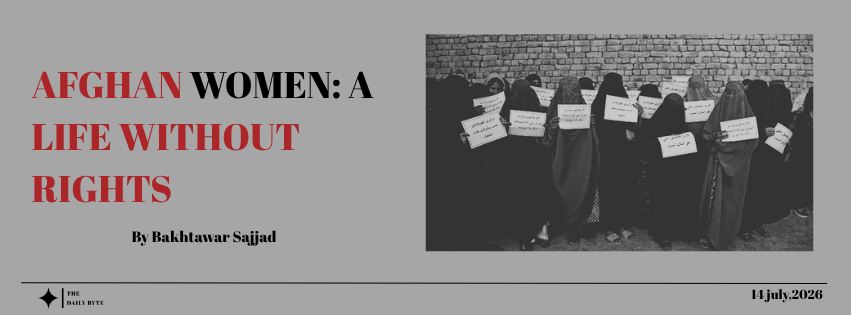
Afghan Women: A Life Without Rights
Just imagine waking up every morning
and hearing that your basic human rights are being taken away from you one by
one. You are banned from chasing your dreams. You are facing domestic violence
and torture. You are banned from living the life you wanted to live and doing
the things you love because the only reason you are being stopped is that you
are a woman. This is not imagination for the women and girls of Afghanistan but
the reality they are facing every day. This not only affects the lives of women
but also the entire country. A country cannot grow if half of its population is
left behind. When opportunities are
stolen away based on gender, everyone pays the price.
Women's rights are basic human rights, not privileges that
can be granted or taken away.
BACKGROUND:
Ever since 2021, the Taliban came to power again, and they have completely
erased women and girls’ public life. They have issued over 80 restrictive decrees against women. They assured the public that
women would be allowed to pursue education and work in accordance with Sharia
law, but despite this, from the start of their rule, they began to suppress
women’s rights and started imposing restrictions on them.
Under the Taliban regime, women are the ones
suffering the most. In May 2022,
girls were banned from attending
school after Grade 6. In December 2022, women were barred from
attending universities and banned from working for NGOs. In May 2022, another decree was issued ordering women to cover
themselves and stay at home unless it was necessary to come out of the house.
Women were banned from entering parks, gyms, and other public places. In July 2023, all beauty salons were
ordered to close. In August 2024,
women were required to cover their entire bodies and faces, and their voices
were not allowed to be heard in public. Decree
No. 18 removed the minimum legal age for marriage and made it more
difficult for women to leave unhappy or abusive marriages. And not only this,
what is worse is that the Taliban allows
men to beat their wives as long as they do not break their bones or leave open
wounds.
The
Reality of Afghan Women Today
From our childhood, we always hear people say
“that
education is the key to success”. But what if this key is taken away
from you? Does a person deserve this? No, no one should be allowed to take away
your right to study, your right to chase your dream, and your right to get an
education based on your gender.
In Afghanistan, on September 17, 2021, girls were only allowed to go to school
until Grade 6, and after the age of 12,
they were ordered to stay at home. Taliban officials prohibited universities
from teaching books written by women.
First, women were legally forbidden from applying to study fields like engineering, agriculture, journalism, and
economics, but later they were completely barred from attending
universities. Since December 2022, women have no longer been allowed to
study.
Education
is a basic human right that should be equal for all human beings. When a girl is banned from education, it is not only
her loss; it is a loss for society and the country too because they lose the
knowledge, skills, and abilities she could have contributed.
Beyond education, employment is also one of the major challenges that Afghan women
are facing. Women are not allowed to work in most government offices, and they
face multiple restrictions in schools, hospitals, offices, and NGOs. Many women
have lost their jobs. Some women earn through small home businesses like
tailoring and handicrafts, but they still face difficulties and a lack of
financial support.
For women, being financially independent in
today's world is really important. It gives them confidence, security, and
independence. They can fulfill their basic needs without relying on anyone.
Women who work can make their own life decisions and can be able to leave
abusive and unhealthy relationships. When women are denied the right to work,
they lose not only their income but also their freedom to make decisions and
contribute to society.
According
to UN Women; only one in four Afghan women is working or looking for a job,
compared to nearly 90 percent of men.
The
United Nations says that because of these restrictions, Afghanistan may face a shortage of
more than 25,000 female teachers and healthcare workers by 2030.
The worst challenge faced by women is
domestic violence. Women face abuse and violence within their own homes. People say homes are a safe place for
everyone, but what if that home becomes an unsafe and threatening place for
many women? Then where should they go?
On January
7, 2026, the Taliban's Supreme
Leader, Hibatullah Akhundzada,
approved a 90-page legal decree known as Decree
No. 12. The decree provides
that a husband who causes his wife a
broken bone, an open wound, or visible bruising may face up to 15 days'
imprisonment if she files a complaint before a judge.
According
to the World Health Organization (WHO),
almost 90% of women in Afghanistan have experienced at least one form of
domestic violence, and 52% have
experienced physical violence.
This is something beyond humanity. This
raises serious concerns, and this should not be normalized. Every single woman
and girl deserve to live their life with dignity and safety.
The restrictions placed on Afghan women do
not stop here. The Taliban also takes away their freedom to make even the basic
and simplest choices. Their freedom has been restricted in almost every aspect
of life. Women cannot travel alone because they must be accompanied by a male
relative (mahram) when they leave their homes. Even accessing healthcare can
become difficult without a male relative. They are heavily restricted from using
public transport. Then imagine how difficult and risky it is for widows or
women without close relatives to go outside, even just to buy food or
necessities. Women are no longer allowed to go to gyms, salons, parks, or many
other public places.
According to the Law on the “Propagation of Virtue and Prevention of Vice,”
it legally
requires women to cover their entire faces and bodies and prohibits their
voices from being heard in public.
Women are no longer able to dress by their
own choice, express their opinions, or use their freedom of speech. The
healthcare restrictions in Afghanistan limit women's access to medical
education and basic treatment. There is a shortage of female staff, and women
are not receiving proper treatment. Women face barriers to visiting hospitals
or traveling without a male guardian because of strict restrictions.
Child marriage is another devastating
challenge that girls face in Afghanistan. The rate of child marriage is
increasing with the passage of time. These little girls are losing their
childhood. At the age when they should study, play, and live freely, they are
facing this situation, which is heartbreaking.
According
to UN Women:
“ In 2023, nearly 30 per cent of
Afghan girls under 18 were married, including 10 per cent under the age of 15.
Some families, facing poverty, marry off daughters as a survival strategy.”
And at
the end, they lose their rights to live freely.
The
Impact of These Restrictions:
These restrictions not only affect the lives
of women and girls but also affect the country's economy and state.
According
to UN Women:
· 78 per
cent of young Afghan women are not in education, employment, or training,
nearly four times the rate for young men.
· By 2026,
early childbearing is projected to rise by 45 per cent.
· Maternal
mortality could increase by more than 50 per cent.
· Denying
girls secondary education is costing Afghanistan 2.5 per cent of its GDP every
year.
With all these restrictions, women are facing
depression and anxiety, and they are not living the life they wanted.
Restricting women from education and employment can lead to a downfall in the
country's economic growth, as it can lead to thousands of teachers, doctors,
journalists, and workers losing their jobs. It can shorten the number of female
healthcare workers and medical staff.
When
half of a country's population cannot fully contribute, national development,
innovation, and economic progress are slowed. These restrictions affect access to education, healthcare, markets, and
social support while also harming women's mental well being.
More
Than a Political Issue:
For many people, this issue is political,
but this is about humanity. Every
single human deserves the opportunity to study, get jobs, express themselves
freely, and share their opinions without any threat or pressure. Every woman
deserves to live with dignity, protection, and respect. Denying women these opportunities does not only affect their lives; it
affects society as a whole. When women are denied opportunities,
society loses their potential.