Why Are Women Still Blamed for Their Own Harassment
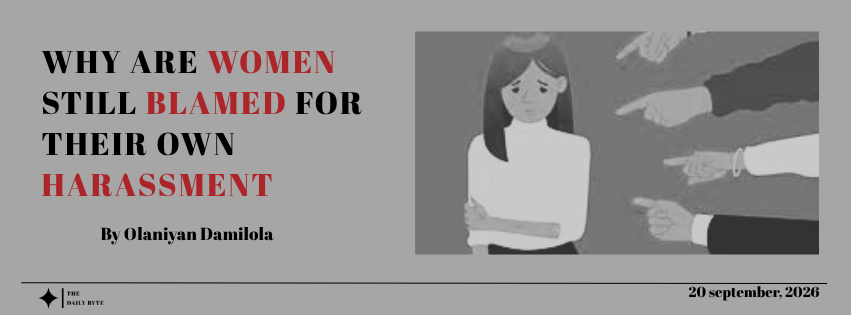
For many women, reporting harassment can feel like entering a second trial.
Instead of immediately asking what the perpetrator did, people may ask what the woman was wearing, where she was, why she was there, whether she had been drinking, why she was alone with the person, or why she did not leave sooner.
These questions may appear harmless or even concerned. But when they become the focus, they can shift attention away from the person responsible for the harassment and place the burden on the woman who experienced it.
This is known as victim-blaming and despite growing awareness about sexual harassment, it remains deeply rooted in many societies.
The question of “what was she doing?”
Victim-blaming often begins with seemingly simple questions.
Why did she go to his house?
Why did she dress that way?
Why was she out so late?
Why didn’t she fight back?
Why didn’t she report it immediately?
The problem is that these questions assume that a woman’s behaviour somehow determines whether another person is allowed to violate her boundaries.
It does not.
Sexual harassment is about unwanted behaviour, power and consent, not about whether a woman behaved “carefully enough.”
UN Women describes sexual harassment as a form of violence and discrimination rooted in historical power imbalances and male-dominated cultures. Its research also emphasizes that harassment occurs across different environments, including workplaces, public spaces and institutions. (UN Women)
A woman can be wearing anything and still deserve to be left alone.
She can be friendly without consenting to sexual attention. She can accept an invitation without agreeing to anything beyond it. She can change her mind. And she can say no at any point.
None of these circumstances transfer responsibility for another person’s actions onto her.
Why does victim-blaming persist?
One reason is the desire to believe that bad things happen only when people make bad choices.
If society convinces itself that a woman was harassed because she went somewhere she “shouldn’t have,” people can maintain the comforting belief that they can completely protect themselves by behaving differently.
But harassment does not work that way.
Women can take precautions and still be harassed. They can be cautious, confident, outgoing, conservative, young or old. The responsibility for harassment remains with the person who chooses to cross another person’s boundaries.
Cultural expectations also play a role.
In many communities, women are taught from an early age to monitor their behaviour, appearance and movements. They are warned about the dangers around them and told how to avoid becoming victims.
Men, meanwhile, may receive considerably less attention about respecting boundaries, understanding consent and taking responsibility for their behaviour.
The result is an unfair equation: women are taught how not to be harassed, rather than society consistently teaching everyone not to harass.
The silence that victim-blaming creates
Victim-blaming does more than hurt survivors after an incident. It can also discourage women from reporting harassment in the first place.
A woman who expects to be questioned, mocked, disbelieved or blamed may decide that speaking up is not worth the emotional cost.
UN Women has noted that stigma, shame and fear can make violence against women difficult to report and document. Its research on violence against women found that these barriers can affect how openly women disclose their experiences. (UN Women)
This creates a damaging cycle.
An incident happens.
The woman considers reporting it.
She remembers the stories of other women who were questioned about their clothing, relationships or decisions.
She stays silent.
The perpetrator faces no consequences.
And society receives even less information about the true scale of harassment.
Silence can therefore be mistaken for the absence of a problem when it may actually be evidence of how difficult the problem is to report.
Nigeria is not outside the conversation
This issue is particularly important in Nigeria, where conversations about gender-based violence often exist alongside strong social expectations about how women should behave.
UNFPA Nigeria identifies rape and sexual assault among the forms of violence affecting women and girls in the country, alongside domestic, verbal and physical abuse and other harmful practices. (UNFPA-Nigeria)
Nigeria has also seen public debates about sexual harassment involving powerful institutions and public figures.
In 2025, allegations of sexual harassment made by Senator Natasha Akpoti-Uduaghan against Senate President Godswill Akpabio generated widespread national debate. Akpabio denied the allegations, while the controversy drew renewed attention to questions of power, gender and the treatment of women who speak publicly about harassment. (The Guardian)
Cases like this demonstrate why conversations about harassment cannot simply be reduced to individual behaviour.
Power matters.
Social status matters.
Institutional structures matter.
And the reaction a woman receives after speaking up matters too.
What should we be asking instead?
When a woman says she has been harassed, the first question should not be, “What did you do to cause it?”
A better question is: “What happened, and how can we support you?”
That does not mean that every allegation should automatically be treated as proven. Investigations and due process remain important.
But investigating an allegation and blaming the person who reported it are not the same thing.
We can ask necessary questions without turning them into accusations.
Institutions can investigate complaints while protecting people from retaliation. Schools and workplaces can establish clear reporting procedures. Families and communities can create environments where people feel safe asking for help.
Most importantly, responsibility needs to be placed where it belongs.
Changing the conversation
Ending victim-blaming requires more than telling women to be careful.
It requires changing the questions we ask, the lessons we teach and the systems we build.
Women should not have to prove that they behaved perfectly before their experiences are taken seriously.
The standard should be simple: people are responsible for their own actions.
A woman’s clothing is not responsible for harassment.
Her location is not responsible for harassment.
Her friendliness is not responsible for harassment.
And speaking up about what happened should not make her the person on trial.
Until society stops asking women how they could have prevented someone else’s misconduct and starts asking how harassment itself can be prevented, the burden will continue to fall on the wrong people.
The goal should not be to teach women how to become “perfect victims.”
It should be to build a society where violating another person’s boundaries is recognised for what it is and where the person responsible, rather than the person harmed, is held accountable.