Pakistan's First Astronaut Nears Launch in China
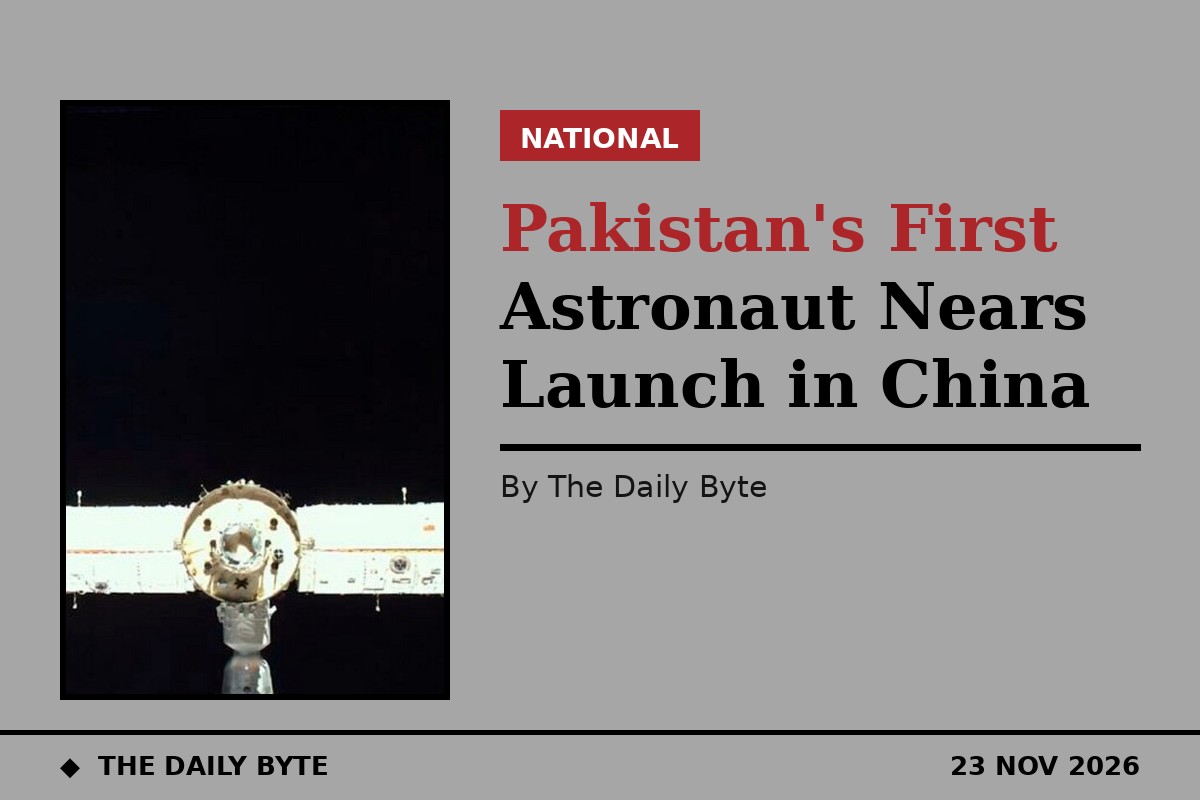
Pakistan moved closer on Monday to sending its first astronaut into space, as Planning Minister Ahsan Iqbal travelled to China for the departure ceremony for the mission, with the final choice of astronaut still to be announced.
Mr Iqbal arrived in Beijing on Sunday, 22 November, and was received at the airport by Yang Yunli, vice president of China Great Wall Industry Corporation, and officials from the Embassy of Pakistan. On Monday he was due at the Jiuquan Satellite Launch Center in north-west China to meet the two Pakistani candidates who have completed their training, and to attend the ceremony marking the mission.
The two candidates are pilots Muhammad Zeeshan Ali and Khurram Daud, who were selected through a three-stage assessment process under a space cooperation agreement signed by Pakistan and China in Islamabad in February 2025. One of them will fly as a payload specialist aboard China's Shenzhou-24 spacecraft, while the other will serve as the backup astronaut. The final selection is expected to be announced shortly before the flight.
A week aboard Tiangong
The astronaut who flies will become the first foreign national to visit China's Tiangong space station, and the first international participant in China's crewed spaceflight programme. The stay is expected to last about a week, during which the astronaut will conduct scientific experiments in the station's microgravity environment before returning to Earth aboard the Shenzhou-23 spacecraft, which is already docked at the station.
As a payload specialist, the Pakistani astronaut will take part in scientific activities and research aboard Tiangong, rather than serving as one of the spacecraft's primary operational crew. The mission will carry three astronauts in total: a Chinese commander, a Chinese pilot and the Pakistani payload specialist.
Mr Iqbal described the flight as a historic achievement for Pakistan and a new milestone in the country's growing space programme. In a statement released by his ministry, he said the mission would carry the hopes and aspirations of Pakistan's youth beyond Earth, and that the long-standing friendship between Pakistan and China would soar even higher than the skies.
Final preparations under way
Preparations for Shenzhou-24 have entered their final stage. Pakistan's space agency, SUPARCO, said the mission's crew completed a launch rehearsal at Jiuquan on Sunday, with all three members finishing the required pre-flight procedures. An official from the China Astronaut Research and Training Center said the crew performed every operation accurately.
The spacecraft and its Long March-2F carrier rocket were moved to the launch area on 17 November. China's Manned Space Agency has said the facilities are in good condition and that the mission will launch at an appropriate time following final checks.
One date should be treated with care. Mr Iqbal had previously indicated 25 November as the expected date for the flight, but China's space authorities have not officially confirmed that date. The departure ceremony in Beijing is an important step towards the mission, but it is not the launch itself, and the final launch date remains for the Chinese authorities to confirm.
How the mission came about
The flight grows out of the agreement signed in February 2025, under which China set up a training programme for Pakistani astronauts. China's Manned Space Agency announced on 7 November that a Pakistani astronaut would take part in the Shenzhou-24 crewed mission as a payload specialist, making it the first joint crewed spaceflight involving Chinese and foreign astronauts in the history of China's human spaceflight programme.
Until now, the space partnership between the two countries has centred on Chinese launches of Pakistani satellites. A Pakistani-built rover is also planned to travel aboard China's Chang'e-8 lunar mission around 2028. China finished building Tiangong in 2022 and aims to land astronauts on the Moon by 2030.
The mission also comes as Pakistan and China mark the 75th anniversary of their diplomatic relations in 2026. For Pakistan, sending its first astronaut into space would be a significant step in developing its human spaceflight capabilities, and a visible outcome of a partnership that has moved from satellites to training astronauts and, now, to carrying one into orbit.