Supreme Court: UAE Court Decree Not Enforceable
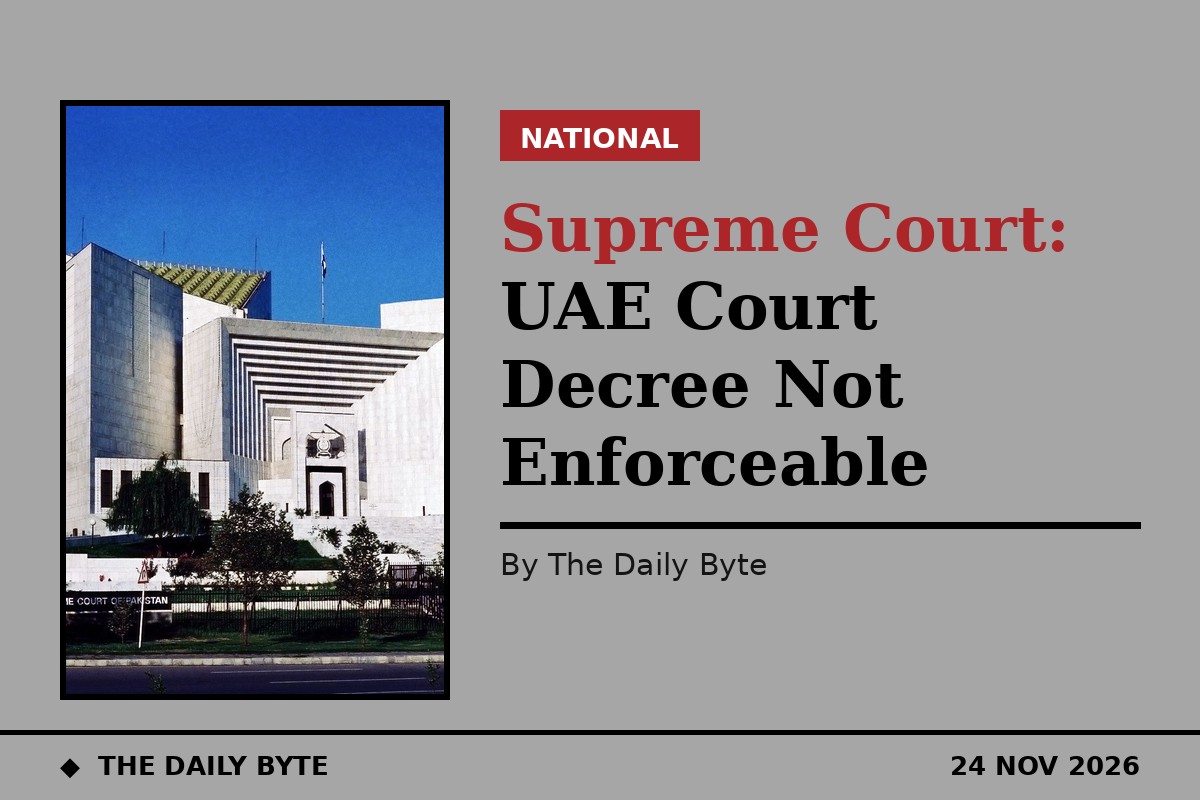
The Supreme Court of Pakistan has ruled that a decree issued by the Abu Dhabi Court of Appeal cannot be directly enforced in Pakistan, settling a long-running question about which courts in the United Arab Emirates count as superior courts under Pakistani law. The judgment, announced on 19 November 2026, was delivered by a 2-1 majority and sets aside earlier orders of the Lahore High Court and a district court in Lahore.
The case concerned a commercial dispute between a Pakistani company, Engineering Kinetics (Private) Limited, and an Abu Dhabi-based party, and it turned on a narrow but consequential point: the United Arab Emirates has two separate judicial systems, one federal and one run by the individual emirates, and a decree from an emirate court is not the same as a decree from a federal court. The News reported that the majority held that only decrees of courts notified by the federal government as superior courts can be executed directly in Pakistan.
How the dispute reached the Supreme Court
The dispute arose from a 2011 commercial agreement for the manufacture and installation of pipes. In June 2014, the Abu Dhabi Court of First Instance ordered Engineering Kinetics to pay 465,933 dirhams with interest, a further 50,000 dirhams, and expenses and legal fees. That order was later affirmed by the Abu Dhabi Court of Appeal. The decree holder then sought to have the decree executed in Pakistan, and the Lahore High Court and the district court in Lahore rejected the company's objections to enforcement.
Engineering Kinetics challenged those orders before the Supreme Court. A two-member bench of Justice Munib Akhtar and Justice Irfan Saadat Khan concluded the hearing on 10 February 2026 and reserved judgment. When the two judges disagreed, the matter was referred to Justice Muhammad Shafi Siddiqui as referee judge. In the final judgment, the referee judge agreed with Justice Munib Akhtar, and the appeal was allowed by a 2-1 majority, with Justice Irfan Saadat Khan dissenting.
What the majority decided
At the heart of the case was Section 44-A of the Code of Civil Procedure, which allows a Pakistani district court to execute a decree of a superior court in a reciprocating territory as though it had been passed by a Pakistani court. The provision only works, however, where the federal government has notified the foreign court as a superior court. A government notification issued in 2007 recognised the UAE as a reciprocating territory and identified the UAE Federal Court of Appeal as the superior court for this purpose.
The majority held that the Abu Dhabi Court of Appeal belongs to the emirate's separate local judiciary and therefore falls outside that notification. The fact that it exercises appellate jurisdiction does not make it a federal court, the judges held, and the affirmation of the trial court's order by the appellate court did not change the institution that issued the decree. The Express Tribune reported that the court accordingly set aside all previous orders and decisions issued by the Lahore High Court and the district court in the case.
The dissent and the practical effect
Justice Irfan Saadat Khan, dissenting, took the view that the order of the Court of First Instance had merged into the order of the Court of Appeal, and that the appellate decree should therefore be treated as the decree of a superior court of a reciprocating territory, executable in Pakistan under Section 44-A subject to the exceptions in the law. The Additional Attorney General had supported direct execution, relying in part on a Ministry of Law and Justice letter dated 4 August 2025, but the majority was not persuaded.
For businesses, the practical effect is clear. A judgment obtained in an emirate-level court in the UAE cannot simply be taken to a district court in Pakistan for execution. The decree holder must instead pursue the claim afresh through the Pakistani courts. Only a decree from the UAE's federal court system, as named in the 2007 notification, qualifies for the direct route. The ruling matters well beyond this one dispute: thousands of Pakistanis and Pakistani companies do business in the UAE, and the decision draws a firm line between the federation's courts and those of the individual emirates.
The judgment also shows the Supreme Court working through the consequences of the UAE's dual court structure in careful detail, with the referee judge's opinion examining the notification, the constitutional position of the emirate courts and the limits of Section 44-A. For lawyers advising clients with cross-border claims, the message is to check which court issued the decree before assuming it can be enforced in Pakistan.