Lahore AQI Hits 538, World's Most Polluted City
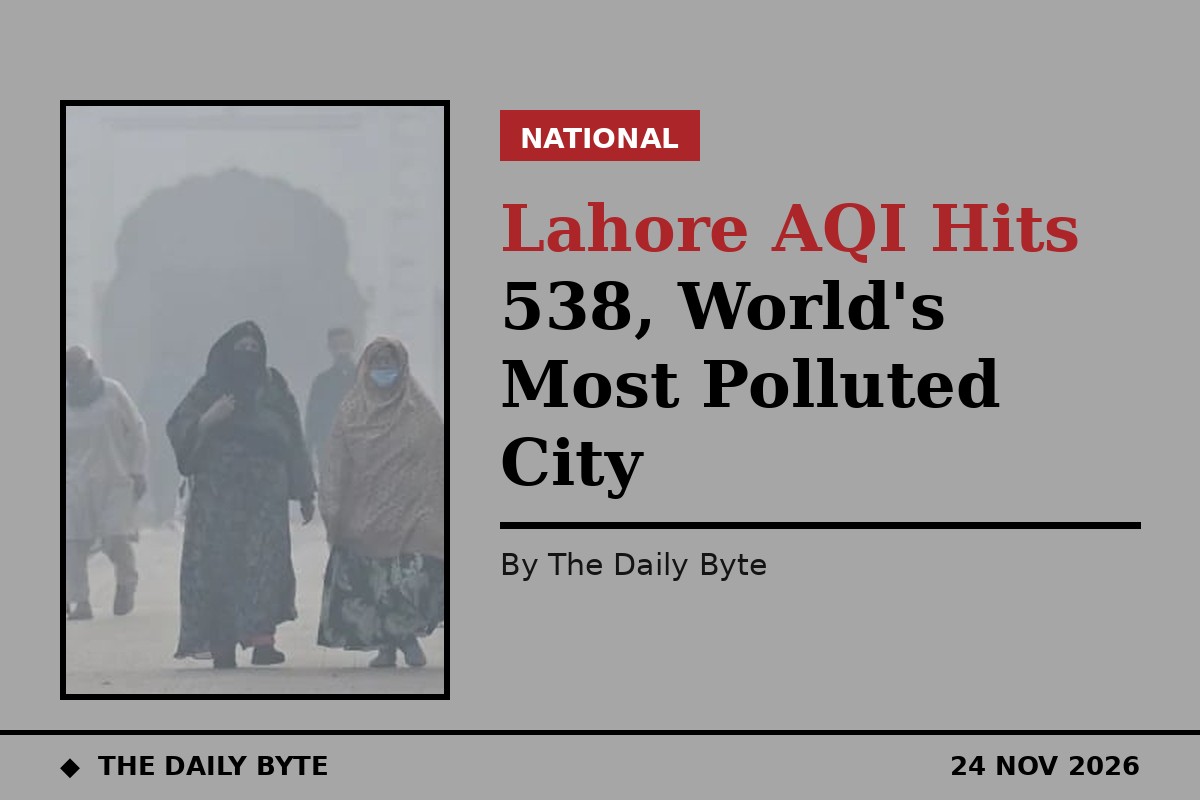
Lahore once again topped the list of the world's most polluted major cities on Sunday morning, recording an air quality index (AQI) of 538 between 9am and 10am, according to figures from the Swiss monitoring platform IQAir reported by Geo News. The reading, published by The News on 23 November, put the Punjab capital far ahead of every other major city on the platform's live global ranking.
A reading above 300 is classed as hazardous by IQAir, meaning the air poses a serious health risk to anyone breathing it for long. Lahore's figure of 538 was more than two and a half times the reading of the next city on the list. Delhi, in neighbouring India, ranked second among the world's major cities with a particulate matter reading of 207.
The pollution was not confined to Lahore. The News reported readings of 463 in Bahawalpur, 382 in Sargodha and 255 in Multan on the same morning. Dawn reported an even higher figure within Lahore district itself, with Kahna Nau recording 606, the worst reading anywhere in the country that morning, followed by Lahore at 538 and Bahawalpur at 536 in its account. The two outlets' provincial figures differ slightly, which reflects how sharply readings can vary by station and by hour.
The Sunday peak was the worst of a bad weekend rather than a one-off spike. Lahore had recorded an hourly reading of 465 between 7am and 8am on Friday, and 266 on Saturday evening, which was already in the hazardous range. The toxic haze had left the city shrouded for days, reducing visibility and causing widespread complaints of throat irritation, breathing difficulties and itchy eyes. Severe fog added to the misery, forcing motorway closures at several points in Punjab and Khyber Pakhtunkhwa. The Met Office predicted similar smoggy conditions for the following 24 hours.
Health experts warn that prolonged exposure to air this polluted can lead to severe illness, including stroke, heart disease, lung cancer and chronic respiratory disease. The scale of the problem is not new: Pakistan's average PM2.5 concentration stood at 67.3 micrograms per cubic metre in 2025, nearly 14 times the World Health Organisation's annual guideline of 5 micrograms per cubic metre, according to the 2025 World Air Quality Report.
Every winter, much of South Asia experiences a surge in pollution as cold air traps fine particles close to the ground. Emissions from transport, factories, construction dust and crop residue burning all feed the dense smog that can linger for weeks. The problem also has a cross-border dimension, and the two countries have repeatedly blamed each other. Earlier in November, Punjab Senior Minister Marriyum Aurangzeb linked worsening smog in the province to large-scale fireworks during Diwali celebrations in India, saying polluted winds entering through the eastern corridor had pushed up readings in Lahore.
Silwat Saeed, chief of Punjab's Environment Protection and Climate Change Department, has previously said the challenge is huge for both countries and that Pakistan has raised the issue with officials from India at international forums. Neither side has agreed a joint plan to cut the smoke at its source, and the argument over where the pollution comes from has run alongside the smog itself for years.
The Punjab government says it is acting. Aurangzeb questioned whether IQAir displays updated data in real time, saying data recorded at 8am continued to appear on the website until noon, and said updated readings were available on the provincial government's own website. She said air quality across Punjab was monitored through 80 monitoring systems, that water was being sprayed through smog guns in areas recording high readings, and that all departments across the province had played their part. She also claimed previous administrations had not undertaken similar levels of work to tackle smog.
What matters now is whether those measures cut the peaks. Lahore has topped the global pollution ranking repeatedly in recent weeks, and a single hazardous morning is no longer unusual enough to surprise residents. The 538 reading is a reminder that the city's winter air emergency returns every year, and that the test of any clean-air plan is not the announcement but the next morning's number.