AI Guidance to Cut Social Care Paperwork
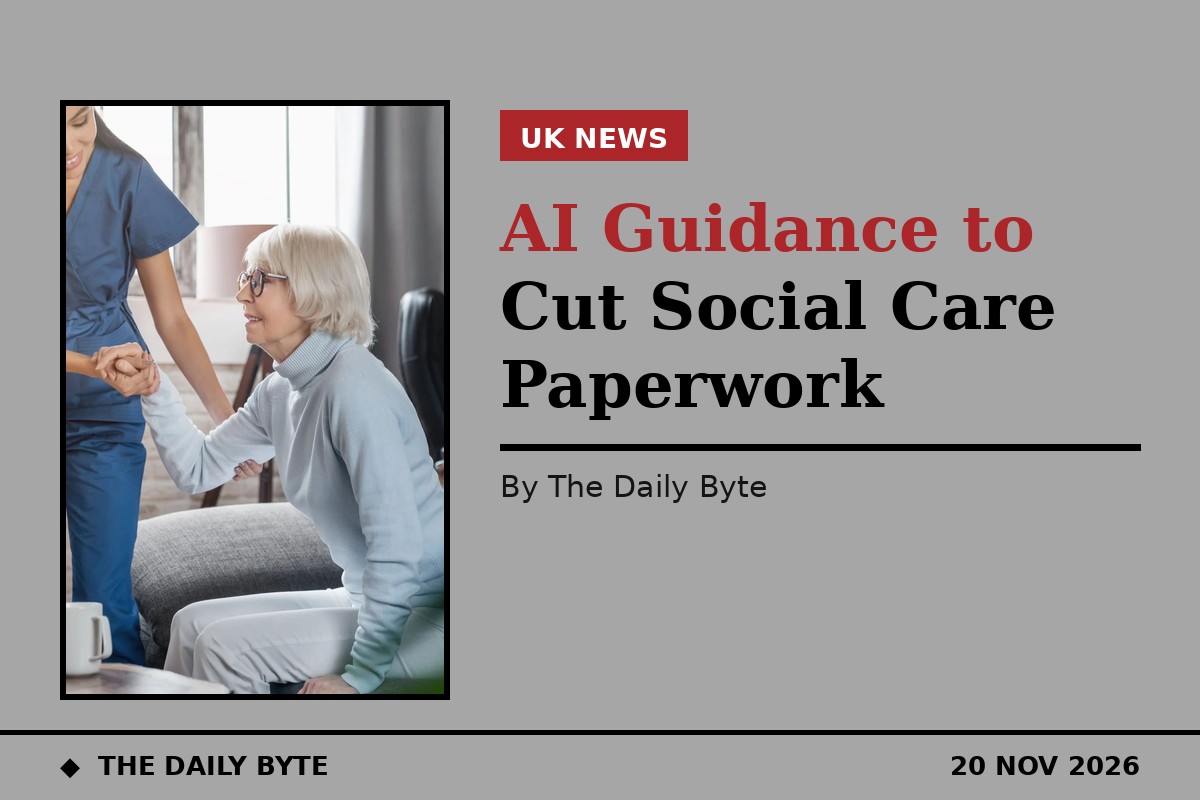
The government has published the first cross-sector guidance on the use of artificial intelligence (AI) in children’s and adult social care, aiming to cut paperwork and free staff to spend more time with the people they support.
The joint guidance from the Department of Health and Social Care and the Department for Education was published on Friday 20 November. It sets out how social care services and providers can make best use of AI, from transcribing and summarising case notes to translating information, searching complex case histories and identifying gaps in support.
Swindon pilot cut admin time by 63%
The announcement points to a pilot in Swindon Borough Council’s adult social care service, where using an AI tool to support social workers delivered a 63% reduction in administrative time. According to the government, the pilot cut the average time taken to complete a Care Act assessment conversation from 1.5 hours to 30 minutes, and the time to write up assessments from 4 hours to 1.5 hours.
Swindon’s own account of the trial, of the Magic Notes tool developed by social enterprise Beam, records the same 63% cut in admin time across 184 frontline meetings involving 19 social workers, and puts the assessment conversation at 35 minutes rather than 30. The tool was also reported to be particularly helpful for colleagues with visual impairments and those for whom English is not a first language.
Staff at Peterborough council developed a bespoke AI assistant called Hey Geraldine, which drew on the knowledge of an experienced occupational therapist to give instant guidance to staff. It answered more than 1,200 questions and saved around 15 minutes per interaction, according to the government.
Safe adoption, with people in charge
The guidance is intended as a single national reference point for leaders, practitioners and sector organisations. It sets out principles on governance, accountability, data protection and professional oversight, alongside practical advice, and is meant to bring more consistency to how AI is adopted across the sector.
Minister of State for Social Care and Mental Health Alison McGovern said: “The administrative load and endless paperwork in social care can all too often take the focus away from patients. By harnessing the power of AI, we can shift that focus right back on what matters most, caring.”
Children and Families Minister Josh MacAlister said: “The best children’s social work is built on relationships. No technology can replace the knowledge and skill of a brilliant social worker, but by taking away some of the admin, AI can free them up to put those skills where they matter most.”
Isabelle Trowler, Chief Social Worker at the Department for Education, said the guidance was “an important step towards the safe use of AI in social care, recognising its potential while keeping practitioners and their professional judgement central”.
Digital records now widespread
The government said 4 in 5 care providers are now using digital social care records, helping almost 90% of people who draw on care, and that this is delivering millions more caring hours by cutting paper records, repeated conversations, errors and inaccuracies. It aims for all care providers to be fully digitised by the end of this Parliament.
The guidance does not present AI as a replacement for social workers. Its emphasis is on AI as a supporting tool, with staff reviewing outputs and remaining accountable for decisions about the people they support.
Sources: GOV.UK, New AI guidance to cut paperwork and free more time for care; Unite.AI, UK Departments Issue First Cross-Sector AI Guidance for Social Care; Swindon Borough Council, Council completes AI trial to enhance Adult Social Care services.


