Anti-Bullying Week: 1 in 4 teachers feel unprepared
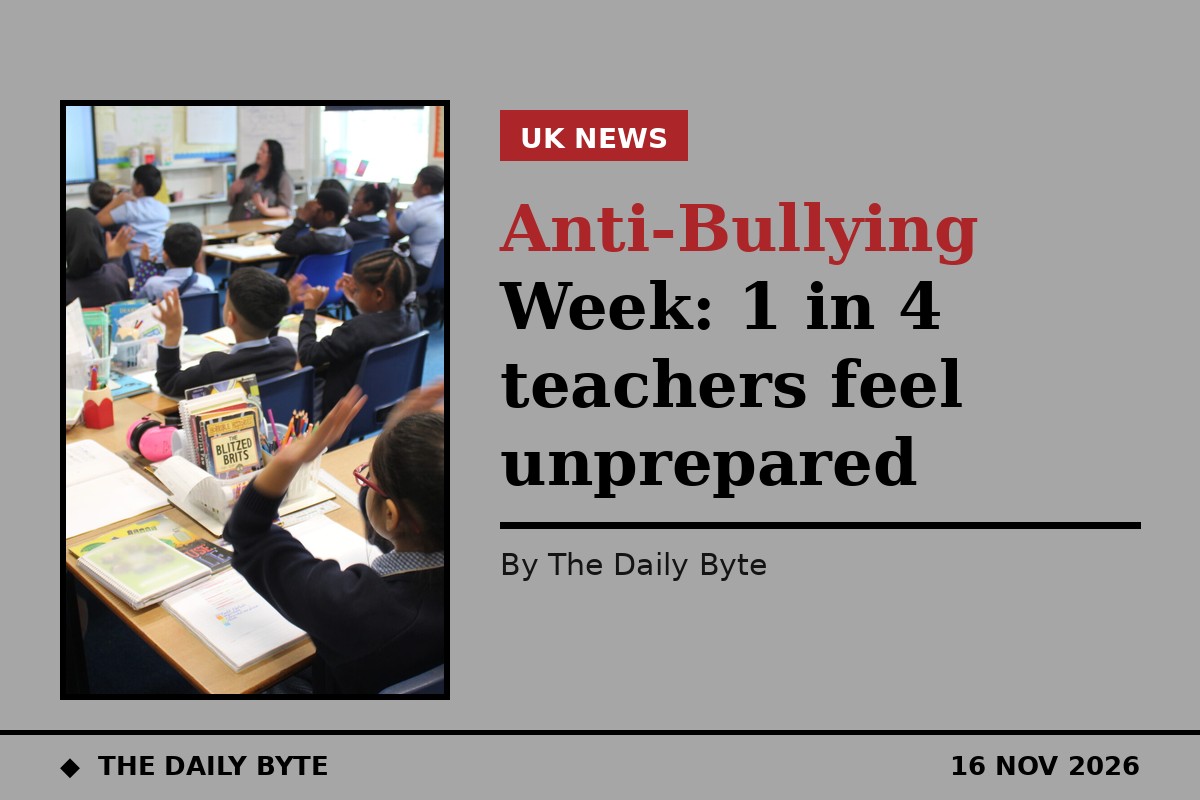
Almost one in four teachers say they feel poorly equipped to respond when a pupil tells them they are being bullied, according to new survey findings released to mark Anti-Bullying Week 2026. The week runs from 16 to 20 November, with the theme Break the Silence, and opened on Monday with Odd Socks Day.
The preliminary findings come from a survey of 812 teachers and other education staff by Nottingham Trent University. Almost a quarter of respondents, 23 per cent, said they were not even moderately equipped to respond to disclosures of bullying from their pupils. The Anti-Bullying Alliance, which coordinates the week in England, Wales and Northern Ireland, published the findings on 16 November.
Disclosures are a regular part of school life
The survey suggests disclosures of bullying are common. More than nine in ten respondents, 92 per cent, said pupils tell them they are experiencing face-to-face bullying at least once during an academic year. Around one in seven, 15 per cent, said they receive such disclosures at least weekly, including some who hear them every day.
Online bullying is also frequently raised with staff. More than 74 per cent of respondents said they receive disclosures from children and young people about experiencing online bullying at least once in each year. The figures underline how often teachers are the trusted adult a child turns to first.
At the same time, more than three-quarters of respondents, 77 per cent, said they felt very or moderately equipped to support pupils who disclose bullying. The Alliance said that was encouraging, but that the gap for the remaining staff still needed to be closed.
Calls for mandatory training
The Anti-Bullying Alliance is calling for mandatory training to prevent and respond to bullying as part of initial teacher training, reinforced by continuing professional development throughout teachers' careers. It also wants every school to have a named lead for anti-bullying, and schools in England and Wales to have a duty to record levels of bullying, as already happens in Northern Ireland.
Sarah Wayman, head of the Anti-Bullying Alliance, said the findings showed how important it was for education staff to have the support they need when a pupil tells them about bullying. She said initial teacher training should give teachers a strong foundation in recognising and responding to bullying, with training reinforced through regular professional development.
Jennifer Moses, co-chair of the Alliance and a national official at the NASUWT teaching union, said three-quarters of teachers feeling equipped was a testament to schools, but that nearly one in four did not, and the government needed to act so all professionals were equipped.
More than 8 million children taking part
More than 8 million children and young people across the UK are taking part in Anti-Bullying Week 2026, according to the Alliance. The campaign reaches three-quarters of schools and millions of children and young people, and this year's theme calls on children, young people and adults to talk about bullying, speak up, listen and act together.
Odd Socks Day, which opened the week on Monday 16 November, invites children and adults to wear odd socks to celebrate individuality. The day, led by children's television star Andy Day and his band the Odd Socks, is marking its tenth anniversary. The campaign is also supported by patrons Andy and the Odd Socks and Manchester City captain Ruben Dias.
The week also includes a parliamentary event on Tuesday 17 November bringing together parliamentarians, anti-bullying organisations and young people, the Anti-Bullying School Staff Awards, and free school resources to help embed anti-bullying messages in school life.
The Alliance notes that the survey findings are preliminary. The research has not yet been peer reviewed, and the results and conclusions may be refined as the analysis progresses before publication in 2027.
Sources: Anti-Bullying Alliance and Tes.


