Armistice Day: UK falls silent at 11am to honour war dead
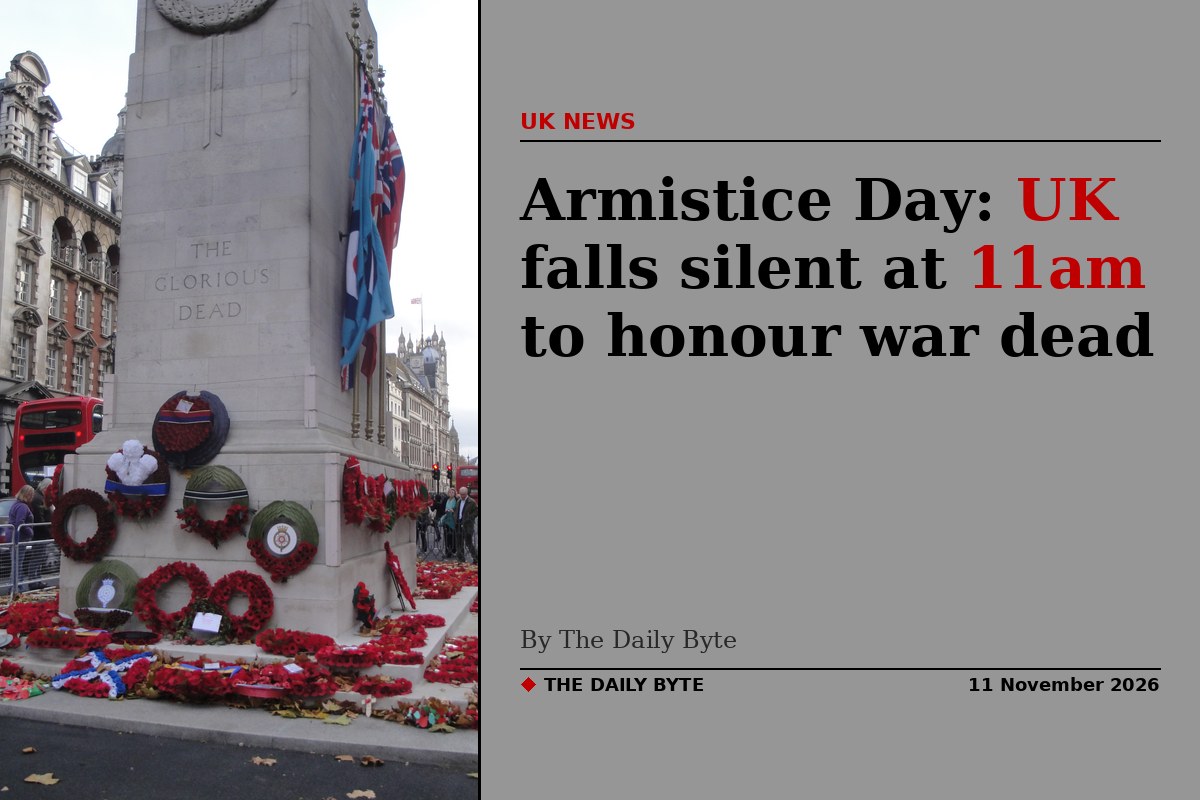
Britain fell silent at 11am on Wednesday to mark Armistice Day, 108 years after the fighting of the First World War came to an end.
The two-minute silence was observed at the Cenotaph in Whitehall, where ministers, senior military figures, schoolchildren and cadets gathered, and at war memorials, workplaces, schools and railway stations across the country.
Defence Secretary Wes Streeting attended the Western Front Association’s annual Armistice Day ceremony at the Cenotaph in central London, where he marked the 110th anniversary of the Battle of the Somme. He was joined by UK Government and senior international military representatives, schoolchildren, cadets and members of the public who braved the rain to pay their respects.
In Westminster, Commons Speaker Sir Lindsay Hoyle and Lord Speaker Lord Forsyth of Drumlean laid poppy wreaths at the Angel Memorial in Westminster Hall to mark the end of the First World War. They were joined by Massachusetts senate president Karen Spilka, who read a poem. Sir Lindsay then processed to the Lower Waiting Hall of the House of Commons for a Turning the Page ceremony remembering Alan Scott Balfour, who died in 1918.
An Armistice Day service was also held at the National Memorial Arboretum in Alrewas, Staffordshire, where the Duke and Duchess of Gloucester laid a wreath and observed the two-minute silence at 11am. The pair were then taken around the memorial, also known as the Royal British Legion National Remembrance Gardens, before speaking with members of the public who attended the service.
Metropolitan Police Commissioner Sir Mark Rowley paid his respects to the war dead during a ceremony at the National Police Memorial in central London. In pictures shared on X by the Metropolitan Police, Sir Mark could be seen holding a wreath, reflecting and speaking to other members of the force. The force wrote: “Today we honour the courage and sacrifice of all those who have served and remember those who gave their lives. Lest we forget.”
Poppy wreaths were also laid during a service at the Portsmouth WWI Memorial in Guildhall Square, where Farming Minister and MP for Portsmouth South Stephen Morgan joined Royal Navy officers and other dignitaries. A veteran could be seen placing a cross of remembrance during the service, and Royal Navy officers saluted. Meanwhile, many gathered at the Tommy statue, a tribute to the soldiers of the First World War, in Dover, Kent.
A number of ceremonies were also held across Scotland, including in Edinburgh, where a service was held at the Garden of Remembrance in Princes Street Gardens. The one o’clock gun at Edinburgh Castle fired at 11am to mark the start of the two-minute silence, and a short service was held by Rev Dr Karen Campbell, the national chaplain of Royal British Legion Scotland. Commemorations also took place at the Scottish National War Memorial in Edinburgh Castle, at Glasgow’s George Square and at the Scottish Parliament.
Across Europe, commemorations were also held. In Paris, President Emmanuel Macron laid a wreath at the Tomb of the Unknown Soldier beneath the Arc de Triomphe.
The Armistice that ended the fighting in the First World War was signed at around 5am on 11 November 1918, in a railway carriage in the forest of Compiègne in northern France. It came into force six hours later, at the eleventh hour of the eleventh day of the eleventh month. A year later, King George V asked people across the Empire to pause for two minutes at 11am to remember those who had died, and the tradition has continued ever since.
The red poppy became the symbol of remembrance because it was one of the few flowers to grow on the churned-up battlefields of Flanders. The Royal British Legion’s Poppy Appeal raises money every year for serving personnel, veterans and their families.
Sources: The Oldham Times and Energy Radio.