Bahamas Pledges $75m More for Blue Carbon Seagrass
The Bahamas will commit a further 75 million US dollars to the second phase of its Blue Carbon Programme, Prime Minister Philip Davis announced at the COP31 climate summit in Antalya, Türkiye, on 11 November 2026. The new funding builds on 25 million dollars already invested in the first phase of the programme, which maps and protects the vast seagrass meadows beneath Bahamian waters.
Davis launched the second phase at an event in the CARICOM Pavilion, telling fellow leaders that the country would no longer wait for others to act on climate change. “No one is coming to save us,” he said, recalling words he delivered to the Bahamian Parliament in January. “We must save ourselves.” He added that self-reliance meant acting before the world arrives and building something the world would want to join.
World’s largest seagrass meadows
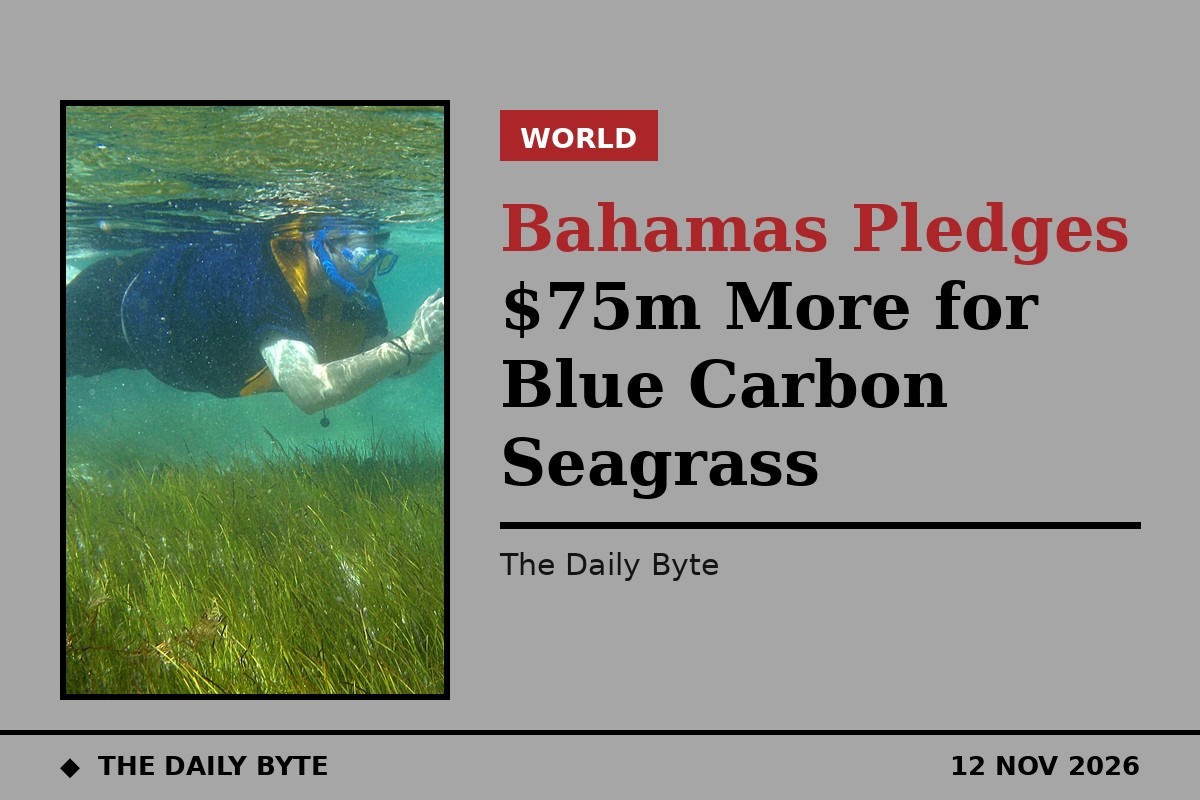
Beneath Bahamian waters lie the largest seagrass meadows of any nation on Earth, covering around 53,000 square kilometres of the sandy banks around the islands. Davis has called them “the blue heart of our planet”. The meadows draw carbon down and store it in the seabed, shelter the fisheries that feed Bahamian families and soften waves before they reach the shore.
The first phase of the programme paid for national mapping, field verification, sampling and the systems needed to measure and report the carbon stored in the meadows. Bahamian field teams have verified the national seagrass map in the water, using satellite data and LiDAR, and the country is building a national carbon inventory to the Tier 2 standard of the Intergovernmental Panel on Climate Change. The Bahamas is also working to include seagrass in its updated Nationally Determined Contribution, known as NDC 3.0A, for the first time.
From science to implementation
Phase two is where measurement must translate into credible action and independently verifiable outcomes, Davis said. The additional funding will sustain measurement, reporting and verification, and support the planning needed to deliver the country’s climate commitments and the Sustainable Development Goals. “Phase One lays the groundwork,” he said. “We are now moving from science to implementation.”
The Bahamas will also launch the Bahamas Blue Economy Institute as it enters phase two. The institute is intended to become a lasting national body for the blue economy, setting a standard for the transparent stewardship of any proceeds from the transfer of carbon credits. It will fund the science and programmes that strengthen the country’s wider marine environment, bringing leading international scientists together with Bahamian professionals.
Carbon markets under Article 6
Davis said The Bahamas wants to take part in international carbon markets under Article 6 of the Paris Agreement, including through Internationally Transferred Mitigation Outcomes, known as ITMOs. Every tonne authorised for transfer will be adjusted in the country’s own national accounts, so that it is never counted twice, he said, and no credit from Bahamian waters should ever become an excuse for anyone to keep polluting. The Bahamas will only take part in internationally verified carbon markets, he added.
The legal framework is already in place. In 2022 The Bahamas passed the Climate Change and Carbon Market Initiatives Act and the Carbon Credit Trading Act, which govern the country’s carbon assets, establish a carbon emissions registry and set the criteria for validating credits. Davis invited governments to explore Article 6 cooperation, scientists and institutions to work alongside Bahamian expertise, and responsible investors and future buyers to begin talks on high-integrity cooperation.
He closed by recalling Hurricane Dorian, which sat over the northern Bahamas for more than a day in 2019 and took more than a quarter of the country’s economy with it. Friends and partners were generous, he said, but the long work of rebuilding fell to Bahamians themselves. “Our task is not merely to calculate its value, or to tell the world how much carbon may lie beneath our waters,” he said. “Our task is to keep this great marine inheritance healthy and productive.”
Sources: Office of the Prime Minister of The Bahamas, Quantum Commodity Intelligence