Bank of England December hike priced at 75 percent
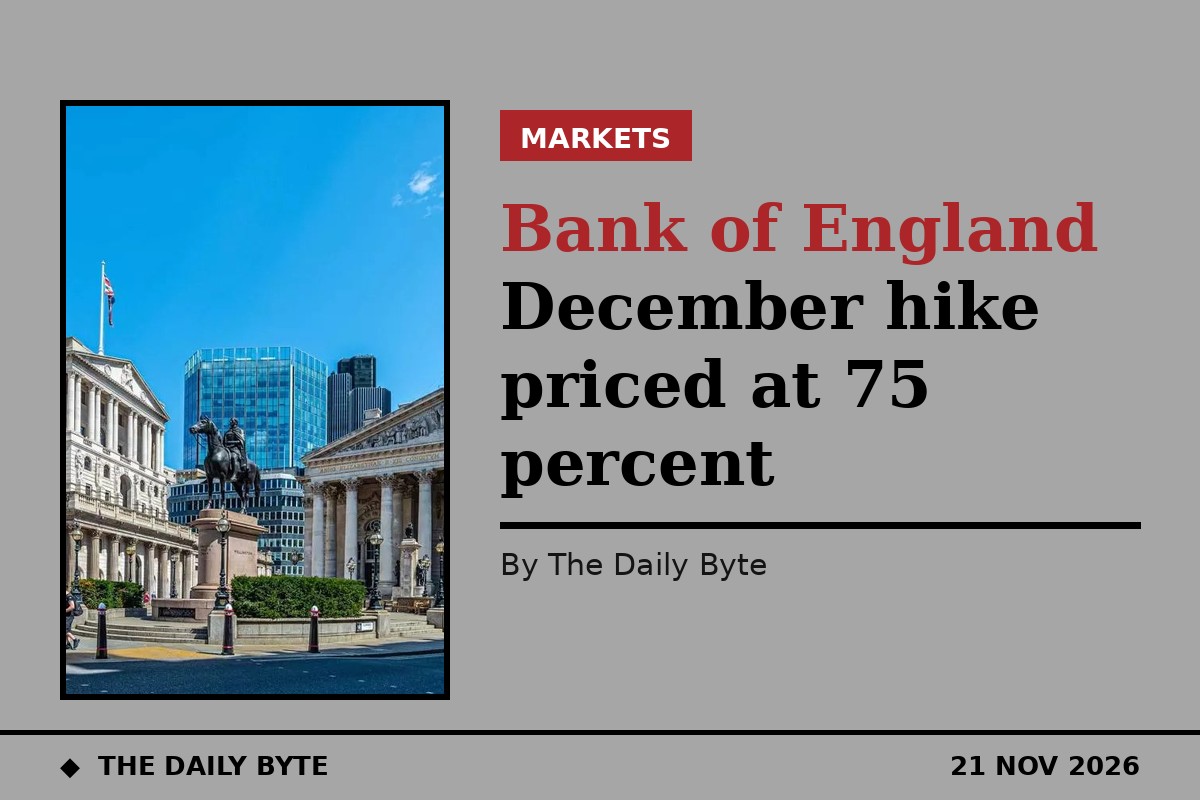
Financial markets and economists are split over whether the Bank of England will raise interest rates again in December, with traders pricing in a roughly three-in-four chance of a move while almost every economist surveyed expects the Bank to wait until February.
Financial markets are currently implying a 74 percent chance of an interest rate increase to 4.25 percent in December, according to the HomeOwners Alliance. A separate market-pricing tracker, BlueGamma, put the probability at 75 percent as of 20 November, with an implied move of 19 basis points from the current Bank Rate of 4 percent.
The Bank raised Bank Rate by 25 basis points to 4 percent on 5 November, its first rise since August 2023. Eight members of the Monetary Policy Committee voted for the quarter-point increase, while the ninth member, Catherine Mann, voted for a larger half-point rise to 4.25 percent. The next decision is on 17 December 2026.
What markets are pricing
Market pricing has moved sharply since the conflict in the Middle East pushed energy prices higher and changed the outlook for inflation. Before the conflict began, markets expected two rate cuts in 2026. Now traders are pricing in further rises, with the SONIA curve implying Bank Rate at around 4.65 percent by May 2027 and close to 5 percent by November 2027, according to data reported in mid-November.
The pricing reflects the Bank's own forecasts. The Bank now expects consumer price inflation to reach 4.9 percent in the second quarter of 2027, driven largely by higher energy costs. Inflation rose to 3.6 percent in October, up from 3.5 percent in September, with higher petrol and diesel prices the biggest driver, according to figures released on 18 November.
Governor Andrew Bailey said on 18 November that interest rates were not on a pre-set path and that policymakers would watch closely how high energy prices affect other prices and the wider economy. He warned that the longer the conflict keeps energy prices elevated, the more likely persistent inflationary effects become, and the higher rates may need to go.
What economists expect
Economists take a different view. In a Reuters poll conducted on 11 to 13 November, 64 of the 65 economists surveyed expected rates to stay at 4 percent in December, with most expecting a rise in February and a peak of 4.25 percent. Only a handful expected rates to reach 4.50 percent, while seven expected no further increase from 4 percent.
The poll was conducted before the latest inflation figures and Bailey's comments on 18 November, so its forecast of a February rise and a 4.25 percent peak may not reflect the newest evidence. Even so, the gap between market pricing and economists' forecasts is striking: traders are almost fully pricing in a December rise that almost no economist expects.
Oxford Economics described the December meeting as a coin flip, with the path of oil and gas prices set to be the decisive factor.
What Bank officials have said
Individual policymakers have sounded more hawkish in recent weeks. Chief economist Huw Pill said in an interview on 14 November that he expected further increases to be needed, including in December and during 2027, and described market expectations of rates approaching 5 percent next year as not outrageous.
Deputy governor Clare Lombardelli said on 10 November that she would not rule December or February in or out, leaving the timing dependent on the evidence. Megan Greene argued on 14 November that acting proactively against inflation would be less risky than waiting too long and allowing wider price and wage effects to take hold.
Five members indicated after the November meeting that they would be prepared to hike again in December if oil and natural gas prices remained high, according to Oxford Economics.
What it means for borrowers
The split matters for mortgage borrowers because fixed-rate pricing follows market expectations rather than economists' polls. Swap rates, the benchmark for pricing fixed mortgages, rise when markets expect higher rates, and lenders typically increase fixed deals in response. Average two-year and five-year fixed rates remain close to 6 percent, according to the HomeOwners Alliance, following sharp increases in September and early October.
Stronger growth has added to the case for another rise. The economy grew by 0.2 percent in September, compared with expectations of no growth, and by 0.7 percent across the third quarter. The December decision will turn on the data between now and 17 December, above all on energy prices and whether they are feeding into wider pay and price rises. This article reports market expectations only and is not financial advice.