Russell 2000 Falls 2.8% as Small Caps Join Rout
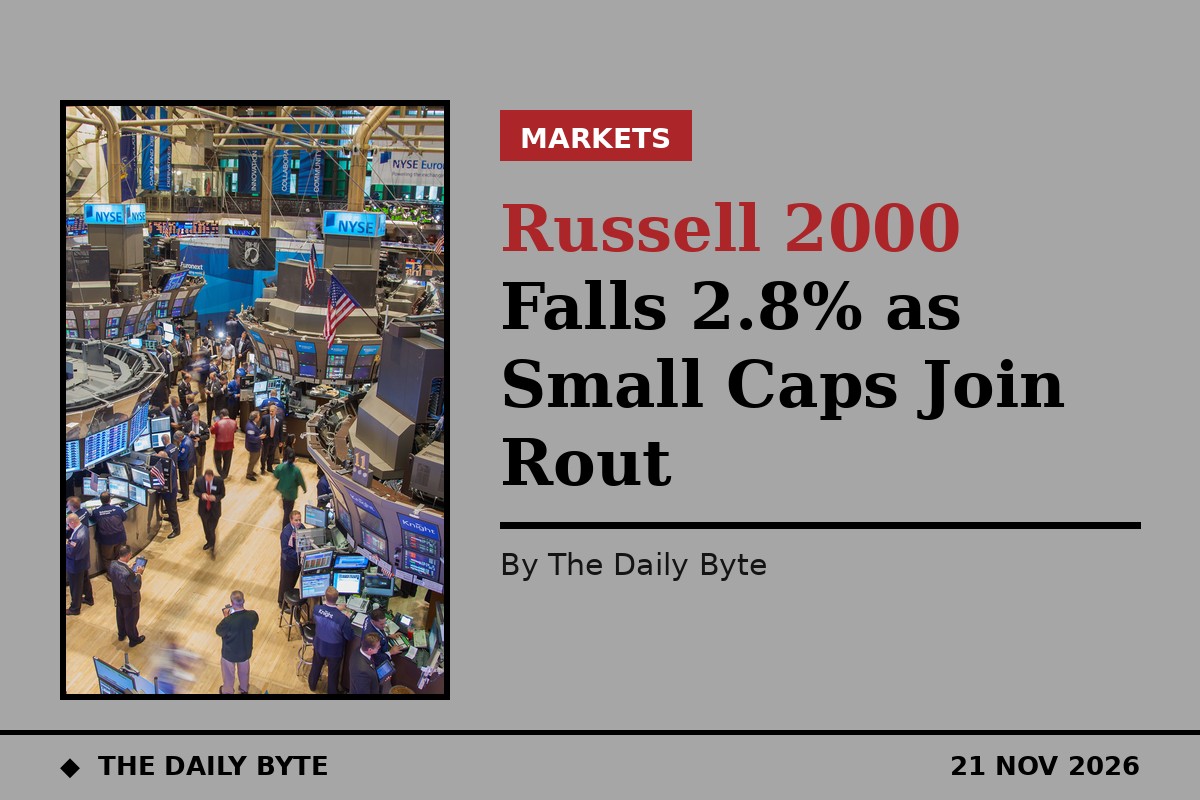
The Russell 2000 fell 2.8 percent to 2,581.79 points on Friday, as a deepening sell-off in artificial intelligence shares spread beyond the biggest technology companies and reached smaller US-listed businesses.
The small-cap index ended the session down 73.32 points. The decline left it 7.5 percent lower for the week, a loss of 208.70 points, although it remained 4 percent higher for 2026, according to the Associated Press.
Selling spreads beyond big tech
Friday's fall formed part of a broad retreat from risk-sensitive assets. The S and P 500 fell 3.7 percent and the Nasdaq Composite dropped 5.3 percent on the same day, with the S and P 500 entering a correction after falling more than 10 percent from its record close on 6 October, while the Nasdaq moved into negative territory for the year.
The Russell 2000 also moved lower as investors reduced exposure across the market rather than limiting selling to a small group of technology companies. Small-cap shares are often more sensitive to changes in borrowing costs and expectations for domestic economic growth, which made the index vulnerable as concerns about AI valuations and the scale of technology investment affected overall risk appetite.
The Russell 2000 tracks 2,000 smaller US companies, those ranked after the thousand largest, and is the standard measure of the country's small-cap market. Its fall on Friday showed that the retreat was not confined to the giant technology stocks that dominate the headline indexes.
The index had closed at 2,655.11 on Thursday, so Friday's 73.32-point drop took it to its lowest levels of the recent slide. The S and P 500 has now fallen for seven consecutive sessions, its longest such streak since 2020, while the Dow has fallen for five straight sessions.
A broad retreat
The selling was broad rather than narrow. On the Nasdaq, 3,964 listed stocks finished lower against 928 gainers, and total US market trading volume reached 25.19 billion shares, above the 20-session average of 19.5 billion. The Cboe Volatility Index, Wall Street's fear gauge, jumped 26 percent on Friday to near 36, its highest mark since last year's tariff turmoil.
The weekly performance shows how quickly pressure on large technology companies can spread to smaller businesses when investors reassess growth and financing risks. The Russell 2000 fell less than the Nasdaq on the day, but its 7.5 percent weekly loss was only slightly smaller than the 8.6 percent fall in the S and P 500 and the 10 percent drop in the Nasdaq.
Markets reopen on Monday, 23 November, with investors watching incoming US inflation data and a crowded week of earnings, including results from Hewlett Packard Enterprise, Agilent and Zoom on Monday, for any sign that the selling is easing.