Bank Rate 4%: Mortgages and Savings Explained
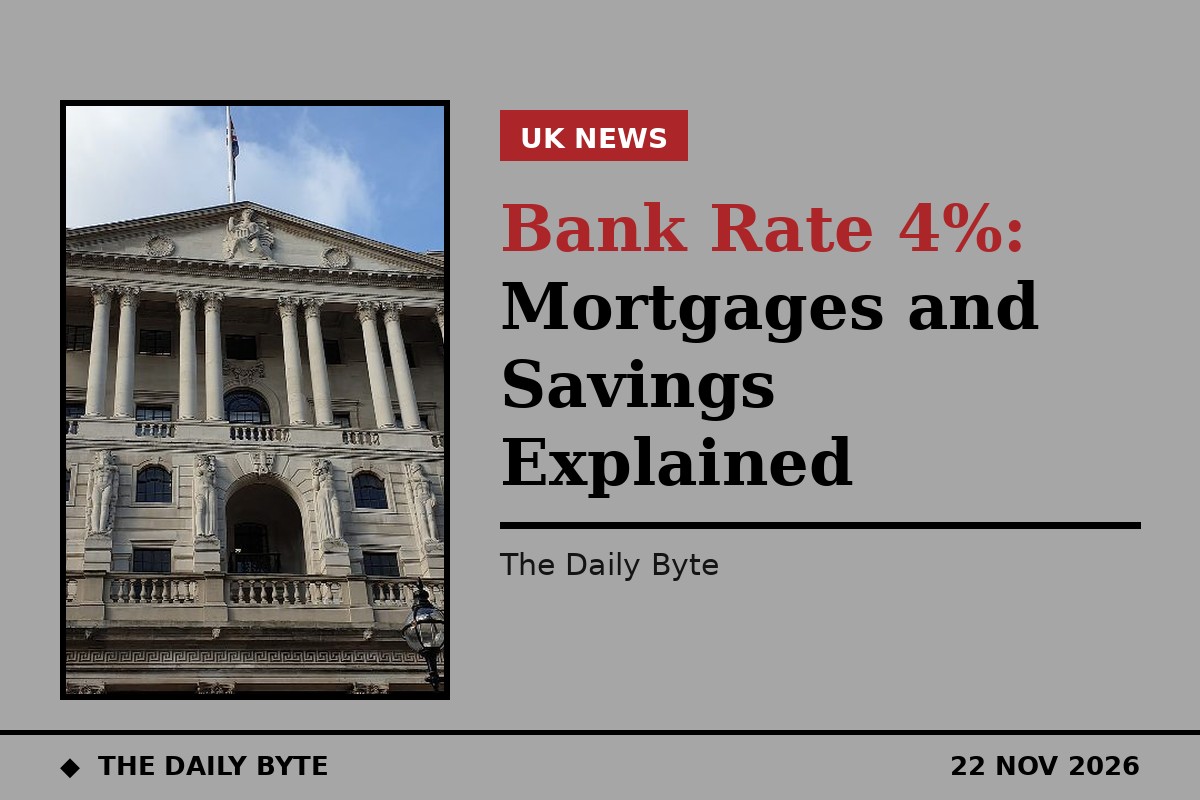
The Bank of England base rate — also called Bank Rate — is 4% as of 22 November 2026, after the Bank’s Monetary Policy Committee raised it from 3.75% on 5 November 2026. It was the first increase in more than three years, and it affects what millions of households pay on their mortgages and earn on their savings. But it does not affect everyone in the same way, or at the same speed.
This guide explains what the base rate is, why the Bank raised it, and what the 4% rate means for tracker, fixed and variable mortgages, and for savers. Figures are as reported on 22 November 2026; the next Bank Rate decision is due on 17 December 2026.
What is the Bank of England base rate?
The base rate is the interest rate the Bank of England charges other banks and lenders when they borrow money. Because it sets the cost of money for the banking system, it influences the interest rates that banks and building societies offer on mortgages, loans and savings accounts. It is sometimes called Bank Rate or the bank rate.
The rate is set by the Bank’s Monetary Policy Committee (MPC), which meets eight times a year. The Committee uses the rate as its main tool to control inflation — the rate at which prices rise. The Government has set the Bank a target of 2% for the Consumer Prices Index (CPI) measure of inflation. When inflation runs above target, raising the rate makes borrowing more expensive and saving more rewarding, which tends to cool spending and bring inflation down.
The latest figures show CPI inflation was 3.5% in the 12 months to September 2026, up from 3.1% in August and still well above the Bank’s 2% target. That is the backdrop to the November rise.
Why the Bank raised the rate to 4% on 5 November 2026
On Thursday 5 November 2026, the Monetary Policy Committee voted eight to one to raise Bank Rate by 0.25 percentage points, from 3.75% to 4%. One member voted to raise it further, to 4.25%. The decision was described as a precautionary move rather than a sign that the economy was overheating, and the Bank had factored the 28 October Autumn Budget into its November forecasts.
It was the first increase in more than three years. The Bank’s own forecasts, as reported at the time, suggested rates could keep edging up, with expectations pointing to a rate of 4.75% by Christmas 2027. Those are forecasts, not promises: the Committee decides at each meeting on the evidence in front of it, and the next decision is due on 17 December 2026.
What the 4% rate means for your mortgage
How the rise affects you depends entirely on what type of mortgage deal you have.
Tracker mortgages. These follow the base rate directly, so a tracker rate rises by the same 0.25 percentage points. MoneySavingExpert calculates that the increase is equivalent to roughly £15 a month more for every £100,000 of mortgage debt. Lenders pass the change on within weeks: Nationwide, for example, said it would increase its tracker mortgage rates from 1 December 2026 to reflect the new 4% base rate.
To put a figure on it, an illustration published after the rise showed a £200,000 repayment mortgage with 25 years left costing £1,111.66 a month at a rate of 4.50%, rising to £1,140.23 a month at 4.75% — about £28.57 a month more. Your own figure will depend on your balance, your remaining term and the margin above base rate in your deal.
Fixed-rate mortgages. If you are already on a fix, nothing changes until your fix ends. Your rate and your monthly payment are guaranteed for the fixed period, whatever the base rate does. The catch comes at the end of the fix: when you remortgage, the new deal on offer will reflect the market at that time. If your fix ends within the next three to six months, it is worth searching for a new deal now and checking product-transfer offers from your existing lender.
Standard variable rate (SVR) and discount mortgages. These are not directly linked to the base rate, so a rise does not automatically feed through — but lenders usually pass on some or all of it. After the November rise, Nationwide said its Standard Mortgage Rate would increase from 6.49% to 6.74% and its Base Mortgage Rate from 5.75% to 6% from 1 December 2026. The Co-operative Bank raised its standard variable rate from 6.62% to 6.79% from 9 November 2026. Check your lender’s announcement rather than assuming your rate has moved by the full 0.25 points.
Why a base rate rise can make new fixed deals cheaper
It sounds backwards, but a base rate rise can lead to fixed mortgage rates falling. That is because the rate on a new fixed deal is not based on today’s base rate. It is based on the market’s view of where interest rates are heading in future — the so-called swap rates. If the market reads a rate rise as the Bank acting early to control inflation, it may expect lower rates further ahead, and fixed deals priced off those expectations can get cheaper even as the base rate goes up. The lesson is to compare the actual fixed deals on offer rather than assuming they must have risen.
What the 4% rate means for savers
For savers the rise is, in principle, good news — but the benefit is neither automatic nor immediate. When the base rate rises, savings rates tend to rise too, yet each provider decides its own rates on its own timetable. Variable-rate accounts may see an increase within weeks, but some providers take longer, and some do not pass on the full rise.
Fixed-rate savings accounts are unaffected: if you have fixed your savings, your rate stays the same for the whole term, whatever the base rate does. That cuts both ways — you are protected from falls, but you do not benefit from rises either.
The practical step is to check the rate your account actually pays. Headline rates can come with balance limits, introductory bonuses and access rules, and an easy-access account paying well below the base rate is common. If your money is earning far less than the rates on offer elsewhere, the November rise is a good prompt to compare accounts. The Bank of England’s own guidance and the reporting by MoneySavingExpert and Nationwide both make the same point: the base rate sets the direction, but your provider sets your rate.
What to do next
If you are on a tracker or variable mortgage, expect your payment to rise and check the letter from your lender, which should arrive before your next payment changes. If you are on a fix, note when it ends and start looking at new deals up to six months early. If you are saving, check your actual rate and compare it with what is available now — and remember that moving savings is usually far simpler than moving a mortgage. The next decision, on 17 December 2026, is the one to watch: another rise would push tracker payments up again, while a hold would leave the rate at 4% into the new year.
FAQ
What is the Bank of England base rate today?
4%, after the Monetary Policy Committee raised it from 3.75% on 5 November 2026. The next decision is due on 17 December 2026.
Does a base rate rise affect my fixed mortgage?
No. A fixed-rate mortgage keeps the same rate and payment until the fixed period ends. Only a new deal, or a move to a variable rate, reflects the higher base rate.
How much more will a tracker mortgage cost at 4%?
Roughly £15 a month more for every £100,000 borrowed, for the 0.25-point rise. A £200,000 mortgage over 25 years was illustrated at about £29 a month more.
Will my savings rate go up when the base rate rises?
Usually, but not automatically. Providers set their own savings rates and move at different speeds. Fixed savings accounts do not change at all.
Why did the Bank raise rates if inflation is the problem?
The Bank uses Bank Rate to control inflation, which was 3.5% in the year to September 2026 against a 2% target. Higher rates make borrowing dearer and saving more attractive, cooling spending and price rises.
Figures in this article are as reported on 22 November 2026. This is general information, not financial advice for your own mortgage or savings.