Two Drone Strikes Hit Bannu Peace Jirga, 10 Hurt
Two successive quadcopter drone attacks struck a tribal peace jirga in Bannu district on Sunday morning, 22 November, injuring at least 10 people, according to an initial police report. The gathering had been convened to discuss the security situation in the area and ways of restoring peace.
The jirga was held in the Gulbadin Landidak area, where elders and residents of the Sardi Khel tribe had come together for consultations on law and order. A quadcopter struck the meeting, and a second strike followed shortly afterwards, spreading panic among those present. The injured were taken to District Headquarters Hospital in Bannu for treatment.
The gathering had been called by the head of the local peace committee, Malik Khush Nawaz Khan, according to initial reports. Hospital records showed that several of the injured were young, with some reported to be between 12 and 20 years old, and some reports said children were among those hurt. Another report put the number of injured at 20. The figure of 10 comes from the initial police count and may be revised as hospital staff complete their assessments.
No claim of responsibility
By the time the first reports were published late on 22 November, no group had claimed responsibility for the attacks. Khyber Chronicles attributed the attack to the banned Tehreek-e-Taliban Pakistan, also known as Fitna al-Khwarij, while other outlets reported that no militant group had claimed the attack and that the identity of those operating the drones remained unclear. The police account did not identify a motive or name a suspect, and the reports do not say what the drones carried, how the injuries were caused, or whether the aircraft were recovered.
Second attack on the same day
The jirga attack was not the only drone incident in the district that weekend. A day earlier, on 21 November, a quadcopter targeted the residence of Malik Tawanai Khan, head of the Hathi Khel Peace Committee, in Domel tehsil of Bannu. No loss of life was reported in that attack.
Hathi Khel tribal elders had earlier convened a jirga of their own to consider measures against suspected militants, address security challenges and seek resources for improving security. They had given the local administration three days to respond to their demands, although the reports do not say when that deadline expires or what the elders proposed to do if it passed without a response. The two incidents took place in the same district on the same weekend, but the reports do not establish whether they were connected.
Police review aerial defences
On the day of the jirga attack, Bannu District Police Officer Shafiullah Gandapur, accompanied by army officers, visited a joint aerial surveillance centre in the district. Officials briefed him on modern drone technology, armed quadcopters and aerial monitoring arrangements in sensitive areas, including locations within the limits of the Ahmadzai, Township and Domel police stations.
The briefing covered real-time aerial surveillance, the early detection of potential threats and the capacity for a coordinated response. Gandapur stressed the need for effective use of technology, timely sharing of intelligence and closer coordination between the police and the army, saying the protection of citizens' lives and property and the establishment of sustainable peace in the district remained the top priorities. The police did not say the visit was a direct response to the jirga attack.
A wider pattern of drone attacks
The attack fits a wider pattern of quadcopter attacks on peace advocates, security personnel and civilian locations across Khyber Pakhtunkhwa. Earlier in November, three police personnel were injured when a quadcopter reportedly targeted a police installation at a camp for displaced people in Bannu's Bakakhel area.
On 19 November, the military's media wing said security forces had killed 22 militants in operations in the province, according to Geo News. In July, the military said it had killed 24 militants in Bannu after a suicide bombing at Miryan police station, Dawn reported. Against that background, a gathering convened specifically to discuss peace was itself struck twice in one morning.
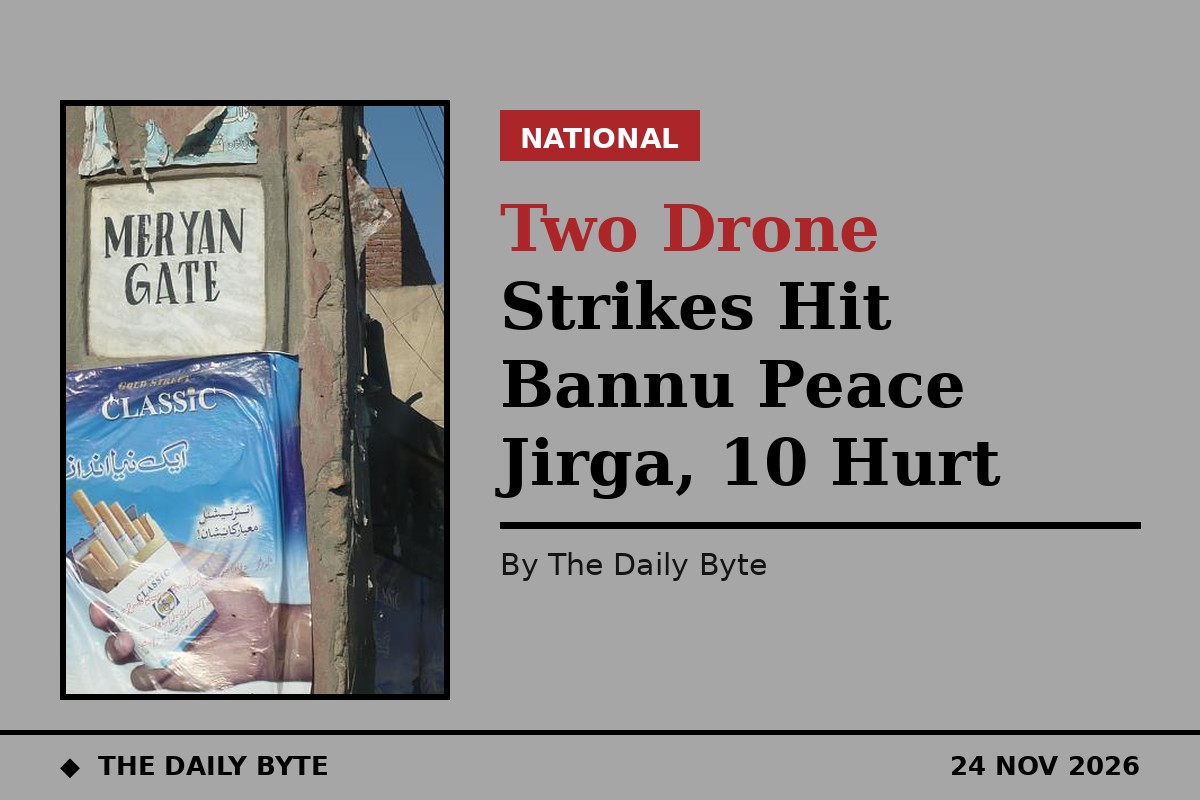
The next signals to watch are whether police identify a suspect or a group, whether the casualty count is revised, and whether the administration answers the Hathi Khel elders before their deadline. Until then, the attack stands as a dated snapshot of a district where the work of local security has itself become a target. The photograph with this article shows the Meryan Gate in Bannu, photographed in 2008; it shows the district where the attacks took place, not the jirga, the injured or the drones.