Bayesian Crew 'Unaware of Critical Risk', MAIB Finds
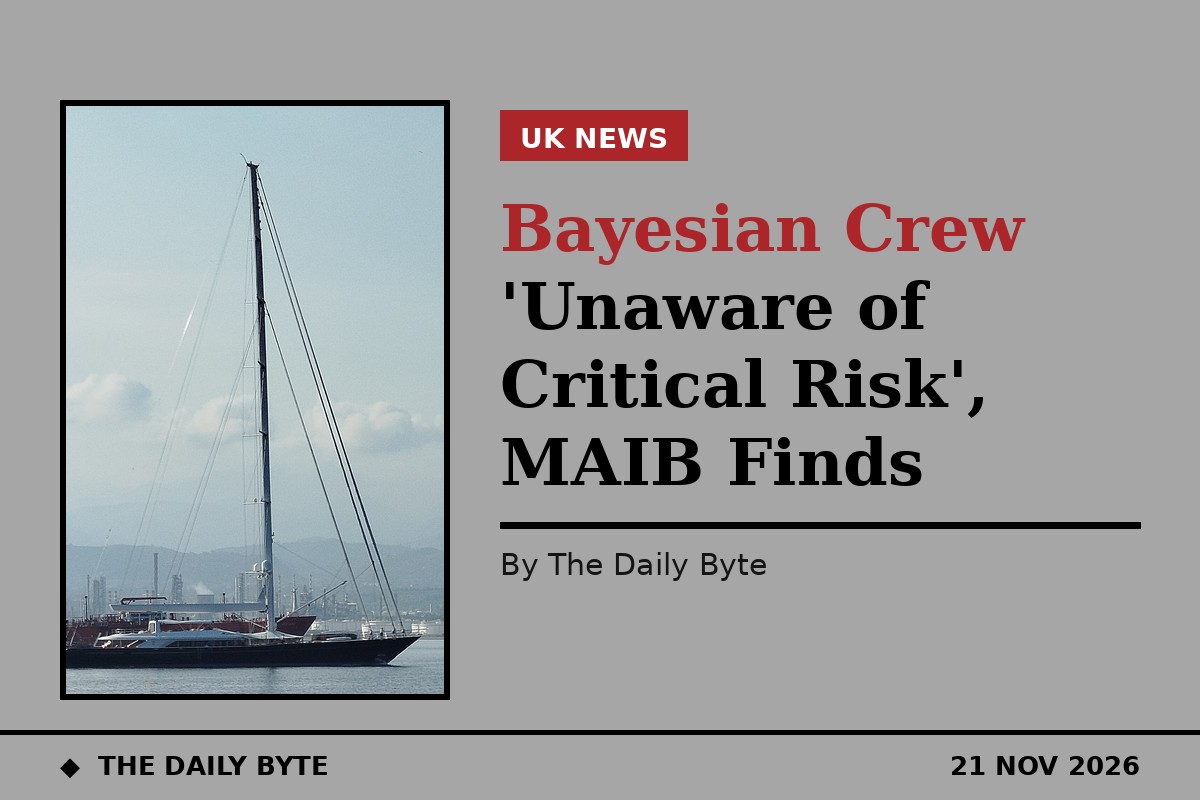
The crew of the superyacht Bayesian had no warning of the stability flaw that sent the vessel to the bottom of the sea off Sicily, Britain's marine accident investigators have found. The Marine Accident Investigation Branch (MAIB) published its final report on Thursday 19 November, more than two years after the sinking on 19 August 2024 in which seven people died.
The 56-metre sailing yacht was at anchor about half a nautical mile south-east of Porticello when a violent downburst struck in the early hours. Conditions changed with terrifying speed: the weather was calm at 03:52, winds had risen to about 30 knots within minutes, and at 04:06 a sudden gust estimated at about 70 knots knocked the yacht more than 90 degrees onto its starboard side in less than 15 seconds. Unable to right herself, she flooded and sank in about 50 metres of water. Fifteen of the 22 people on board escaped. Six guests and one crew member died: British technology entrepreneur Mike Lynch and his 18-year-old daughter Hannah; Morgan Stanley International chairman Jonathan Bloomer and his wife Judy; US lawyer Chris Morvillo and his wife Neda; and the yacht's Canadian chef, Recaldo Thomas.
A risk that was never assessed
The central finding is that Bayesian was vulnerable to being knocked down by severe winds while operating with no sails set, in what investigators call the motoring condition, with her centreboard raised. That vulnerability had never been assessed, and nothing in the yacht's approved stability information warned the crew about it. The report says the crew were therefore "unaware of a critical risk to the vessel and unable to take account of it in their operations".
A study by the University of Southampton's Wolfson Unit, commissioned for the investigation, found that in the reconstructed condition the mast accounted for more than 56 percent of the wind force trying to heel the yacht over, with the furled sails contributing more than another 20 percent. The yacht's stability booklet contained guidance and calculations for sailing, but no assessment of the risk with sails down. Neither the Large Commercial Yacht Code under which Bayesian was originally assessed, nor the later Red Ensign Group Yacht Code, required that assessment for a yacht of her type, leaving people on such vessels exposed to what the report calls "an undetermined risk".
Forecasts did not warn of the downburst
The weather forecasts for the night were broadly accurate, the investigators found, but they did not communicate the risk of downbursts from the thunderstorms that were predicted. The crew were focused on managing the dragging anchor and securing the yacht as the wind rose, rather than on a knockdown risk they did not know existed. The report says the crew were unaware of the possibility of weather of the magnitude experienced when they retired for the night.
The investigation also found that none of the yacht's four liferafts automatically released and inflated as she sank. The MAIB stressed that its conclusions are those of the British safety investigation.
What the report recommends
The MAIB has asked the Red Ensign Group to study the knockdown vulnerability of large monohull sailing yachts with no sails set, and to revise its Yacht Code where necessary, with better guidance in stability booklets and liferafts that can float free. It has also asked the Maritime and Coastguard Agency to amend the training syllabus for yacht masters so it reflects the danger from downbursts and severe wind gusts, and it has issued a safety flyer for the yachting industry.
Chief Inspector of Marine Accidents Rob Loder said: "Our investigation found that Bayesian had a vulnerability to high winds that was not recognised, because the yacht had never been assessed at anchor with [her] sails down. The extreme winds that night were also not explicitly forecast, so the crew had no warning of the risk." He added that his thoughts remained with the families and loved ones of the seven who lost their lives.