Bilawal calls for democratic reset to restore trust
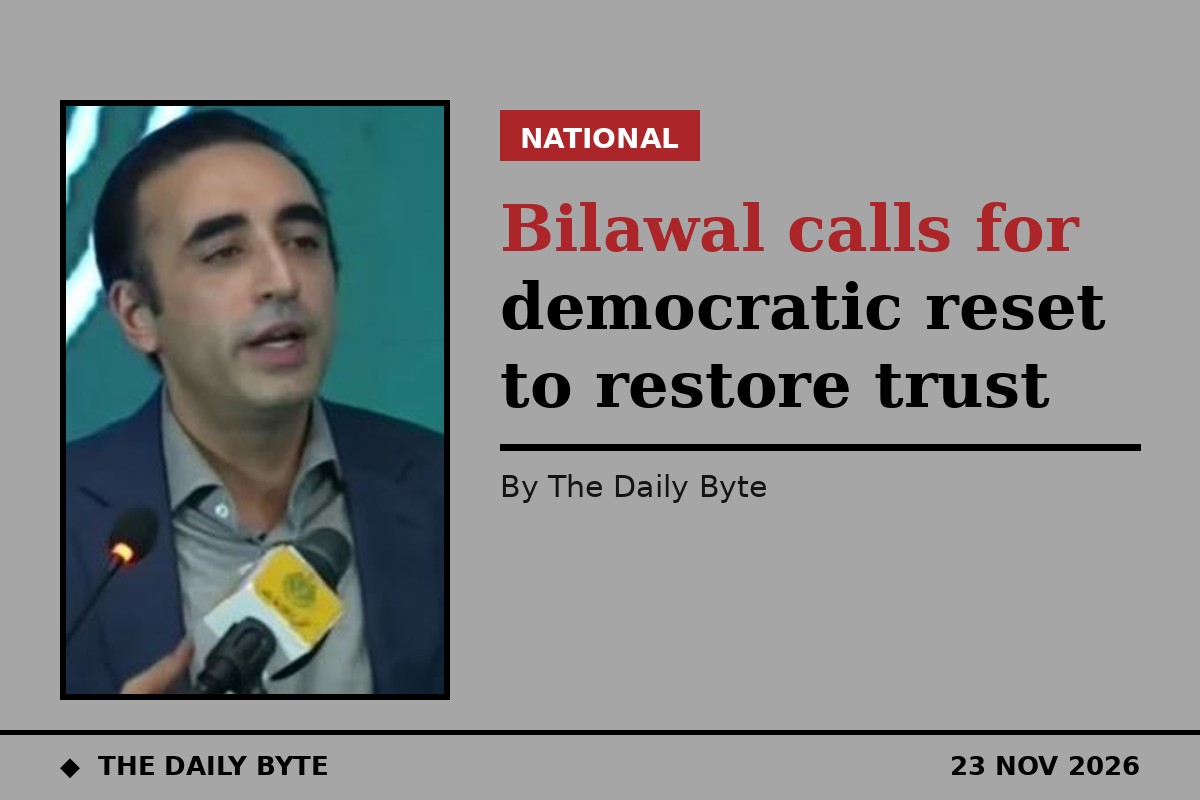
Pakistan Peoples Party (PPP) Chairman Bilawal Bhutto-Zardari has called for a democratic reset to restore public confidence in the country's political system, saying any reform of governance must be rooted in democracy, unity and public trust. He was speaking in Karachi on Monday, 23 November 2026, at the launch of the Sindh Youth Card.
"If there has to be a reset, it should only be a democratic one," Bilawal said. "Through the proposed reset, we must rebuild the confidence of the public in the parliament, judiciary, election process, and accountability." He said restoring public trust in the political and institutional system was essential for the country to move forward.
Bilawal said politicians must maintain public hope and confidence in the system, warning that if political leaders themselves became disillusioned, they could not expect people to trust it. He urged rulers to abandon the politics of hatred and division and focus on public welfare, saying the country could confront every crisis and disaster through unity but would fail if it remained divided.
Restoring trust 'a joint effort'
The PPP chairman said a democratic reset should restore the supremacy of parliament and rebuild confidence in the judiciary and the electoral system. He said the restoration of trust would have to be a joint effort, rebuilding confidence between the government and the opposition as well as public trust in the system, its parliament, judiciary, media and accountability structures.
He stressed that political differences should be set aside in the national interest, particularly as the country faced dangerous inflation and difficult economic conditions. Against the backdrop of conflict in the Middle East and concerns about a possible global economic crisis, Bilawal urged political parties to abandon divisive politics and focus on public welfare.
Bilawal also called for the use of modern technology to improve transparency and close avenues for corruption, saying the system should be designed in a way that left no room for corrupt practices. He said young people wanted a Pakistan free of corruption and that public services should be delivered without causing inconvenience to citizens.
Sindh Youth Card: 100,000 young people in first phase
At the ceremony, Bilawal launched the Sindh Youth Card, describing it as an initiative to help young people enter the formal economy and access opportunities in Pakistan and abroad. In its first phase, the programme will cover 100,000 young people aged between 15 and 29, he said.
The card, which is linked to Visa, will help beneficiaries take part in Pakistan's formal economy as well as the global economy, Bilawal said. It will also offer discounts at participating private facilities, including gyms, restaurants and shops. He said he was considering subsidised transport fares for young people and exploring opportunities to secure scholarships for them from institutions around the world.
Bilawal said the programme would eventually be extended to all districts of Sindh. He said the provincial government was making history by introducing the programme ahead of other provinces and the federal government, and urged the government to prepare the country to face future economic challenges and take measures to protect people from an economic crisis.
Technology, transparency and housing
The PPP chairman said the government must also use technology to curb corruption and improve governance, and that a united Pakistan would be better positioned to tackle future crises. He said the country needed a governance system capable of responding to emerging challenges, and stressed that public confidence in such a system could only be built through unity.
Bilawal also pointed to the Sindh government's housing programme for flood-affected families, saying 100,000 homes had been built and provided to them. He described it as the largest project of its kind in the world and said it had created livelihoods for at least 100,000 people while economically empowering the same number of women by making them homeowners.
The wider reset debate
Bilawal's remarks come as debate over a possible reset of Pakistan's governance system has intensified amid political polarisation and discussion of institutional reform. Earlier this month, he argued that any restructuring must be political and democratic, with elected representatives playing a central role, and called for restoring public confidence in parliament, the judiciary and the electoral process.
His latest intervention puts the emphasis firmly on democratic means. Rather than proposing a change imposed from outside the political system, he argued that if a reset is to take place, it must keep the people's stake in governance intact by restoring the supremacy of parliament and trust in the judiciary, the election system and accountability. The first phase of the Sindh Youth Card, meanwhile, will now move into distribution to the 100,000 young people it is meant to reach first.