Brent crude week ahead: CPI and OPEC report in focus
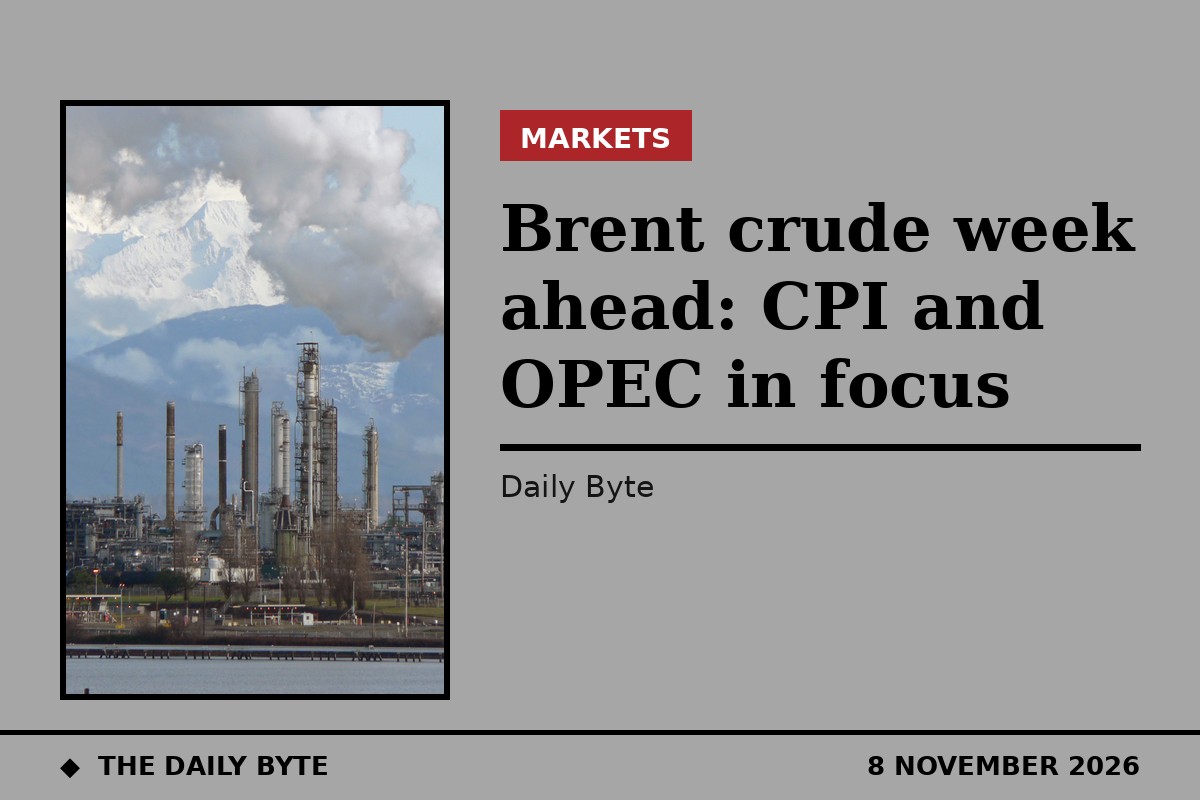
Brent crude starts the new week at $98.32 a barrel, after a Friday session that ended almost flat but closed out one of the sharpest weekly falls in years. The January Brent contract settled up just 0.03 percent, or three cents, on Friday 6 November, while US West Texas Intermediate for December delivery rose 0.3 percent to $90.83, according to Rigzone, reporting Bloomberg.
The quiet finish hides the scale of the week. Front-month futures fell about 13.2 percent over the week, the biggest weekly percentage loss since 2022, Bloomberg reported. The January Brent contract had settled at $113.43 on 30 October, so Friday's $98.32 close represents a fall of roughly $15 in a single week, with prices swinging within a range of about $19 since Monday.
Wednesday was the worst day. Brent dropped 9.73 percent in one session to settle at $93.52, before rebounding 3.9 percent on Thursday to $98.29 after reports of attacks on tankers in the Strait of Hormuz. Friday then brought a calmer session, with traders weighing whether the diplomacy driving the sell-off will produce a real agreement.
The trigger was political. Democrats swept both chambers of Congress in the US midterm elections on 3 November, and markets read the result as pressure on Washington to bring the war with Iran to an end. Iran has since sent a nuclear proposal to Washington through Qatar, according to Reuters, cited by CNBC. Tehran is reported to want a US naval blockade lifted, sanctions eased and frozen assets released before any full reopening of the Strait of Hormuz, and no formal agreement has been announced.
Traders are split on what happens next. Bob McNally, founder and president of Rapidan Energy Group, told CNBC he sees an 80 percent probability that fighting resumes and that both benchmarks could climb back above $100. The physical picture supports caution: flows through the Strait of Hormuz are running at less than 60 percent of capacity, tanker attacks continued on Thursday, and Gulf crude exports are only now recovering toward pre-war levels, with Saudi Arabia cutting prices for Asian buyers to a fresh six-year low.
Three scheduled events frame the week ahead. The US October consumer price index is due on Tuesday 10 November, the same day the US Energy Information Administration publishes its Short-Term Energy Outlook. OPEC follows with its Monthly Oil Market Report on Wednesday 11 November. In its October outlook the EIA raised its fourth-quarter 2026 Brent forecast to $105 a barrel, $14 higher than a month earlier, so any cut to that figure will show how much of the war premium the agency now expects to last.
Further ahead, OPEC+ holds its next full ministerial meeting on 29 November, giving the group three weeks to see where the talks land before setting supply policy. On the supply side at home, the Baker Hughes rig count rose by one to 604 in the week to 6 November, the highest since 2024, with oil rigs up one at 463. With no deal yet signed and tanker attacks continuing, the premium that left Brent in a week can return quickly. This article reports market prices and is not financial advice.