Bristol Pupils Walk Out in Youth Strike Rally
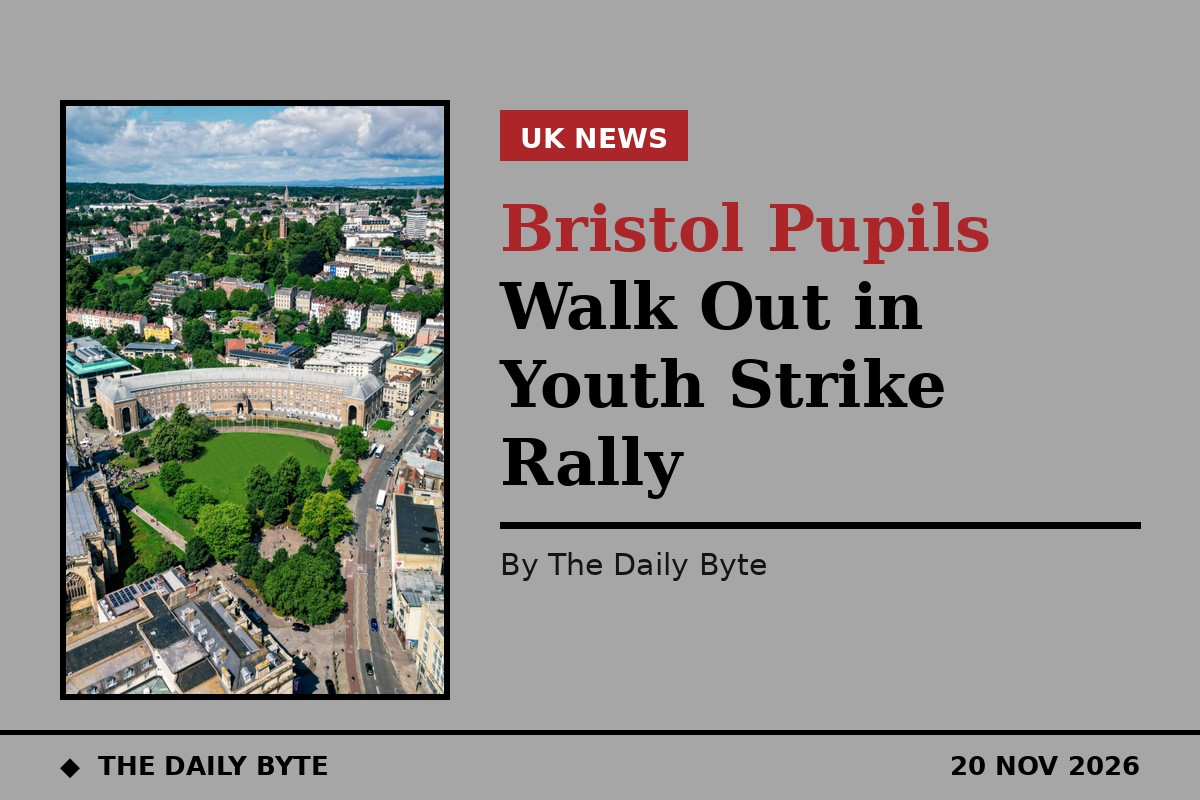
Pupils and students walked out of schools, colleges and universities in Bristol on Friday 20 November as part of an international youth strike, gathering for a rally on College Green in the city centre.
The walkout was organised by Socialist Students and inspired by recent demonstrations in France. The Bristol rally took place at 1pm under the slogan "Fight for Our Futures, Not Their Wars", on World Children's Day, which marks the anniversary of the United Nations Convention on the Rights of the Child.
Organisers said students at more than 300 schools, colleges and universities across Britain would walk out on the day, with young people also taking action in France, Italy, Germany, Spain and other countries. Students at the University of Bristol met at Senate House at 11am before joining students from the University of the West of England and school pupils for the main Bristol protest at 1pm. Live reports from organisers later in the day described a few hundred staff and students taking part in Bristol.
Why students said they walked out
Socialist Students chair Adam Powell-Davies said students were told there was no money for education, mental health services or decent jobs and homes, while the government had cut university teaching grants two years running and planned to raise military spending to close to 80 billion pounds a year by 2029.
"Friday is a beginning, not an end," he said. "Every student who walks out should sign up with Socialist Students, and come to our conference on December 5 to decide how we take this fight forward. This is a fight for our future, not their wars."
Bristol College student Penny, who planned to take part, said she was backing the walkout because Britain's involvement in war affected everyone, from food and fuel prices rising to hotter summers and colder winters. Owen, a student at the University of the West of England, said it was vital for young people to make a stand in a world where states were increasingly prioritising defence above all else.
Union backing and criticism
Bristol Trades Union Council backed the strike alongside the National Education Union, the University and College Union and the Stop the War Coalition. Earlier this month the National Education Union executive voted unanimously to support the protest and oppose disciplinary sanctions, while its Bristol branch offered hi-vis jackets, sound equipment and volunteer stewards.
Sheila Caffrey, secretary of Bristol Trades Union Council, said the whole working class was suffering under the weight of austerity and the cost of living crisis, and that people leaving school faced a lifetime of debt to go to university or a jobs market where insecurity and low pay predominated.
Not everyone supported the action. A parent writing to the Bristol Post criticised the union backing and warned that demonstrations could spark unrest, saying children should be sent to school to learn rather than swept up in political campaigns. The parent pointed to France, where student protests had seen more than 1,000 high schools closed or blockaded, and said parents should urge Ofsted to investigate the National Education Union.
Police powers in place
Avon and Somerset Police said officers were present to enable the peaceful protest to take place and to keep the wider public safe, and would take robust action in the event of any criminality. A dispersal zone under Section 35 of the Anti-social Behaviour, Crime and Policing Act 2014 was authorised for the area from 10am until 8pm, giving officers the power to move on groups or individuals causing, or likely to cause, harassment, alarm or distress.
Temporary powers under Sections 157 and 158 of the Crime and Policing Act 2026 were also authorised for the same time and area. That meant anyone wearing a face covering or other item concealing their identity within the designated area could be committing an offence, although officers said they would first make people aware of the restrictions and give them the chance to remove the covering or leave the area.
Neighbourhood Inspector John Shaddick said the force had significant experience in enabling peaceful protest while keeping the public safe, and remained in close contact with partner agencies and stakeholders to ensure disruption was minimised. "These powers have been authorised to support the policing operation and to help officers take action wherever the law is broken. Criminality will not be tolerated," he said.


