Caribbean sargassum crisis gets $10 million regional project unveiled at COP31
By The Daily Byte
·19 Nov 2026
·4 min read
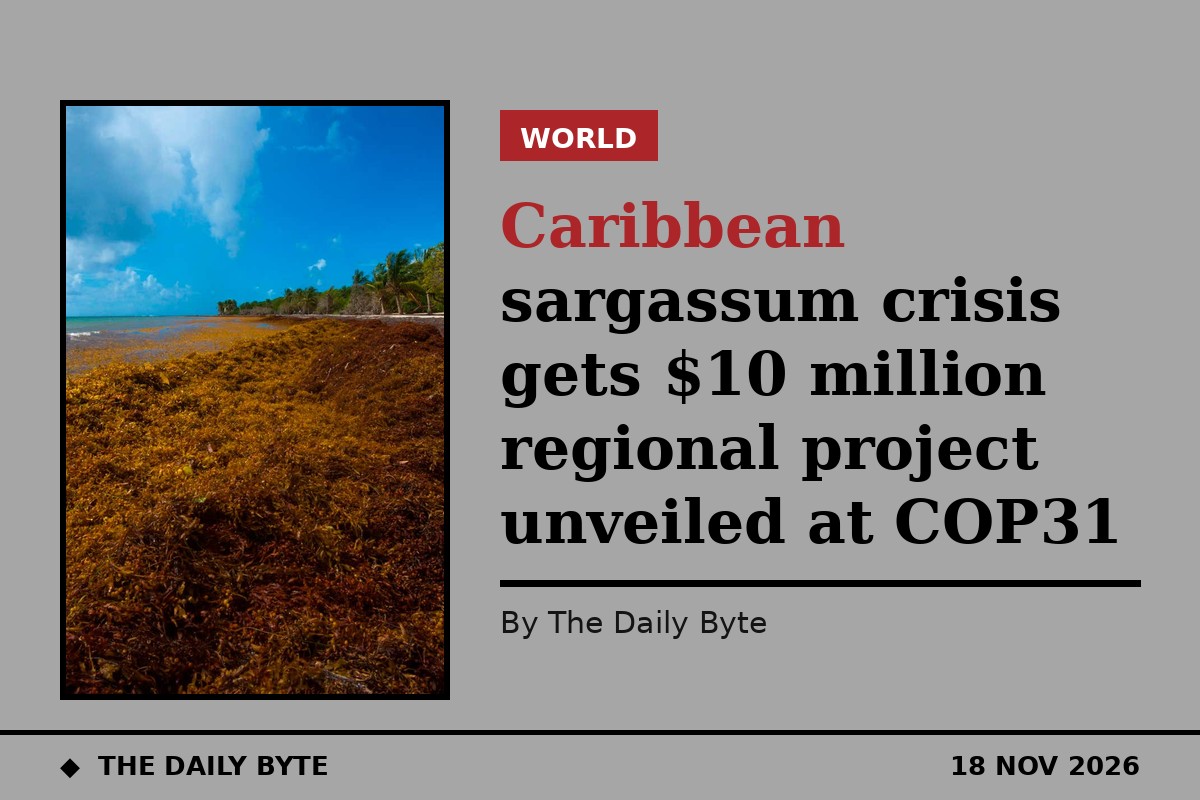
A $10 million regional project to tackle the sargassum seaweed inundating Caribbean beaches has been presented at the COP31 climate conference in Antalya, Türkiye, bringing seven countries together behind a shared system for forecasting, responding to and making productive use of the floating weed.
The initiative, known as SargMarine, was announced by the Development Bank of Latin America and the Caribbean (CAF) and the Global Environment Facility (GEF) on Wednesday 18 November. It covers Jamaica, Trinidad and Tobago, Grenada and St. Lucia — all members of the Caribbean Community (CARICOM) — alongside Colombia, Panama and the Dominican Republic, according to the Caribbean Media Corporation (CMC).
The project will strengthen early warning systems, coordinate national responses and develop alternatives for the productive use of sargassum, which has become one of the region's most persistent environmental and economic headaches. A further $67.3 million in co-financing is envisaged alongside the $10 million GEF grant. CAF will act as the implementing agency, the Organization of American States (OAS) as the executing agency, and the Inter-American Institute for Global Change Research (IAI) as a technical partner.
## A record tide of seaweed
The scale of the problem is hard to overstate. According to the United Nations Environment Programme, 37.5 million tonnes of sargassum were recorded in the Atlantic in May 2025 — the highest volume observed since monitoring began in 2011. Massive accumulations smother beaches, damage marine and coastal ecosystems, harm tourism and fisheries, and create health risks for coastal communities as the rotting weed releases hydrogen sulphide gas.
For small island states whose economies depend on clean beaches, the weed arrives in waves that no single country can manage alone. "Sargassum is a transboundary phenomenon, but our responses remain largely national," said Lina Mondragón, CAF's Climate Action and Positive Biodiversity Manager. "Overcoming this fragmentation requires strengthening existing mechanisms, building on the capacities of regional organizations, and reaching agreements that enable more effective joint action."
## From warning to productive use
The project's first priority is anticipation. Matthew Samuda, Jamaica's Special Envoy for Climate Change, Environment, Oceans and the Blue Economy, said Jamaica's priorities were to strengthen monitoring and forecasting. "We want to know when it will arrive and where," he said, adding that such information would help determine where protection efforts should be concentrated and support planning for the productive use of sargassum.
That second strand — turning a nuisance into a resource — is central to the design. The project aims to develop alternatives for the productive use of sargassum that can create opportunities for local economies, from fertiliser and animal feed to bioenergy and construction materials. Colombia's Minister of Environment and Sustainable Development, Fabio Arjona Hincapié, told the launch that local solutions on their own would not work, and stressed the need for joint responses and stronger regional and international negotiating capacity.
Ana Emilia Pimentel, the Dominican Republic's Vice Minister for Climate Change and Sustainability, added that responses must take community needs into account alongside the economic consequences, saying: "We also have to think about this from the perspective of the people."
## Ready to get under way
The project has already received final approval from the GEF, and its formal launch at COP31 signals that implementation can now begin. "The initiative has already received final approval. This means it is ready to get underway. We are ready to drive action on the ground," said Chizuru Aoki, the GEF's manager for Conventions and Funds Division.
The presentation was also supported by Mexico and France. For the Caribbean countries facing ever more frequent sargassum influxes, the hope is that regional cooperation will finally turn a shared threat into coordinated monitoring, preparedness and response — and perhaps, over time, into a shared economic opportunity.
## Frequently asked questions
**What is the SargMarine project?**
A $10 million GEF-funded regional project, implemented by CAF, to manage sargassum in the Caribbean through early warning systems, coordinated responses and productive use of the seaweed.
**Which countries are involved?**
Jamaica, Trinidad and Tobago, Grenada, St. Lucia, Colombia, Panama and the Dominican Republic.
**How much sargassum was recorded in 2025?**
The United Nations Environment Programme recorded 37.5 million tonnes in the Atlantic in May 2025, the highest since monitoring began in 2011.
Sources: [Caribbean Media Corporation via CANA News](https://www.cananews.com/caf-and-gef-launch-multi-million-dollar-project-to-tackle-sargassum-in-the-caribbean/) and the [Global Environment Facility project record for SargMarine (GEF ID 11526)](https://www.thegef.org/projects-operations/database?f%5B0%5D=implementing_agencies%3A616&f%5B1%5D=regional_country_list%3A81).
Source
CANA News (Caribbean Media Corporation) — https://www.cananews.com/caf-and-gef-launch-multi-million-dollar-project-to-tackle-sargassum-in-the-caribbean/