Carney to Raise EV Manufacturing in Talks with Xi
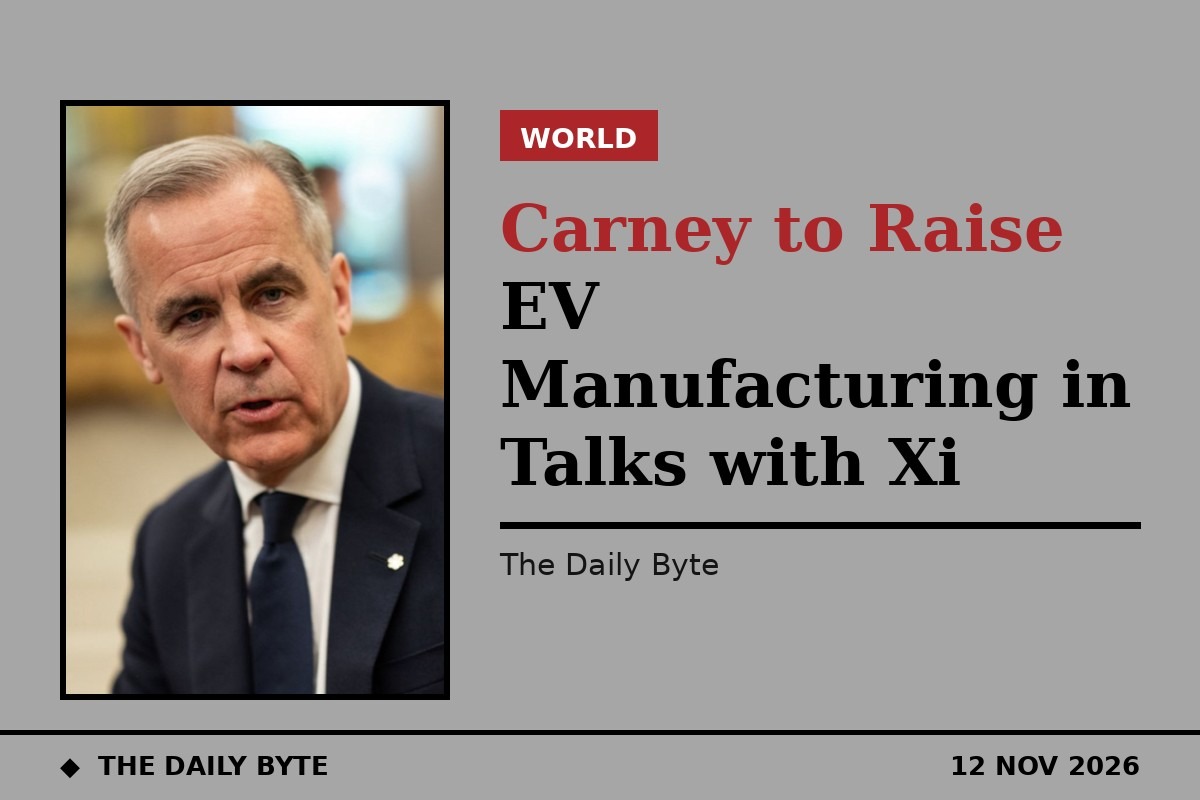
Canadian Prime Minister Mark Carney said on Thursday 12 November 2026 that he will discuss electric vehicle manufacturing with Chinese President Xi Jinping when the two leaders meet next week, while playing down expectations that Chinese cars will soon be built in Canada. Carney was speaking at the European Political Community summit in Dublin, the first stop on a diplomatic tour that takes him to Asia for a series of summits.
“The extent to which there’s Chinese investment depends on a variety of factors,” Carney said, according to Bloomberg. “It will be one of the discussions with President Xi.” He added that any discussion of Chinese electric vehicles was also relevant to Canada’s ongoing trade discussions with the United States, without elaborating.
Carney confirmed earlier this week in Montreal that he will meet Xi on the sidelines of the Asia-Pacific Economic Cooperation leaders’ meeting in Shenzhen, which runs from 18 to 19 November. He also said he would raise concerns about foreign interference in Canada’s internal affairs directly with the Chinese leader. China’s foreign ministry has said Beijing follows a principle of non-interference in other countries’ internal affairs and has no interest in interfering in Canada’s domestic matters.
A deal struck in January
The electric vehicle question sits at the centre of a trade understanding the two countries reached in January 2026, when Carney made his first visit to China as prime minister — the first by a Canadian prime minister in eight years. Under that deal, Canada agreed to cut its 100 per cent tariff on Chinese electric cars and allow up to 49,000 Chinese electric vehicles a year into the country at a most-favoured-nation tariff rate of 6.1 per cent, with the cap growing to about 70,000 over five years. In return, China agreed to cut its total tariff on Canadian canola seed, a major export, from about 84 per cent to about 15 per cent from 1 March.
The arrangement angered some officials in the Trump administration in Washington, which has pressed its allies to keep Chinese electric vehicles out. Carney has argued that Canada is pursuing a more diversified trade strategy as it seeks to reduce its dependence on the United States, its largest trading partner. Ottawa wants to increase exports to China by 50 per cent by 2030, and is exploring Chinese investment in electric vehicles, clean energy and advanced manufacturing.
Auto industry under strain
Canada’s auto industry has been under strain from US tariffs and the shift to electric vehicles, and the government is looking for new investment to support manufacturing jobs, particularly in Ontario. Carney said the scale of any Chinese investment in the sector would depend on several factors, and he cautioned against expecting Chinese cars to enter production in Canada soon.
Beijing agreed this week to extend trade relief for Canadian agricultural products, most notably canola, until the end of 2028, Carney said last week, as officials from both countries discussed deepening trade ties after the January deal. Chinese Vice Premier He Lifeng is also due to visit Canada next week for talks with Canadian officials.
Carney’s Asia tour continues after Dublin, with the ASEAN summit in Manila, the Francophonie summit in Phnom Penh and the APEC leaders’ meeting in Shenzhen. His meeting with Xi follows their first encounter on the sidelines of a regional summit in South Korea last year, which ended years of diplomatic estrangement between the two countries, and the January visit to Beijing that established a new strategic partnership.
Sources: Bloomberg, CnEVPost, The Daily CPEC