Central banks bought 321 tonnes of gold in Q3
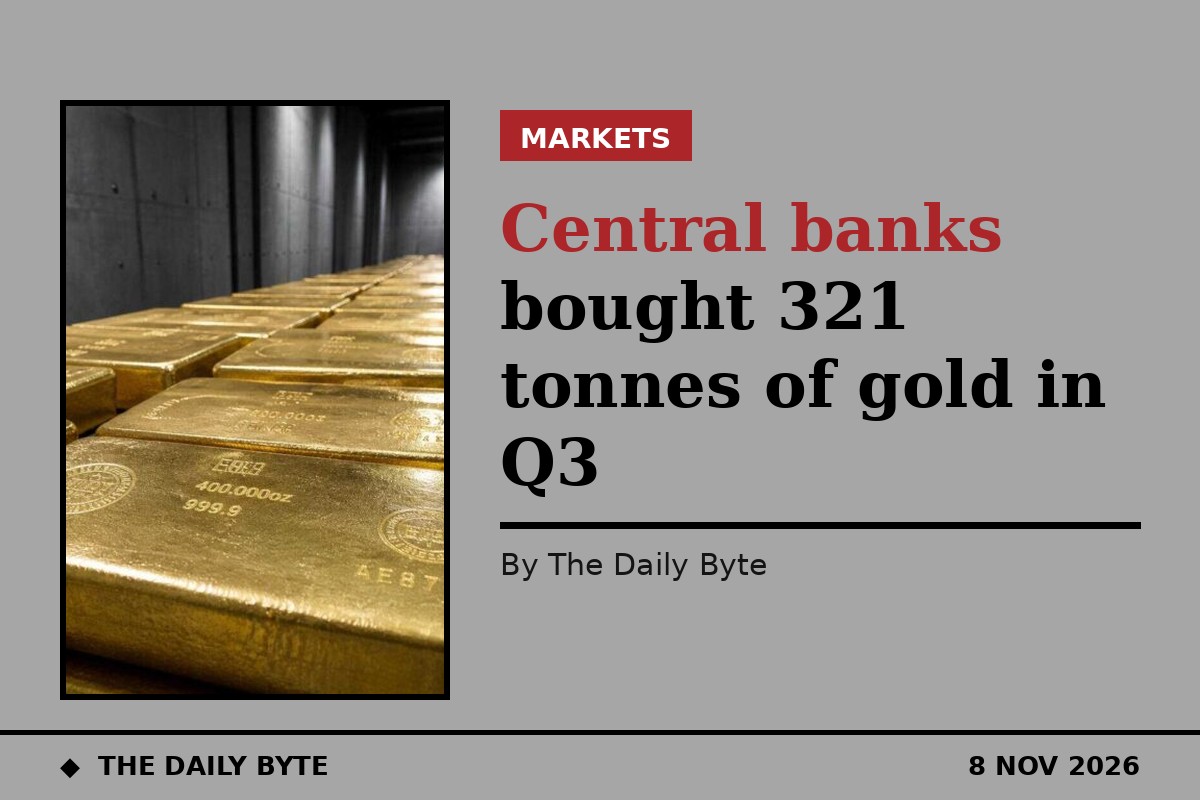
Central banks bought 321 tonnes of gold in the third quarter of 2026, up 42 percent on a year earlier, as official buyers stepped up purchases while the gold price stayed near record highs.
The figures come from the World Gold Council's Gold Demand Trends report for July to September, published on 3 November. Total gold demand, including over-the-counter trading, was 1 percent lower than a year earlier at 1,369 tonnes, but the average price of 4,262 dollars an ounce lifted the value of that demand by 22 percent to 188 billion dollars.
Demand for the first nine months of the year reached 3,881 tonnes, virtually matching the record pace set in 2025, while its value hit a record 566 billion dollars.
Central banks lead the buying
Central banks and other official institutions added a net 321 tonnes to their reserves in the quarter, the highest quarterly total since the final quarter of 2024 and well above the five-year quarterly average of 227 tonnes. Purchases for the first nine months reached 675 tonnes, 6 percent higher than in the same period last year.
Only 120 tonnes of the quarterly buying was officially reported, meaning roughly two-thirds came from unreported purchases, a pattern that has held for about four years. Of the disclosed buying, China and Poland dominated, accounting for 104 tonnes between them. The People's Bank of China bought 63 tonnes, while the National Bank of Poland added 40 tonnes.
The Council said diversification and risk management remained the main drivers of official demand, and it now expects central bank buying to at least match 2025 levels for the year as a whole.
ETFs swing back to inflows
Physically backed gold exchange-traded funds returned to inflows in the quarter, adding 211 tonnes in a marked reversal from the outflows of the previous quarter. Holdings rose to a record 4,256 tonnes at the end of September, with the value of the inflows reaching a record 31 billion dollars.
European-listed funds led the recovery, adding 92 tonnes, followed by North American funds with 81 tonnes and Asian funds with 34 tonnes. Over-the-counter and other demand reached 143 tonnes, up from 101 tonnes a year earlier.
Retail investors, by contrast, stayed on the sidelines. Bar and coin demand fell 19 percent to 268 tonnes, its lowest quarterly level in four years, as buyers waited for a clearer direction in the price. China was the exception, with demand up 7 percent to 79 tonnes, while Indian demand fell 40 percent to 55 tonnes and demand in the United States dropped 40 percent to just eight tonnes.
Record output, shrinking supply
On the supply side, gold mines produced a third-quarter record of 1,071 tonnes, up 3 percent on a year earlier, with Canadian output up 22 percent on new mines and higher production at existing ones. The Council expects mine production to reach another annual record in 2026.
But record output did not lift overall supply. Recycling fell 8 percent to 314 tonnes, its lowest level since the final quarter of 2023, as holders showed little appetite to sell despite high prices. Total supply edged down 1 percent to 1,369 tonnes.
High prices also continued to weigh on jewellery, which fell 17 percent to 313 tonnes, the weakest third quarter in the Council's data series, which starts in 2000. Consumers kept switching to lighter and lower-carat pieces, although the value of jewellery demand still edged higher to 43 billion dollars. Demand from the technology sector rose 3 percent to 85 tonnes, its highest quarterly total since the final quarter of 2021, helped by electronics demand linked to artificial intelligence.
Outlook finely balanced
Louise Street, senior markets analyst at the World Gold Council, said the quarter had been a mixed bag, with ETF inflows roaring back on geopolitical risk and concerns about fiscal discipline, while retail investors held back and central banks remained an important pillar of demand.
"The outlook for gold looks finely balanced through to the end of the year," she said. "While rising interest rates and mixed inflation expectations present potential headwinds, the combined shadows of geopolitical risk and financial market stress may cause participants to seek stability in gold."
The Council expects investment demand to grow by about 200 tonnes in 2026 compared with last year, a lower forecast than its earlier estimate of 400 tonnes. Spot gold ended last week at around 4,070 dollars an ounce, recovering from a one-year low near 3,870 dollars at the end of October, with traders now looking to United States inflation data due on Tuesday 10 November as the next test for prices.