CFTC Clears Perpetual Futures on Individual US Stocks
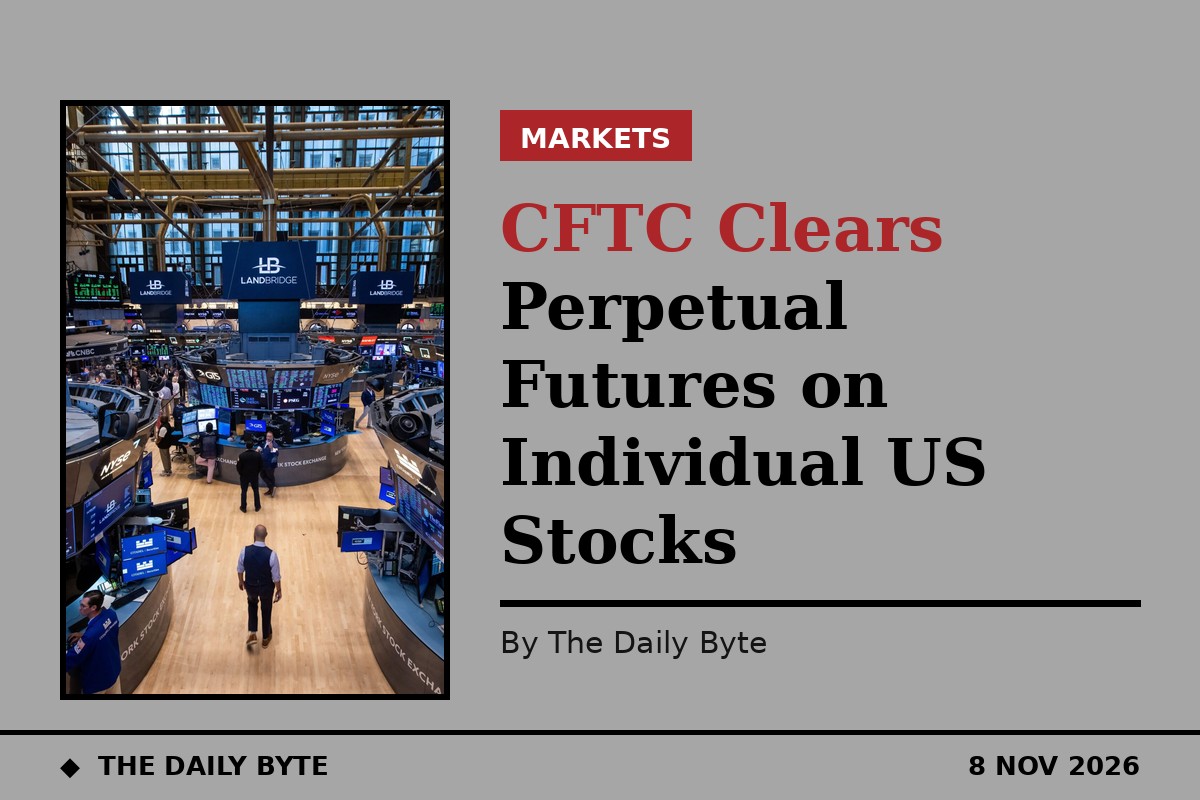
The US Commodity Futures Trading Commission (CFTC) has cleared perpetual futures tied to individual stocks for trading on regulated American exchanges, bringing one of crypto trading's defining products into the mainstream equity market. The agency announced the move on Tuesday 3 November 2026.
Perpetual futures track the price of an underlying asset but never expire, so traders can hold leveraged positions indefinitely as long as they meet margin and funding requirements. The structure has long been associated with offshore crypto platforms. Applied to single stocks, it gives investors exposure to a share's price through a derivative contract rather than owning the shares themselves.
CFTC Chairman Michael S. Selig said the contracts, which the agency calls Equity Perps, are deemed approved as security futures products under Regulation 40.3. That classification places them under the joint oversight of the CFTC and the Securities and Exchange Commission, under a framework dating back to the Commodity Futures Modernization Act of 2000.
Only exchanges holding both CFTC registration as designated contract markets and SEC registration as national securities exchanges can list the contracts. No exchange has yet announced a launch date, and the CFTC statement named no venue and listed no contracts.
The market is already taking shape. Coinbase has filed to list single-stock perpetual contracts tied to companies including Apple, Tesla and Nvidia, while Kalshi filed in September for 58 contracts covering major US stocks and exchange-traded funds. Kalshi requires traders to hold collateral worth at least 15.5% of a contract's value.
The decision extends the CFTC's approval in May 2026 of Kalshi's BTCPERP, the first bitcoin perpetual future on a regulated US exchange. Selig has argued that regulated domestic venues can reduce traders' reliance on offshore platforms, where investor protections may be weaker. Critics warn the leverage involved can magnify losses: the Better Markets group cautioned on 2 November that leverage increases losses during sharp market declines. Read the PYMNTS report.