CMA gives McCormick-Unilever until 18 November
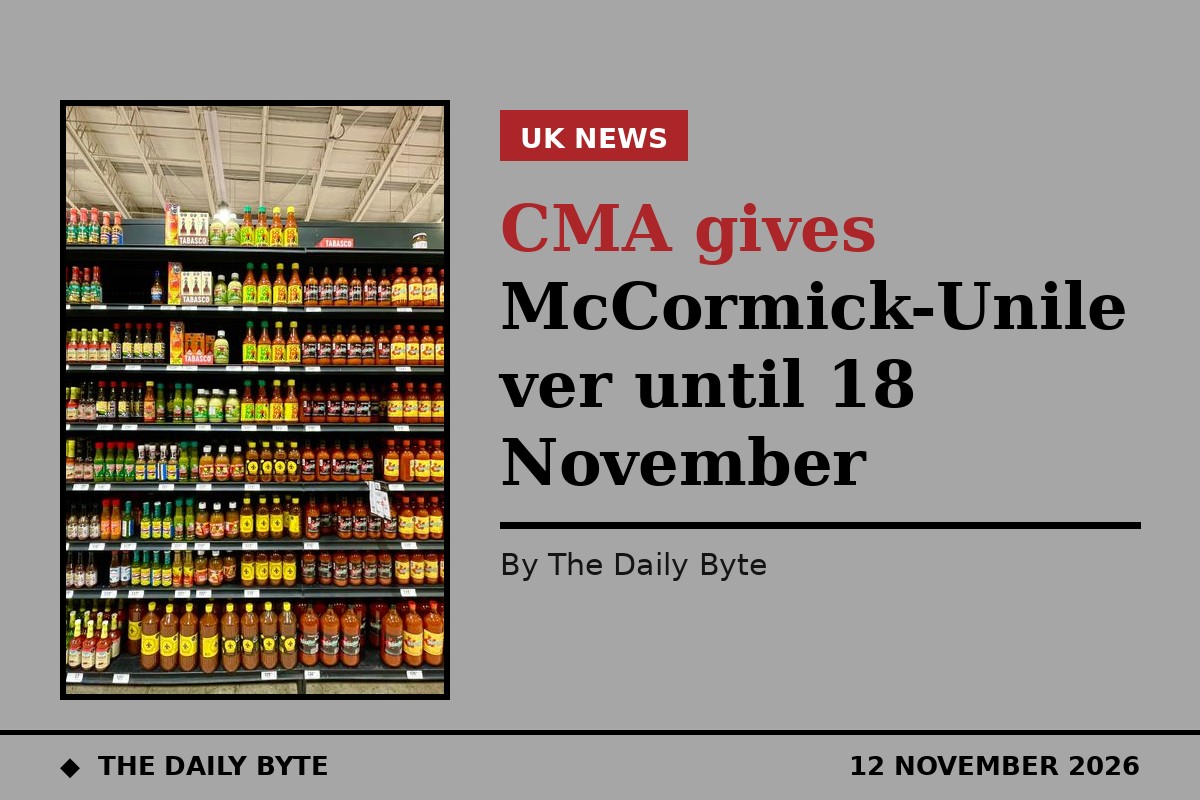
McCormick and Unilever have until 18 November 2026 to offer remedies for their planned food deal, after the UK Competition and Markets Authority (CMA) found the merger could substantially reduce competition in two supermarket categories. If they offer no acceptable remedy, the deal will be referred for an in-depth Phase 2 investigation.
The CMA published its Phase 1 decision on 11 November 2026. It said there was a realistic prospect of a substantial lessening of competition in the supply of dry ingredient mixes and dry sauces to UK retailers, and that the companies had until 18 November to offer undertakings in lieu of a reference to Phase 2.
What the CMA found
The concerns centre on two separate product categories sold to retailers in the UK: dry ingredient mixes, such as chilli con carne mixes, and dry sauces, such as parsley sauce. In both categories, the CMA said the deal would bring together the two largest branded suppliers, leaving the combined company by far the largest supplier in each.
McCormick sells dry mixes and sauces in the UK under the Schwartz brand, alongside condiments under French's. Unilever's food brands include Knorr, Colman's and Maille. The CMA said the two companies were particularly close competitors in dry mixes and dry sauces, and that rival brands would impose only a limited constraint on the combined group.
Among the rivals the CMA considered were Nestle's Maggi range in dry ingredient mixes and Premier Foods' Bisto brand in dry sauces. The regulator concluded that neither private-label products nor those branded rivals would be enough to offset the position the merged business would hold.
The CMA cleared the deal in a third category it examined. It found no realistic prospect of competition concerns in mustard, where it treated American, English and French-style products as separate markets with no overlap between the companies.
The deal and the deadline
McCormick announced in March 2026 that it would buy most of Unilever's global food business, including Knorr and Hellmann's, in a deal valued at $44.8 billion. The transaction is expected to close by mid-2027, subject to McCormick shareholder approval and clearance from competition authorities, including the CMA.
The CMA said it had jurisdiction to review the combination because the UK turnover of both McCormick and Unilever Foods exceeds £100 million. It opened its Phase 1 inquiry on 16 September 2026, after inviting public comments between 21 July and 5 August.
The 18 November deadline is the next key date. The companies must offer undertakings, formally known as undertakings in lieu of reference, that address the CMA's concerns. If no undertaking is offered, or the CMA finds the proposal insufficient, the watchdog will refer the transaction for a full Phase 2 investigation, which would examine the deal in much greater depth and take considerably longer.
What the companies have said
Unilever said the Phase 1 decision was an expected step in the regulatory process and that it was working constructively with the CMA on a suitable remedy. The company also told Reuters that it had decided to sell the Colman's brand and assets to address potential competition concerns, according to reports of that statement.
That reported decision does not by itself settle the matter. A sale of Colman's would still need to form part of a formal remedy offered to the CMA, and the regulator would need to accept it as sufficient to address its concerns in the two affected categories. Until the companies put a formal proposal to the CMA, the outcome remains open.
What it means for shoppers
The Phase 1 decision does not itself change what is on supermarket shelves, and it does not change current listings or supply terms. Dry mixes and sauces from Schwartz, Knorr and other brands remain on sale as before while the regulatory process continues.
The CMA's concern is about the future structure of the market: with the two largest branded suppliers combined, the regulator fears there would be too little competition to keep prices and choice in check for retailers, and ultimately for shoppers. That is the question a remedy, or a Phase 2 investigation, will have to answer.
If the companies offer a remedy the CMA accepts by 18 November, the deal can proceed without a Phase 2 referral. If not, the deeper investigation will begin, and the timetable for completing the $44.8 billion transaction will slip. Either way, the decision published on 11 November is not a decision to block the deal. It is a finding that, on the evidence so far, the merger raises competition concerns that must be addressed first.