Crewe Sect Raid: 41 Child Care Cases Before Family Court
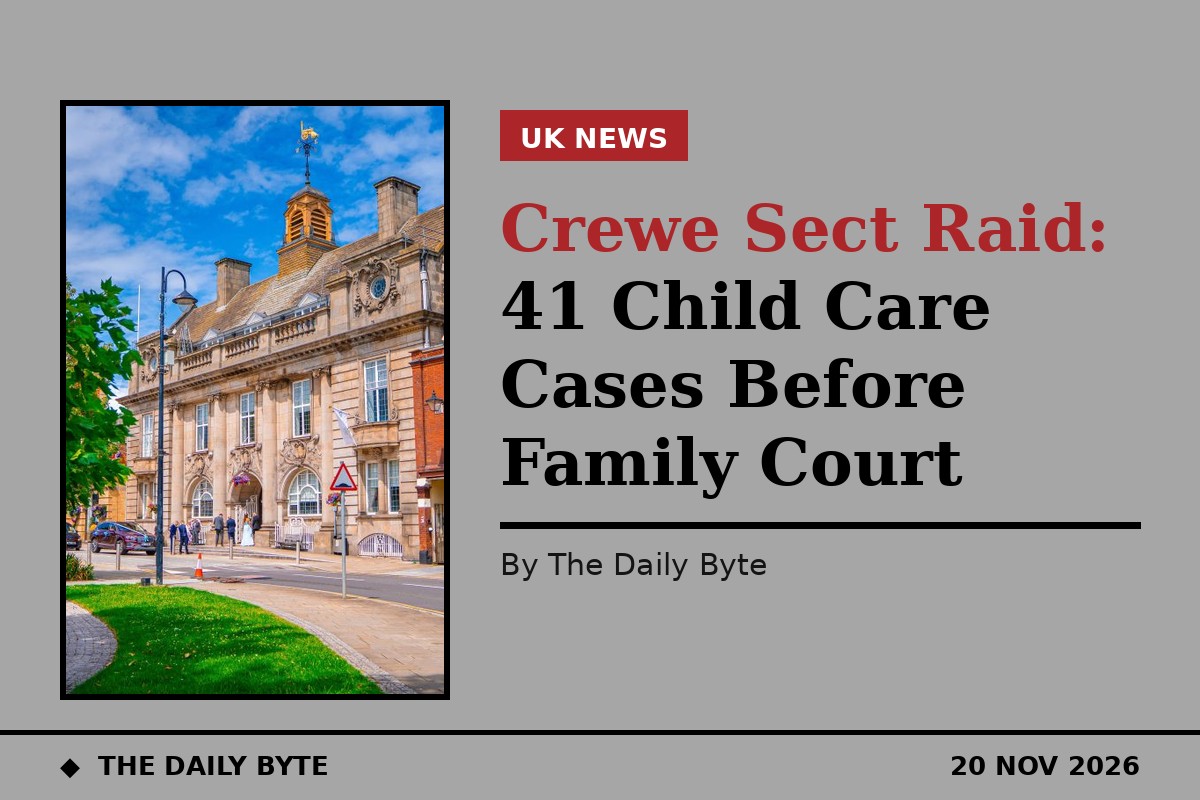
Family courts are dealing with 41 cases involving children who lived at the headquarters of a religious group in Crewe that was raided by police in April, newly published court rulings have revealed.
The cases concern children found living at Webb House in Crewe, the headquarters of the Ahmadi Religion of Peace and Light (AROPL). The details emerged in judgments from Mr Justice Hayden in the Manchester family court, published on Tuesday 17 November.
Cheshire Police raided the site in April as part of an investigation into allegations including forced marriage and modern slavery. Fourteen people were arrested on suspicion of offences including human trafficking, serious sexual offences, rape, forced marriage and modern slavery. One person was later released with no further action, and 13 people remain on conditional bail.
What the court heard about the children
Interim care orders were made for children living at Webb House, giving Cheshire East Council shared parental responsibility while proceedings continue. The judge said the "overwhelming majority" of the children remained living with a parent or other family member, and none of them still lives at the group's headquarters.
Council representatives told the court that conditions in the dormitories where the children were reported to have lived were neglectful, with dirty bedding observed, and that CCTV cameras had been found inside the children's dormitories. They also raised concerns about the children's education, saying most of them were home schooled through computer screens rather than attending a formal school. Knives and a sharps bin were recovered during the raid.
The council alleged the children faced risks of significant harm involving modern slavery, forced marriage, unsuitable living conditions, lack of access to medical help, weapons and violence.
The judge's ruling
In a ruling handed down in June and published this week, Mr Justice Hayden dismissed an application by the mother of two children previously living at Webb House to discharge the interim care orders relating to them.
The mother told the court that members of the group "choose to live together and share resources" and that she felt she was "being dictated how I am to live my life and who is able to live with me". The judge described those arguments as "tendentious and manipulative" and said returning the children to Webb House was "simply not a sustainable proposition".
He said the issues raised by the case "have not been heard in the family courts before", adding: "Modern slavery and people trafficking are new challenges for this jurisdiction." He stressed that, at this stage, the matters before the court are allegations, not proven facts, and that "the position may very well change, in relation to some of the children, as the police investigation proceeds".
Why the judgments were published
Representatives for the families had opposed publication of the rulings, arguing it could renew hostility towards the community and expose children and parents to harm or public disorder. Media organisations, including The Guardian and the Press Association, opposed the attempt to block publication.
In a second ruling, also published on Tuesday, Mr Justice Hayden said publication was in the public interest. "There can be little doubt, to my mind, that it is in the public interest to be informed that protective and safeguarding measures have been taken to protect potentially vulnerable children," he said. "Openness is intrinsic to maintaining public confidence in the administration of justice within the family court."
A family lawyer not involved in the proceedings said the scale of the litigation had rarely been seen before, and the cases account for almost one in 20 of the care cases currently before the family court in Manchester. The group, which moved to Crewe in 2021, is separate from the Ahmadiyya Muslim Community. Cheshire Police has stressed that its investigation concerns individual people rather than the group as a whole. The family court cases are expected to take months to resolve.
Sources: World Right Now, reporting from The Guardian; the BBC also reported the 41 cases and the judge's rulings.


