CVE-2026-135208: Kerberos Agent Flaw Forges Admin Tokens
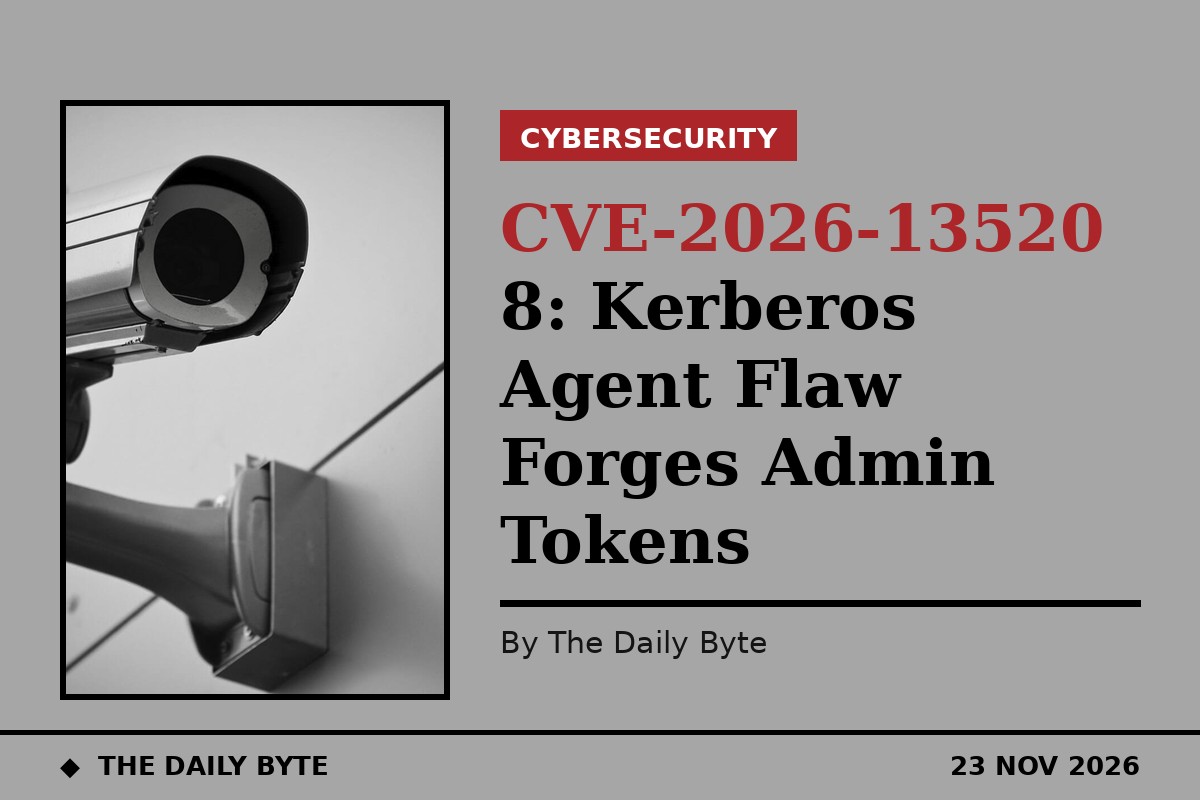
A hard-coded signing key in Kerberos Agent, an open-source video surveillance agent, lets an unauthenticated attacker forge administrator tokens and take full control of the software. The flaw, tracked as CVE-2026-135208, affects all versions before 3.14.4 and is fixed in that release.
The CVE record was published on 23 November 2026. The vulnerability was disclosed in a GitHub security advisory, GHSA-3c52-7fc8-c39j, and the CNA VulnCheck scores it 9.3 under CVSS 4.0.
A key anyone can read
Kerberos Agent protects its REST API with a JWT bearer-token check. The signing key comes from the AGENT_JWT_SECRET environment variable, but when that variable is not set the software falls back to the literal string "TOBECHANGED". The advisory notes that none of the project's own deployment manifests, for Docker Compose, Kubernetes, Snap or Balena, set the variable, so a default deployment signs and verifies every token with a key that is published in the source tree.
That makes the forgery straightforward. An attacker who can reach the agent over the network can sign their own token with the known key, claim any username and the administrator role, and pass the API's checks with no credentials and no user interaction. The server binds to all network interfaces on port 80 by default, and the published Docker Compose examples map it to host ports, so the API is reachable from off the host in a default deployment.
The researcher who reported the flaw proved it with a working test. Requests with no token, and with a token signed by the wrong key, were both refused, while a token forged with the "TOBECHANGED" key was accepted and returned the agent's full configuration, including its agent key.
What an attacker gains
A forged administrator token reaches every authenticated endpoint. With a camera configured, the same access exposes stored camera credentials, including RTSP and ONVIF details, Kerberos Hub keys and the recording encryption key. It also reaches state-changing endpoints, so an attacker could rewrite the configuration, re-point the camera, use its pan, tilt and zoom controls, or stop the camera and the recording altogether. The advisory describes the result as complete takeover of the surveillance agent, with confidentiality, integrity and availability all lost.
The advisory also notes that the default login credentials are root and root. Changing the password alone does not close this flaw, because forging a token bypasses the login entirely.
What to do
Upgrade Kerberos Agent to version 3.14.4 or later, and set AGENT_JWT_SECRET to a strong, randomly generated value that is unique to each deployment. Until the upgrade is done, restrict network access to the agent's API and configuration interfaces so only trusted hosts can reach them. Any credentials stored in an exposed agent, camera logins, Hub keys and the recording encryption key, should be treated as compromised and rotated.
The advisory does not report exploitation in the wild; it presents the flaw as a researcher-disclosed issue with a verified proof of concept. Even so, a published key is a published key: any deployment still running with the default is open to anyone who reads the advisory. The full disclosure is available on GitHub.