DfE accounts flag attendance and AI as risks
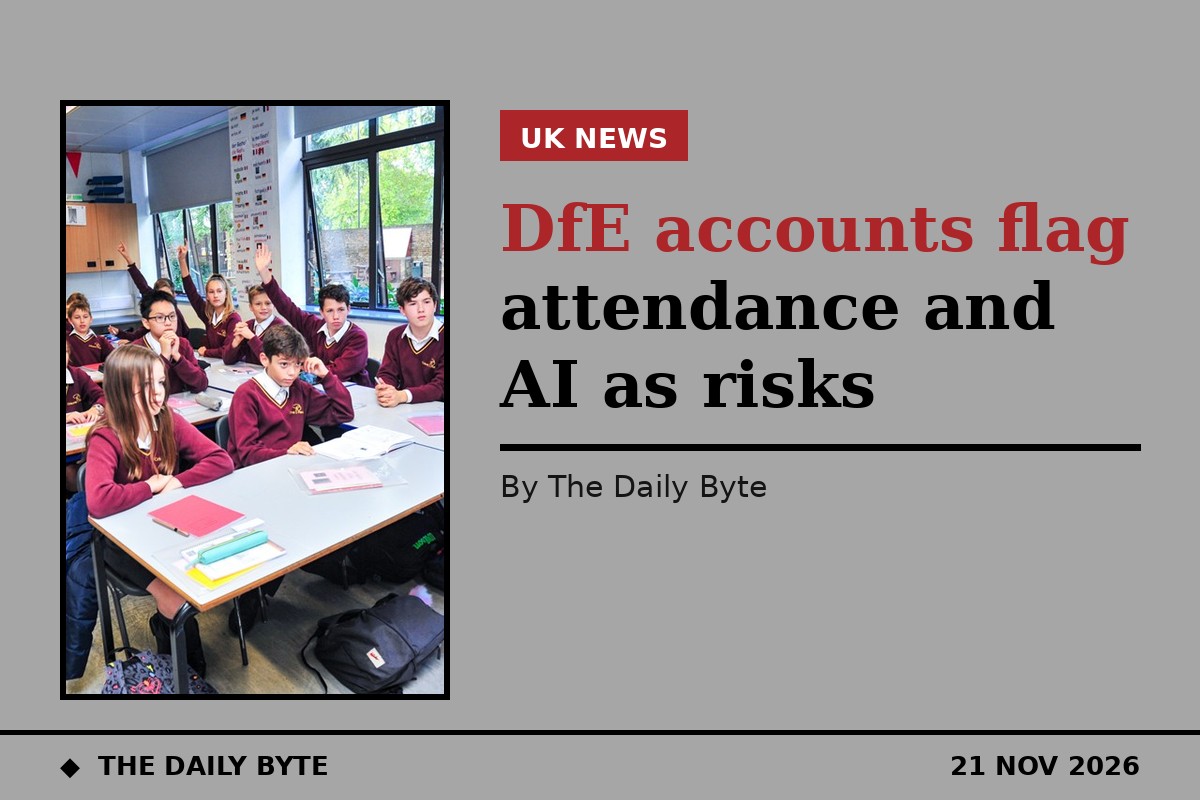
The Department for Education has named school attendance and artificial intelligence as key risks in its long-delayed annual report and accounts, published on 19 November.
The accounts, which cover the year to 31 March 2026 and were laid before Parliament as HC 413, are usually published in July. The department's own review of the year says attendance "remains below pre-pandemic levels" and calls it a "major issue".
Officials put the problem down to "inconsistent attendance management, shifts in attitudes, unmet mental health and SEND needs, and wider economic pressures on families". The department says its reform programme has strengthened attendance systems, with clearer guidance, better data sharing and extra resources.
AI risk rated critical
The risks from artificial intelligence were rated "critical - possible", with the department fearing the "rapid development" of the technology could "exceed the education system's capacity to respond effectively". It says it is piloting and evaluating AI tools, strengthening data protection and governance, and "pursuing AI's potential to improve productivity, strengthen decision-making and support innovation through disciplined investment and responsible adoption".
The accounts also contain the department's first assessment of the physical risks of climate change to the school estate, warning of overheating and flooding. The department estimates that 11.4 "learning days" could be lost each year to "chronic indoor overheating", and warns that the cost of preparing for a net zero energy system and adapting to climate change could hamper the bodies responsible for delivering services.
Severance payouts and written-off debts
The accounts reveal that former education minister Catherine McKinnell received a £7,920 severance payment and former children's minister Janet Daby £5,593 after leaving their roles in a reshuffle last September. Ministers receive severance payments when they leave office, whether they resign, are sacked or lose their seats.
Special severance payments to employees and contractors who resign, are dismissed or reach an agreed termination fell from 23 to 12, totalling £614,559 against £1,299,000 the year before. The largest single payment was £136,360.
The department also wrote off £2.9 million of debt owed by The Schools Company Trust, which had launched legal action in 2021 with the department's backing to recoup £2.8 million in alleged losses from six former trustees. Reach South Academy Trust had £522,000 written off after a pupil number adjustment loan for Parkfield School in Bournemouth was cancelled following the school's closure. A further £394,000 was listed as a fruitless payment for Pudsey Grammar School after a post-16 capacity fund project was withdrawn.
Breaches, slow replies and a moderate audit opinion
Three personal data breaches were serious enough to be reported to the Information Commissioner's Office, involving ransomware, personal data shared incorrectly and data emailed to the wrong person. That is down from five in 2024-25 and eight in 2023-24, but non-reportable breaches rose to nearly 300, most commonly emails sent to the wrong person.
Replies to correspondence also slowed. Only 60 per cent of ministerial correspondence was answered within the 20-working-day target, against a 95 per cent target, after volumes rose 23 per cent. Freedom of information requests answered on time fell to 83 per cent from 86 per cent, with volumes up 6.9 per cent.
Costs in the department's regions group, which replaced the regional schools commissioners in 2021, fell from a record £275 million to £208 million. The Government Internal Audit Agency gave the department a "moderate" opinion, meaning some improvements are needed, but said it had "maintained an adequate system of governance, risk management and internal control". It gave "limited assurance" over two areas: oversight of lower tier investments and progress in moving pension administration from Capita.


