Essar fined £800,000 over Stanlow pollution
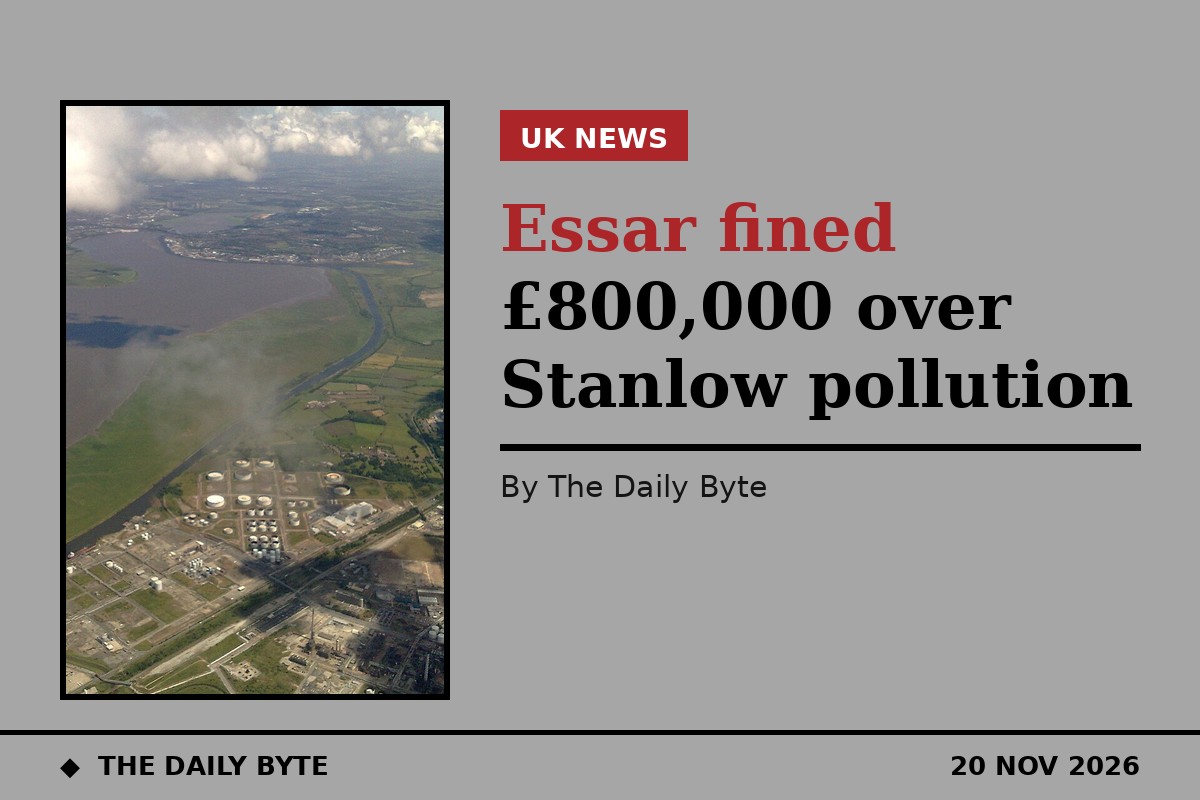
Essar Oil (UK) Limited has been fined £800,000 after breaching wastewater permit limits at its Stanlow refinery at least 489 times over a three-year period.
The company was ordered to pay £873,473 in total at Warrington Magistrates' Court, comprising the £800,000 fine and £73,473 in prosecution costs, after pleading guilty to 12 charges brought by the Environment Agency. The sentencing hearing took place on Wednesday 19 November.
The breaches took place at the Stanlow Manufacturing Complex in Ellesmere Port, Cheshire, between January 2018 and December 2020. Ten of the charges related to the refinery exceeding permit limits for discharges to water, including trade effluent containing suspended solids, oil and chemicals including cyanide.
489 breaches in three years
The affected water was pumped into Thornton Brook, the River Gowy and the Manchester Ship Canal. Environment Agency officers who visited the site several times reported a silver sheen of oil on the watercourses, and in January 2020 vegetation downstream of the refinery's discharge point was found black with oil.
Essar pleaded guilty to all 12 charges on 11 March 2026 and received credit for its early plea. The court fined the company £80,000 for each of 10 offences, with no further separate penalty for two further charges relating to separate incidents in 2019.
The company also asked the court to take three further offences into consideration, relating to similar breaches of the permit's emission limits in 2022 and 2023. Those offences were dealt with but received no further punishment.
Two serious incidents in 2019
Two of the charges related to separate incidents in 2019 which saw up to 20 tonnes of chemicals and 15 tonnes of sewage leak into watercourses leading to the protected Mersey Estuary.
In February 2019, between 15 and 20 tonnes of a chemical used to remove hydrogen gas leaked into the drainage system and out into the ship canal. Investigations found that a vent had been left open and a written procedure had not been followed, in what the company itself called “a conscious deviation from operating procedures”.
The following month, a contractor's vehicle reversed into an effluent pipe, causing a rupture. During repairs to the pipe, which took until April to complete, around 15 tonnes of partially treated sewage was discharged into Thornton Brook, which leads to the Mersey Estuary. The person responsible was banned from the site, and investigators found that vehicle risks had not been properly assessed.
The Mersey estuary is protected under several conservation designations, including as a Site of Special Scientific Interest and a wetland of international importance. It supports bird and fish migration routes.
“Repeated failure to comply”
Nigel Glasgow, Area Environment Manager at the Environment Agency, said oil refineries were among the largest industrial facilities the agency regulates, and operated under environmental permits designed to protect rivers, seas and wildlife.
“This case demonstrates a repeated failure to comply with those permit conditions, with at least 489 exceedances over a three-year period. Operators have a fundamental responsibility to properly manage their sites, and where they fail to do so we will hold them to account.”
He added that the agency would continue to regulate the facility rigorously, investigate breaches and take enforcement action where necessary.
The refinery operates under an environmental permit issued by the Environment Agency, which sets limits on what can be discharged into surface water. The company, which now trades as EET Fuels, has previously said it takes its environmental responsibilities seriously and that its environmental performance and governance have improved since the historical breaches.


