Ethiopia Denies Sudan Drone Claims in UN Reply
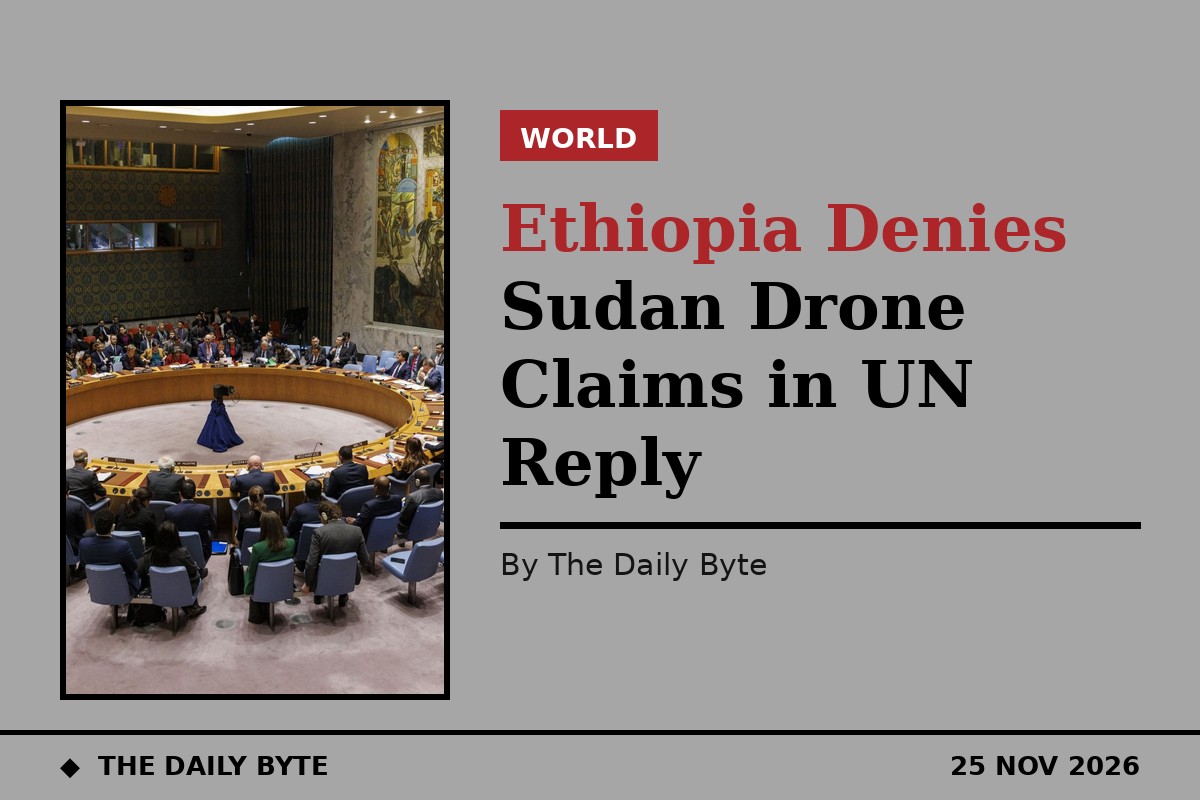
Ethiopia has formally answered Sudan's complaint to the UN Security Council over alleged drone attacks, denying that its territory was used to launch strikes inside Sudan and calling the accusations baseless. Sudan Horizon reported on Wednesday, 25 November, that Addis Ababa submitted its official response in a letter from Ethiopia's Permanent Representative to the United Nations.
The reply answers a Sudanese complaint dated 30 October, registered with the Security Council as document S/2026/872, in which Khartoum invoked Article 51 of the UN Charter — the right to self-defence — and accused Ethiopia of facilitating drone attacks on Sudanese soil and supporting the paramilitary Rapid Support Forces (RSF). Ethiopia's response, circulated as document S/2026/892 and dated 6 November, rejects the claims as unfounded.
Addis Ababa's letter also turns the accusation around, alleging that Sudan has supported Ethiopian armed opposition groups, including formations linked to the Tigray People's Liberation Front (TPLF), and expressing concern about the repercussions of the tension for security and stability in the Horn of Africa.
What Sudan alleged
Sudan's army-led government lodged formal complaints with the Security Council and the African Union's Peace and Security Council in early November, saying RSF drones had been launched from Ethiopian territory against Sudanese power infrastructure and civilian sites. Khartoum named three alleged launch sites — Asosa airport in western Ethiopia, the Kurmuk-Gizen border area and the Bahir Dar air base — and cited a tally of about 70 drone attacks involving 187 one-way munitions between 15 February and 27 October, which it said killed or wounded 484 civilians. Neither government's claims have been independently verified.
Ethiopia has denied the accusations from the start and counter-accused Sudan's army of backing Tigrayan armed groups, a charge Khartoum denies. The row has already had diplomatic consequences: on 4 November the two countries closed each other's consulates near their shared border and expelled diplomatic staff, with Ethiopia shutting Sudan's consulate in Asosa and Sudan closing Ethiopia's consulate in Gedaref.
A wider diplomatic rift
The exchange comes as relations between the neighbours have deteriorated sharply. Sudan's government on 25 November also rejected Prime Minister Abiy Ahmed's offer to host an inclusive Sudanese dialogue in Ethiopia, saying Addis Ababa could not be considered a neutral mediator. The RSF-aligned administration and a civilian coalition led by former prime minister Abdalla Hamdok welcomed Abiy's initiative.
The dispute also sits inside a wider regional alignment. Foreign ministers of Egypt, Eritrea and Sudan met in Aswan on 21 November, weeks after their leaders met at El Alamein, and Ethiopia has accused Sudan of cooperating with forces seeking to undermine its government — claims that form part of its Security Council reply.
Neither the Security Council nor the African Union's Peace and Security Council has announced when, or whether, it will formally take up Sudan's complaint. For now, the formal exchange of letters leaves both governments' accusations on the UN record, unresolved, while the war in Sudan and the renewed fighting in northern Ethiopia continue. Sudan Horizon first reported Ethiopia's formal reply, and Abren confirmed the two UN documents and their dates.