Europe agrees principles for Ukraine peace talks role
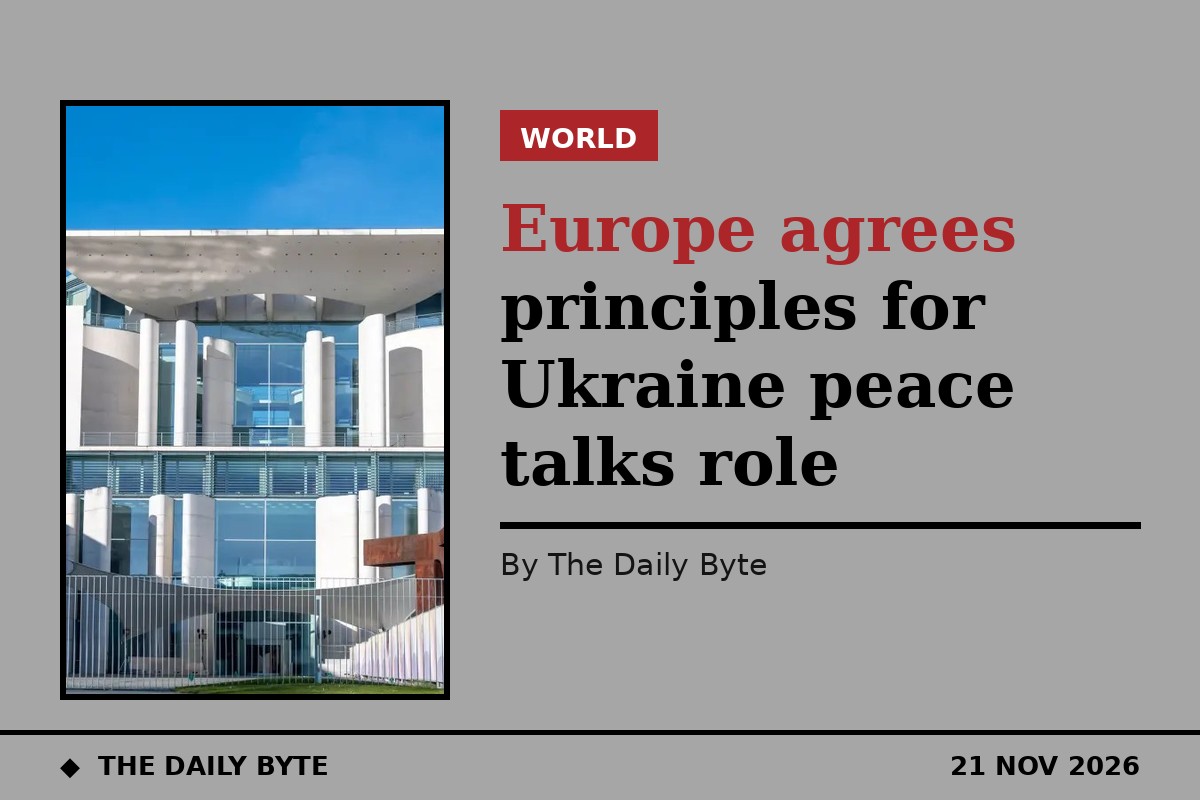
European leaders have agreed a set of shared principles for Europe's participation in talks to end the war in Ukraine, after a meeting of the Coalition of the Willing in Berlin on Thursday 19 November. German Chancellor Friedrich Merz, French President Emmanuel Macron, British Prime Minister Andy Burnham and Ukrainian President Volodymyr Zelenskyy set out the position in a joint statement on Friday 20 November, following talks that also involved the United States' special envoys.
The statement marks Europe's clearest attempt yet to secure a seat at negotiations that Washington has so far led. It follows a trilateral meeting in Shenzhen, China, between US President Donald Trump, Russian President Vladimir Putin and Chinese President Xi Jinping, which European leaders feared could settle Ukraine's future without them. Trump joined the Berlin meeting by telephone from Air Force One, and his envoys Steve Witkoff and Jared Kushner attended in person.
What the leaders agreed
The leaders backed direct dialogue between Ukraine and Russia, with the participation of the United States and European countries, and said the talks should take place in the near future. A source at the French presidency said working groups had been set up with Poland, Italy, the European institutions and NATO so that all sides could speak with one voice in the next round of negotiations.
The first priority, the leaders said, remains ending the hostilities. As a first step towards that goal, they called on Russia to agree to a ceasefire applying to energy infrastructure for the duration of the winter. Any agreement on wider European security issues would not be conceivable while Russia continued its war of aggression, they added.
On territory, Merz said the starting point for any agreement needed to be the line of contact. Ukraine must be able to continue on its European path and count on support for its reconstruction, the leaders said, while a gradual and conditional lifting of sanctions imposed on Russia could be considered in return. Any elements of a negotiation related to the European Union or NATO would need the consent of EU member states and NATO allies respectively.
Security guarantees on the table
Kushner sought to reassure European allies that Washington wanted Europe at its side in any peace deal. He said Trump was open to security guarantees for Ukraine modelled on Article 5, NATO's mutual defence clause, and that Russia had become comfortable with the idea. Any such guarantee would have to form part of a broader security package, he said.
"From America's perspective, giving an Article 5-like security guarantee is a really, really big deal. And I think that that's something that President Trump is open to," Kushner said. He added that the Berlin talks had made a lot of progress on what those guarantees could look like, as well as on a post-war prosperity plan for Ukraine.
Macron went further, saying the question of Ukraine joining NATO was relevant for European security, given the strength and equipment of its army. "I think we must reopen the question of Ukraine's membership to NATO," he told reporters after the summit.
Scepticism remains
Not all leaders shared the optimism. Polish Prime Minister Donald Tusk said he did not expect Russia to negotiate seriously before winter ends, adding: "Mr Putin is not our friend and will never be." Zelenskyy said Europe must be part of peace negotiations from now on, and noted that Putin had rejected every proposal so far. "Putin has always said no," he said.
Merz dismissed the Shenzhen meeting as above all a photo opportunity and warned against a great-power carve-up of Europe. "A 'Yalta' format will not bring peace," he said, holding a piece of the Berlin Wall as he spoke. Putin had invited European officials to Moscow for preliminary talks, but the European leaders insisted any dialogue must take place on neutral ground, with a search under way for a venue.
The fighting, meanwhile, has not paused. As the leaders met, Russian daytime drone attacks on Kyiv killed at least one person and injured five others, according to the city's mayor, damaging the Dutch and Austrian embassies, Saint Volodymyr Cathedral and a residential building. The European Commission has also proposed a 45-billion-euro loan to help cover Ukraine's funding needs in 2027, as leaders prepare to discuss sanctions and financing at the European Council summit on 26 and 27 November.