Lula nears finance minister pick as Alckmin leads
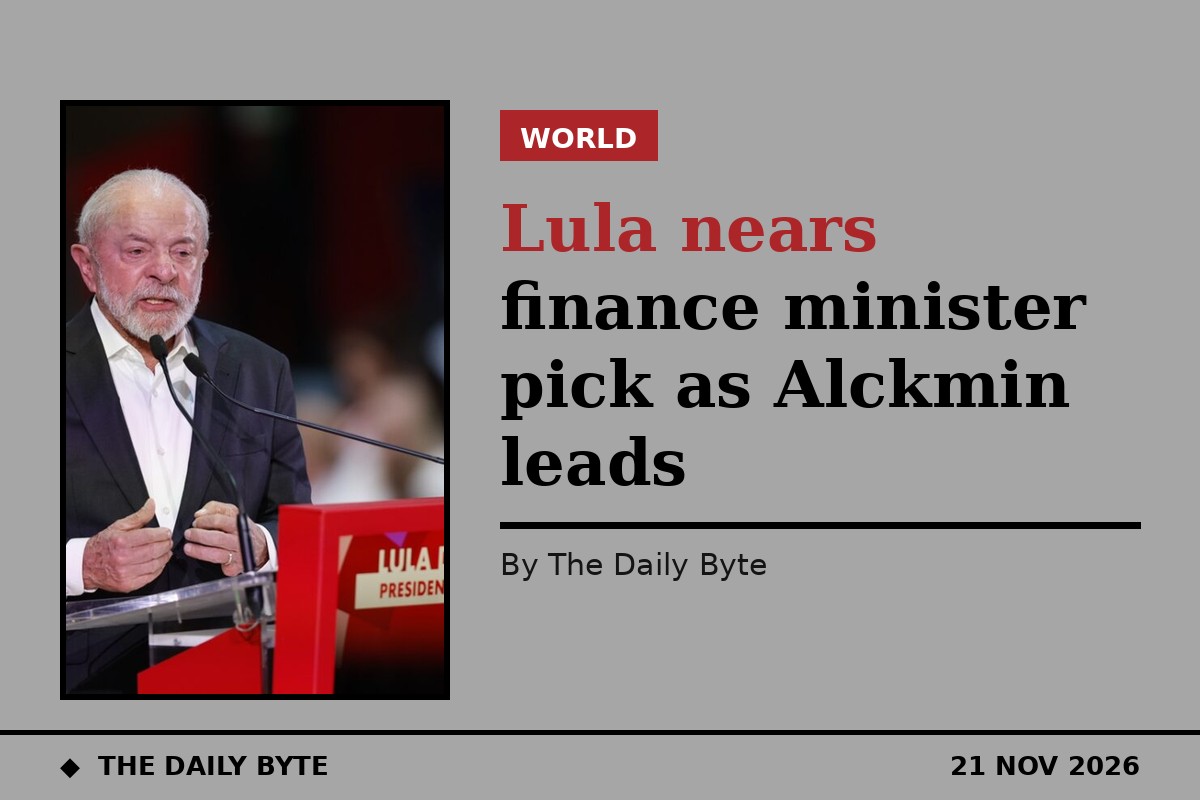
Brazil's President Luiz Inacio Lula da Silva is getting closer to naming his next finance minister, with a decision possible next week, according to six people familiar with the discussions.
The leading contenders are Vice President Geraldo Alckmin and Rafael Fonteles, the re-elected governor of Piaui state. Both men are seen as steady hands, but they would come to the job from very different positions, and each carries a complication for the president.
Fonteles, a trained mathematician, has won favour in financial markets for the fiscal policies that helped balance the accounts of Piaui, one of Brazil's poorest states. His name has gained momentum in recent days after a quieter period spent forming his second-term government in the state.
Alckmin also remains a strong contender. Allies say public finance reforms led by him would carry extra weight given his reputation as a fiscal conservative, a quality Lula's critics have questioned in the president himself.
Each contender also carries a complication, since a vice president or a newly elected governor would be difficult for Lula to remove if the choice went wrong.
Markets watching the choice closely
Brazilian assets have sold off sharply since Lula won re-election on 25 October, in part because of investor worry about the outlook for public finances, which has raised the stakes around the appointment.
The Ibovespa, Brazil's main stock index, fell 13.88 percent on Monday 26 October, the first trading day after the runoff, and the commercial dollar rose 8.21 percent to R$5.40. By Thursday 19 November the index stood at 166,376 points, after losing 3.53 percent that week, while the dollar closed at R$5.932, its highest close since 8 April 2025.
Lula won the 25 October runoff with 51.79 percent of valid votes, beating Senator Flavio Bolsonaro, the son of former president Jair Bolsonaro, by 64,256,232 votes to 59,826,041, according to the electoral court. He begins his fourth term on 5 January 2027.
The finance decision is not the only test of Lula's promise to be responsible with public money. On 11 November Senator Jaques Wagner of the Workers' Party filed a fiscal package that Planning Minister Bruno Moretti says would save R$50 billion to R$60 billion in 2027. Lula reaffirmed his commitment to fiscal responsibility in a national address on 8 November, and the Senate approved the package by 69 votes to 2 on 18 November. The lower house has it on the agenda of an extraordinary session on Monday 23 November.
Lula warns he will choose on his own timetable
The sources said Lula has told the current finance minister, Dario Durigan, that he probably will not stay in the job. Durigan remains in post: as of 20 November no new minister had been named.
The president has also grown irritated by press speculation about his cabinet, telling aides on Thursday that each ministry will be appointed by him, when he wants, on the day he wants, and that no one will appoint anyone through the press. On 19 November he said publicly that he will name each minister on the date he wants and is in no hurry.
The finance decision is part of a wider cabinet puzzle that includes the next chief of staff, a role that could lead to a run for president in 2030, and the leadership of a public security ministry Lula considers central to his final term. Former ministers say the full line-up may take a while, noting that in 2022 he announced most of his cabinet on 27 December, days before taking office.
Whoever gets the finance job will inherit an economy under close market scrutiny and a government trying to prove that its spending plans add up. The choice will be read as the clearest signal yet of how Lula intends to run the economy in his fourth term.