Facial recognition errors risk wrongful arrests in UK
Police officers risk arresting innocent people, especially from ethnic minorities, if they treat inaccurate facial recognition results as evidence, an official report has found. His Majesty's Inspectorate of Constabulary and Fire and Rescue Services (HMICFRS) published the report on Wednesday 11 November 2026, warning that some investigators did not understand the limits of the technology they were using.
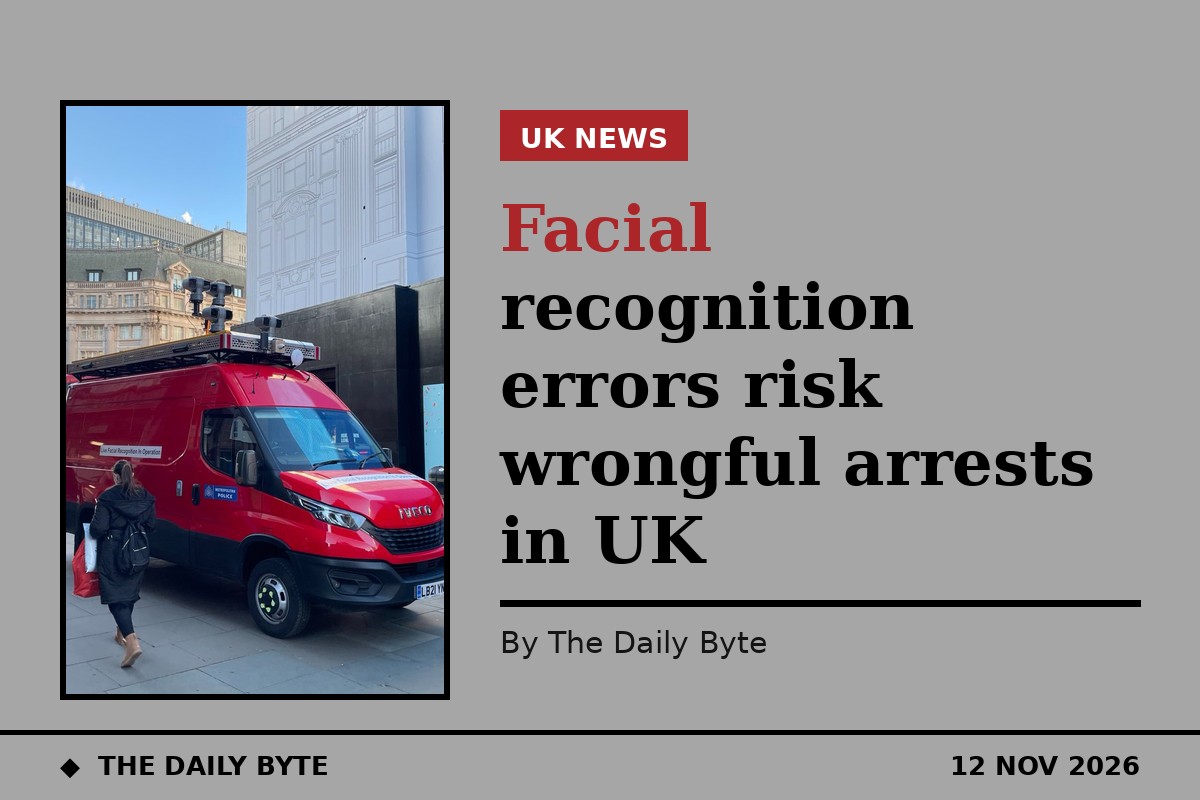
The report covers only retrospective facial recognition, known as RFR. That is the use of the technology after an incident, when an image from CCTV or another source is searched against custody images to try to identify a suspect. It is different from live facial recognition, which scans faces in real time as people pass a camera. The photograph with this article shows a live facial recognition van in London; the report itself is about the retrospective searches carried out after a crime.
Intelligence, not evidence
Inspectors found that some investigators did not know that RFR results were intelligence rather than evidence, and that further enquiries were required before officers took enforcement action. The report said: "Some investigators didn't know that RFR results were intelligence rather than evidence and required further enquiries before officers took enforcement action."
In a small number of cases, officers relied too heavily on RFR results, which led to inappropriate investigative action, inspectors found. "We found that some investigators didn't always carry out enough corroborative enquiries before acting on potential matches," the report said. "In a small number of cases, officers relied too heavily on RFR results, which led to inappropriate investigative action."
The report also found problems with the quality of the images fed into the system. Auditors identified cases where users uploaded poor-quality or unsuitable probe images, including blurred images and images containing multiple faces. Those weaknesses reduce the reliability of any match the system returns.
Bias and deleted images
On bias, the report said there are still issues with the algorithm, including a greater likelihood of wrongly flagging people from ethnic minorities as suspects. "More needs to be done to reduce the risks of people being wrongly arrested," inspectors said. That finding is the most serious in the report, because a wrong match that is acted on without further checks can lead directly to an innocent person being arrested.
Inspectors also found that custody images that should have been deleted were kept, undermining public confidence in how the technology is managed. And they found that the law has not kept pace with the technology. "Inspectors found that legislation hasn't kept up with changes in facial recognition technology and there is no comprehensive statutory framework governing this technology's use," the report said.
Reaction to the findings
His Majesty's Inspector of Constabulary Kathryn Stone said continued public support for the technology relied on showing that it was being used properly. Campaigners were more direct. Jasleen Chaggar, from Big Brother Watch, said it was alarming that officers were treating facial recognition results as established evidence rather than a probability score.
Ben Russell, the National Police Chiefs' Council lead on facial recognition, said policing remained committed to the ethical, proportionate and responsible use of retrospective facial recognition to help investigate crime, bring offenders to justice and keep communities safe, and that he was pleased HMICFRS had recognised the possibilities of the technology.
The report does not call for retrospective facial recognition to be abandoned. It calls for it to be used as it is intended to be used: as a lead that must be checked against other evidence before anyone is arrested. Until forces can show that every match is verified in that way, the inspectorate's warning stands: treating a computer-generated match as proof risks arresting the wrong person.
Sources: USA News Hub, reporting The Guardian and Briefly, summarising The Guardian.