First AI Guidance for Social Care Published in England
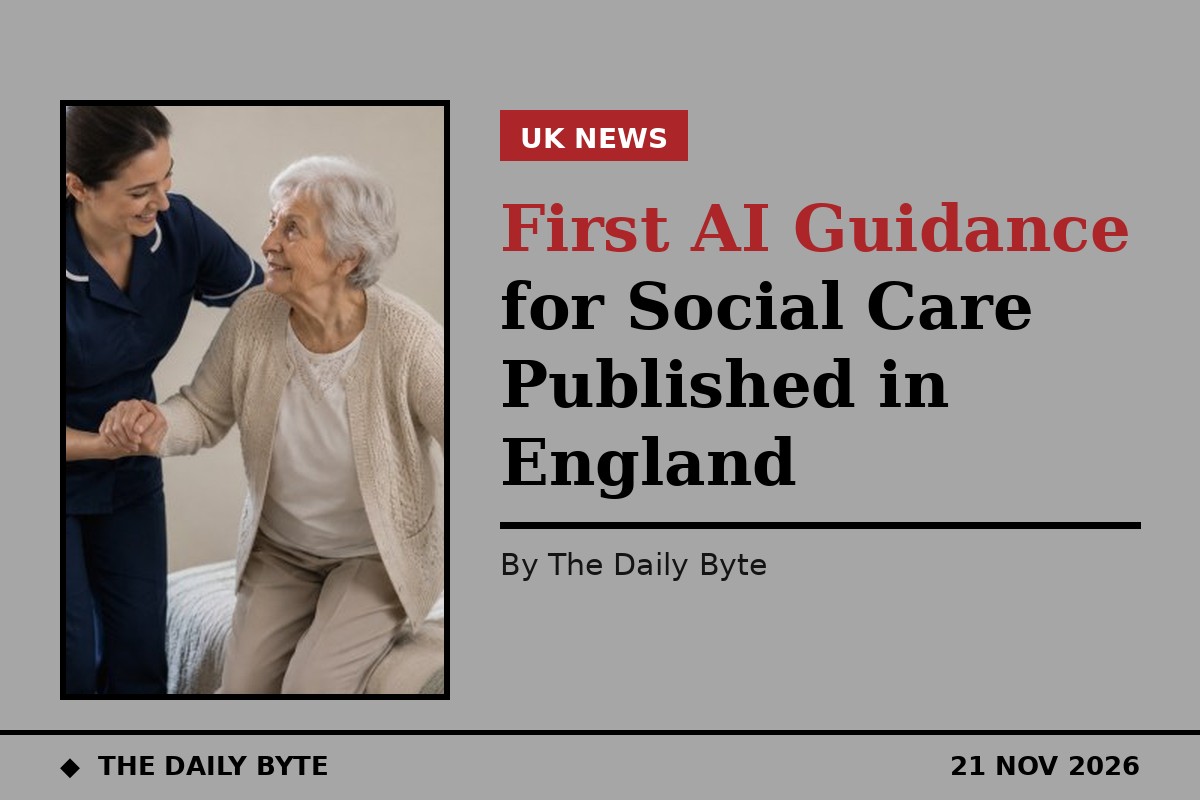
England has published the first national guidance on the use of artificial intelligence in children’s and adult social care, telling councils and care providers what the technology can help with — and what it must never decide. The guidance, published on 20 November by the Department for Education and the Department of Health and Social Care, is the first to cover both children’s and adult services in a single document.
The guidance is non-statutory, which means it does not create new legal duties. Instead it is intended as a single national reference point for leaders, practitioners and organisations deciding how to use AI, setting out principles on governance, accountability, data protection and professional oversight, alongside practical advice drawn from councils already using the tools.
What the guidance says
At its centre are four principles. Practitioners remain responsible for their casework, records and decisions, and should review, challenge and correct anything an AI tool produces. AI should not make decisions that directly affect people, including decisions on safeguarding and intervention. It should be used to improve experiences and outcomes, for example by cutting administration and giving staff more time with people. And personal information should not be entered into publicly available AI tools; only approved tools should be used, in line with data protection rules.
People should also be told when AI is being used in their care and support, and can object to its use. The guidance lists the risks organisations must manage, including bias, inaccuracy and invented content, privacy and security, and automation bias, where staff give an AI output more weight than it deserves.
Early results from councils
The government points to early examples from councils already using AI. A pilot in Swindon Borough Council’s adult social care found that using an AI tool to support social workers delivered a 63% reduction in administrative time. It also cut the average time taken to complete a Care Act assessment conversation from 1.5 hours to 30 minutes, and the time to write up assessments from four hours to 1.5 hours. The tool was particularly helpful for colleagues with visual impairments and those for whom English is not a first language.
Staff at Peterborough council developed an AI assistant called Hey Geraldine, built on the knowledge of an experienced occupational therapist, which answered more than 1,200 questions from staff and saved around 15 minutes per interaction. The government says four in five care providers are now using digital social care records, helping almost 90% of people who draw on care, and it aims for all care providers to be fully digitised by the end of this Parliament.
What AI must not do
The guidance is explicit about the limits. AI should not be used to determine risk, need or safeguarding thresholds, to complete assessments or care plans, or to replace professional judgement. Checking AI-assisted work is not just proofreading: the practitioner quick guide published alongside the main document asks staff to check what a tool has produced, challenge it, add their own professional judgement, and be able to explain and justify the final document and decisions.
Ministers presented the guidance as a way to give carers back time. Alison McGovern, Minister of State for Social Care and Mental Health, said the administrative load and endless paperwork in social care can all too often take the focus away from patients, and that harnessing AI can shift that focus back to caring. Children and Families Minister Josh MacAlister said no technology can replace the knowledge and skill of a brilliant social worker, but by taking away some of the admin, AI can free them up to put those skills where they matter most.
Reaction and what happens next
England’s two chief social workers welcomed the document. Sara McClinton, Chief Social Worker at the Department of Health and Social Care, said AI offers a significant opportunity to improve outcomes in adult social care, while Isabelle Trowler, Chief Social Worker at the Department for Education, called it an important step towards the safe use of AI in social care, keeping practitioners and their professional judgement central.
The departments describe the guidance as a foundation, with further resources to follow. One analysis of the document noted that it does not address where the data used by AI tools is processed or stored, a question councils will still have to answer for themselves. The guidance applies in England and sits alongside existing legal, regulatory and professional requirements.