First Past the Post: How UK Elections Work
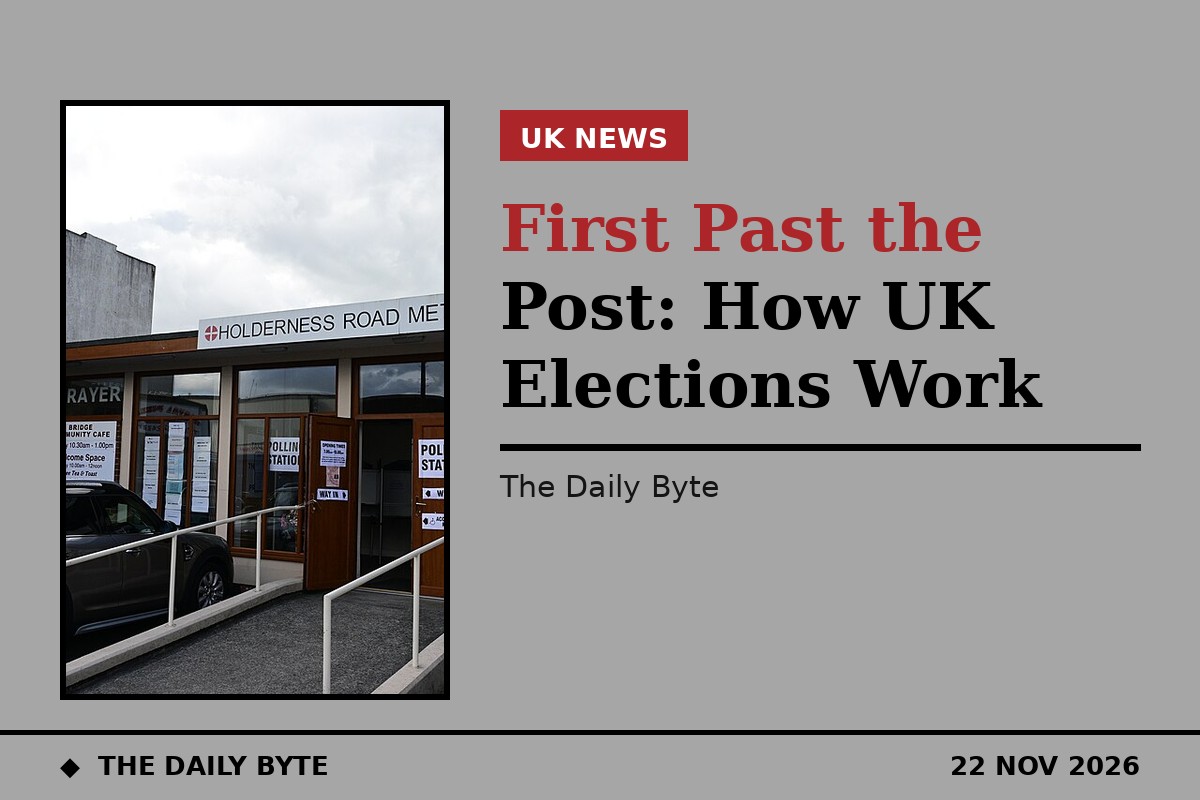
First past the post is the voting system used to elect MPs to the House of Commons. The UK is divided into 650 constituencies, each electing one MP. In each constituency, voters mark one cross next to one candidate, and the candidate with the most votes wins the seat — even if they have far less than half the votes cast.
It is the system behind every UK general election, and it shapes British politics in ways that surprise many voters: a party can win a large majority of seats without winning a majority of votes, and most votes in a general election are cast for candidates who do not win. This guide explains how first past the post works, why it produces those results, and what its supporters and critics say about it.
How first past the post works
First past the post is a majoritarian system: its purpose is to identify a winner, rather than to spread representation across the parties in proportion to their votes. The country is divided into areas known as constituencies. There are 650 of them for elections to the House of Commons, each electing one MP.
On polling day, each voter gets one ballot paper listing the candidates standing in their constituency, and puts a single cross next to one name. The candidate who gets the most votes wins the seat and becomes the MP. Crucially, the winner does not need a majority — more than half the votes. A plurality is enough: the largest single share of the vote wins, however small it is.
The Constitution Unit at University College London gives a simple example: in a constituency where the votes split 35/30/25 between three candidates, the candidate with 35% of the vote is elected, even though 65% of voters chose someone else. A candidate can in theory win by a single vote. The Electoral Commission puts it the same way: “the candidate with the most votes is elected and becomes your Member of Parliament.”
Each constituency is drawn up by an independent Boundary Commission — there is one for England, Scotland, Wales and Northern Ireland — which reviews the boundaries every eight years so that constituencies hold roughly equal numbers of voters. The most recent review was completed in 2023, and under it constituencies must have between 69,724 and 77,062 voters.
How a general election result is decided
In a general election, all 650 constituencies vote on the same day. The national result is simply the sum of the 650 local contests: each constituency winner takes a seat in the House of Commons. The party that wins the most seats is generally invited by the King to form a government, and its leader becomes Prime Minister — voters do not vote directly for a Prime Minister, as the Electoral Commission explains.
If a party wins more than half the seats — 326 or more — it can form a majority government. If no party reaches that number, the result is a hung parliament, and parties must negotiate a coalition or a looser agreement to govern.
MPs are normally elected every five years, but by-elections can take place at any time when a seat falls vacant, for example because an MP has resigned, died or been removed through a recall petition.
Why seats do not match votes
The most argued-over feature of first past the post is that the share of seats a party wins rarely matches its share of the vote. Because each seat is decided separately, a party’s votes only turn into seats where they are concentrated in the right places. Votes for losing candidates in a constituency have no effect on the result, and votes above what the winner needed to win are surplus to requirements.
The pattern is consistent. The Constitution Unit notes that the 23 UK general elections since 1945 have delivered 20 single-party majority governments, but no party has ever won a majority of the votes. In general the largest party wins a larger share of seats than of votes, while most smaller parties are under-represented. The Electoral Reform Society calculated that in the 2024 general election, 57.8% of votes were cast for candidates who were not elected.
That is why a party can win a landslide in seats on well under half the vote, while another party can win a substantial national vote and only a handful of seats. Whether that is a flaw or a feature is the central argument about the system.
The case for first past the post
Supporters make four main arguments. First, it is simple to understand and quick to count: one cross, most votes wins, and results are usually known on the night. Second, it gives every area one clearly identified MP who is answerable to local voters — a strong link between voters and their representative. Third, it usually produces a single-party government with a working majority, which supporters say makes for stable, decisive government. Fourth, it keeps out very small parties: a party needs concentrated local support to win seats, not just a small national vote.
Supporters also point out that the system is not confined to Parliament. First past the post is also used for local elections in England and Wales, and it is used in many other democracies, including the United States, Canada and India, for their lower houses.
The case against first past the post
Critics make the opposite case, and it centres on wasted votes. Because only the winner in each constituency matters, millions of votes have no effect on the outcome — every vote for a losing candidate, and every vote above the number the winner needed. Critics say that discourages voters in safe seats, where the result is rarely in doubt, and encourages tactical voting, where people vote against the candidate they dislike rather than for the one they prefer.
Critics also say the system exaggerates swings: a small shift in votes can produce a large swing in seats, and a party can win power on a minority of the vote. Small parties with evenly spread support lose out, and the result can give a government a large majority in Parliament on the basis of a minority of votes cast.
Reformers usually propose a proportional system instead, in which a party’s share of seats closely matches its share of votes. The UK already uses more proportional systems elsewhere: the Scottish Parliament and the Welsh Senedd combine constituency MPs with regional lists, and the Northern Ireland Assembly is elected by the single transferable vote. The House of Commons is the outlier.
How other UK elections differ
First past the post is not the only system used in the UK. It elects MPs to the House of Commons and councillors in England and Wales, but elections to the Scottish Parliament, the Welsh Senedd and the Northern Ireland Assembly use more proportional methods, and local elections in Scotland and Northern Ireland use the single transferable vote.
The difference matters at election time: the same voter can use first past the post for a general election and a different system for a devolved or local election, sometimes on the same day. The ballot papers look different, the counting works differently, and the relationship between votes and seats is different. That is why guides to a general election always specify that the House of Commons uses first past the post — it is not a description of every election in the UK.
For more detail, the two sources used for this guide are the Constitution Unit’s explainer, What is First Past the Post?, and the Electoral Commission’s How MPs are elected.
FAQ
What is first past the post?
The voting system used for UK general elections. The country is split into 650 constituencies; in each one, the candidate with the most votes wins the seat.
Does the winner need more than half the votes?
No. The winner needs only more votes than any other candidate — a plurality, not a majority. A candidate can win with 35% of the vote if rivals split the rest.
How many constituencies are there in the UK?
650, each electing one MP to the House of Commons. Constituencies are reviewed every eight years by the independent Boundary Commissions.
Why do seats not match votes under first past the post?
Because each seat is decided separately. Votes for losing candidates do not count towards the result, so a party’s national vote share and its share of seats can differ widely.
Do voters choose the Prime Minister?
No. Voters elect their local MP. The leader of the party that wins the most seats is generally invited by the King to form a government and becomes Prime Minister.
Is first past the post used for all UK elections?
No. It is used for the House of Commons and for local elections in England and Wales. Scotland, Wales and Northern Ireland use more proportional systems for their devolved elections.