Flagship Bets £100m on London Lab to Build AI Companies
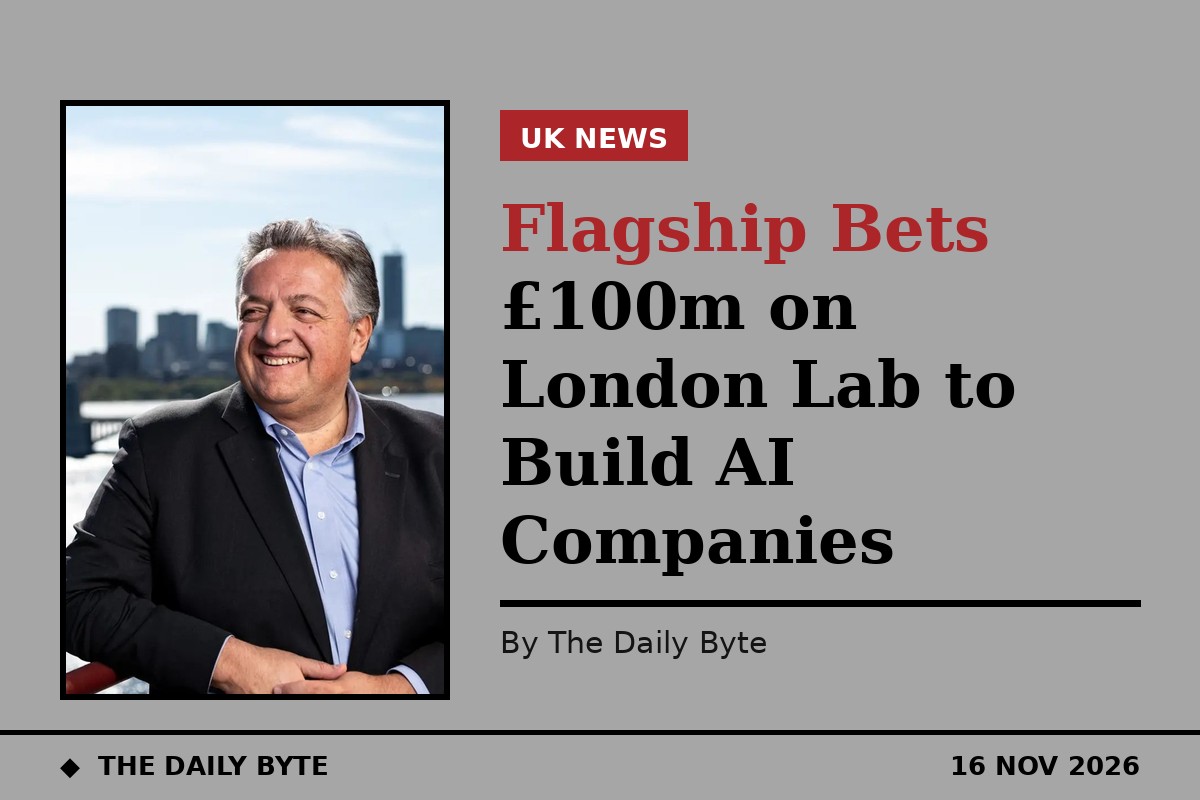
Flagship Pioneering, the venture firm behind Moderna, has committed an initial £100 million to open a laboratory in London that will create AI-native companies, its first dedicated company-creation unit outside the United States. The announcement was made on Monday, 16 November 2026, on the first day of London Life Sciences Week.
The new unit, called the Flagship Origination Lab, U.K., will be based in London and operate as part of Flagship Labs, the company’s innovation foundry in Cambridge, Massachusetts. It is the first time in more than 25 years that Flagship has expanded its company-creation model beyond its home base in the US.
What the London lab will do
The lab will conceive, test, fund and build AI-native platform companies working in human and planetary health and other frontiers of science and technology. It will draw on Flagship’s internal AI platform, Pioneering Intelligence, and its in-house drug discovery and development unit, Pioneering Medicines.
Flagship expects to recruit and train an initial team of about 50 scientist-entrepreneurs and operators in the UK. The lab will be anchored at the firm’s London office, which it opened in 2023 near the Francis Crick Institute in King’s Cross, and will build on three years of partnering and research work across the UK.
£100 million committed, £500 million hoped for
The figures need careful reading. Flagship has committed an initial £100 million — about $132 million — to launch the lab and build its first companies. Founder and chief executive Noubar Afeyan said the firm anticipates scaling that commitment through partnerships to attract an additional £500 million. That larger sum is an ambition, not committed money: no partners or timetable have been named, and it has not been secured.
Flagship has also disclosed no initial projects and no founding teams for the London lab, so the first companies it creates have yet to be announced.
Why London, and why now
Flagship has created more than 130 companies since it was founded in 2000, including Moderna, the Covid-19 vaccine maker. Afeyan, who is also chairman of Moderna, said artificial intelligence would run through every stage of the lab’s work, from invention to clinical trials, while cautioning that the use of AI in the field is still at an early stage.
The move is a vote of confidence in the UK life sciences sector, and it lands as London Life Sciences Week begins. It also reflects a wider shift in the industry: venture firms that once built drug companies around a single scientific idea are now building them around AI platforms that can generate and test many ideas at once.
What happens next
Recruitment comes first, with the team of around 50 scientist-entrepreneurs and operators to be hired and trained in the UK. The lab’s first company announcements will be the real test of whether the model that produced Moderna in Massachusetts can be repeated in London — and whether the hoped-for £500 million of partnership funding follows the initial £100 million.
Source: Flagship Pioneering; see also Fierce Biotech.