GL.iNet Cloud Flaw Put Malware on Routers and KVMs
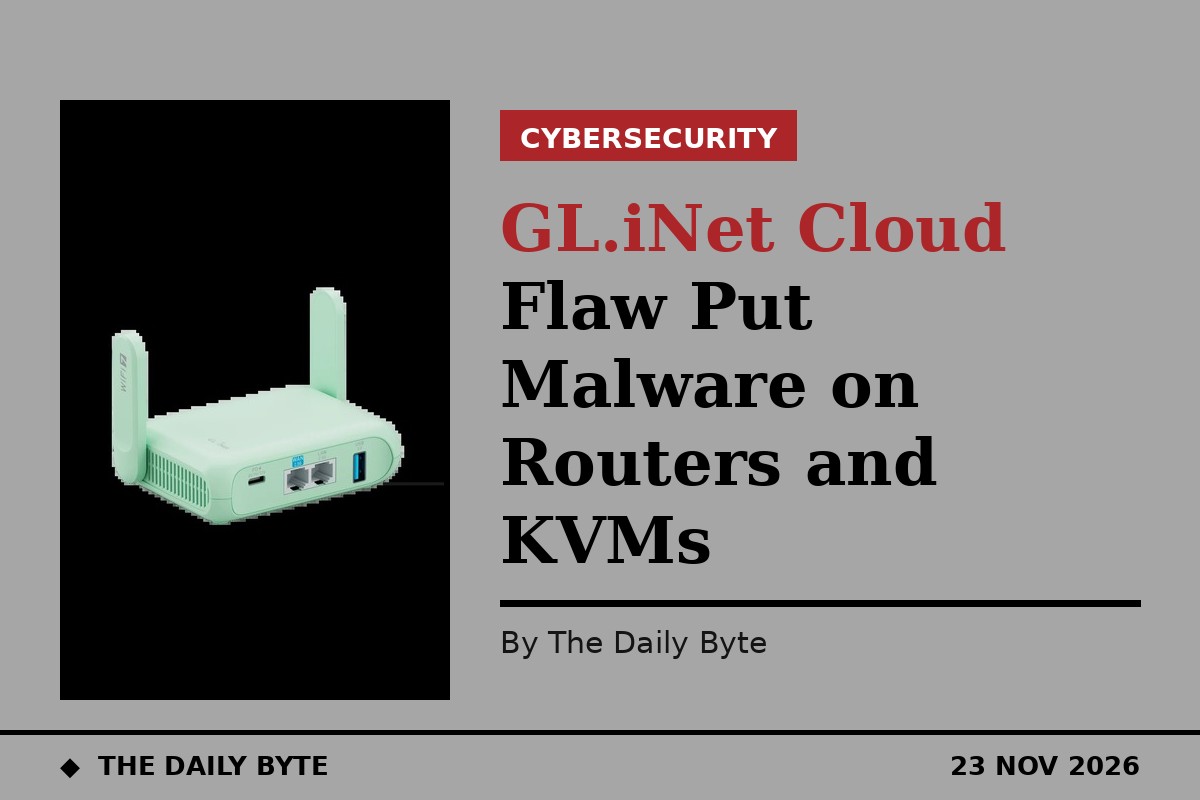
Hackers exploited a flaw in GL.iNet's GoodCloud remote management service to install malware on some customer routers and KVM devices, the networking equipment maker has confirmed. The company identified the flaw on Friday, 20 November, fixed it the same day and blocked the attacker's access, so devices can no longer be newly infected through that route. But the cloud-side fix does not remove malware from devices already infected, and owners must still check their hardware and install the security firmware in the company's notice, updated on Monday, 23 November.
GL.iNet's travel routers are among the best-selling networking devices on Amazon. A compromised router sits between a household or office and the internet, and a compromised KVM sits beside the computer it controls.
Root shells and a command channel
RemoteToHome Consulting, which examined the incident on routers it manages, says it verified a root-level reverse shell on one of its GL-AXT1800 routers. The shell started on Friday evening and connected to 170.39.226.219, and two more owners reported the same shell on the same model and firmware, version 4.8.3, with GoodCloud switched on. On GL-MT6000 routers the shell command ran but the connection never completed.
One KVM owner described an infected GL-RM1 that from Thursday downloaded a script and two programs from 66.245.219.252, looked up the copycat domain gl-inet.top and scanned the local network, while repeatedly connecting to 65.20.71.131, a suspected command channel. Whether computers attached to infected KVMs were affected is still under investigation, and the company has not said how many devices were infected, when the attacks began, or how its cloud service was breached. The Hacker News reported that the researchers' analysis found the shell arrived through the GoodCloud client software on the router itself.
A weakness researchers say dates to 2024
According to the researchers, a handler in that client takes two values from a cloud message and runs them as root through the shell without checking them; the vendor has not confirmed that finding. They say the unchecked code has been in firmware since at least 5 December 2024, when it appeared in a GL-MT3000 release, and runs whether or not AstroWarp, its SD-WAN feature, is in use. Its presence since 2024 does not mean attacks began then.
The researchers reported a second weakness in the cloud client to the vendor on Sunday, 22 November, and are withholding details until it is fixed. As of publication, The Hacker News found no CVE identifier for the flaw behind the attacks. The investigation also found an unrelated, older backdoor on 49 of the routers the firm manages, installed in batches between September 2025 and May 2026 by a route that is not known. Nothing so far links it to last week's attacks, although Cybernews reported the consultancy found 166 of 199 routers it examined affected by the recent attack, the older backdoor, or both.
How to check a device
GL.iNet's check looks for one marker: a running process containing the exact text crond -i /tmp/.log. On a router, owners can search for tmp/.log under Status, Processes in the LuCI web panel, or run ps | grep tmp over SSH. On a KVM, the device's own terminal runs ps -a | grep tmp on the RMQ1 or ps -aux | grep tmp on other models, on the KVM itself rather than the attached computer.
Check before rebooting or upgrading where compromise is suspected: the shell's traces disappear at restart, and the marker can miss infected devices, as it did on the router with the verified shell. Before running netstat on a suspect device, check that /bin/netstat is still a link to busybox, because the command itself may have been swapped, and running a compromised copy starts the malware.
What the update does, and what it does not
The notice, updated on 23 November, lists security firmware for the router and KVM lines, including 4.11.1 for the GL-MG1300, GL-MT3000 and GL-MT6000, 4.8.4 for the GL-AX1800, GL-AXT1800, GL-SFT1200, GL-X3000 and GL-XE3000, and 1.10.3 for the RM1, RM1V2, RM10, RM10RC, RM1PE and RM4PE KVMs. The notice now says the update removes the malware identified in this incident without a factory reset, with settings kept, replacing earlier guidance that offered a factory reset.
The researchers disagree with the vendor on that point. For a device with signs of compromise they advise reinstalling firmware without keeping settings, and treating every stored secret as exposed: VPN keys, Wi-Fi and admin passwords, cloud credentials and SSH keys. Until a device is updated, switching GoodCloud off, after first securing another way to reach the device, stops the cloud client from running but does not clean a device already infected, the researchers say. GL.iNet says it will email customers it identifies as affected, and warns a model missing from its firmware table is not necessarily unaffected.