N-able MailAssure Flaw CVE-2026-134624 Added to KEV
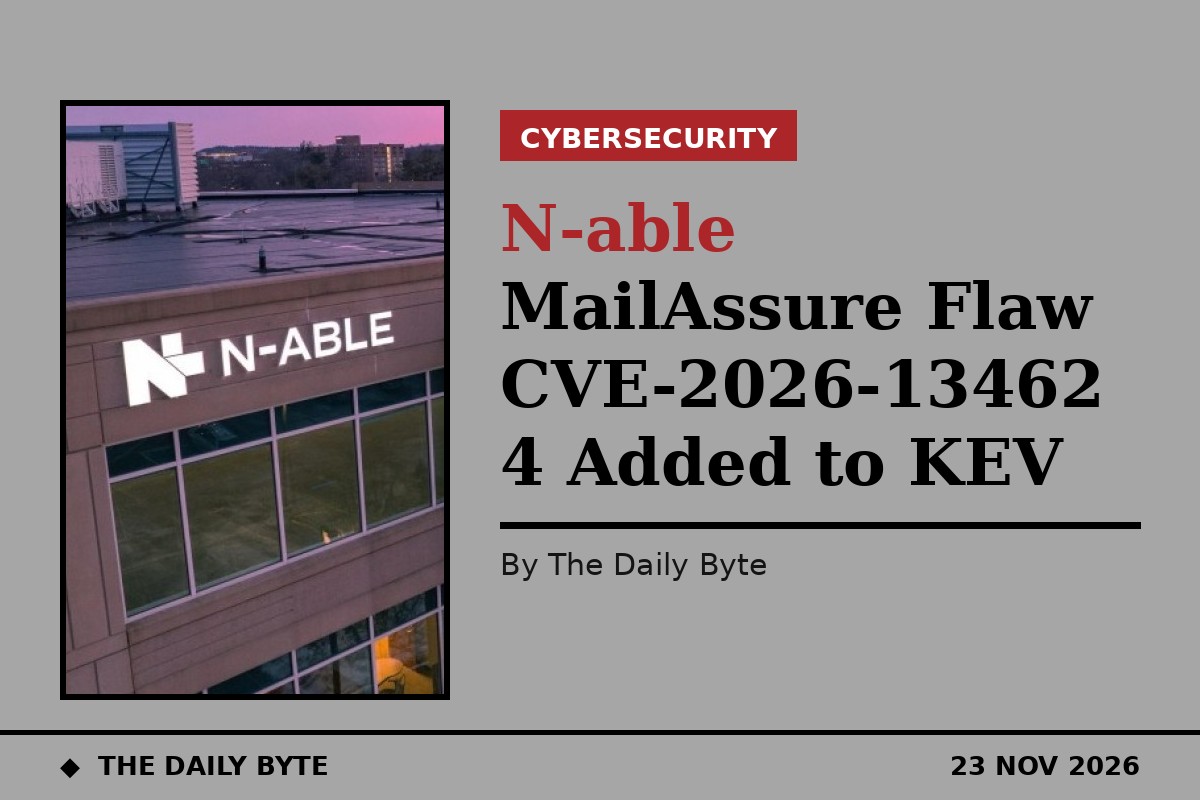
N-able has patched a critical flaw in its Mail Assure email filtering service after a cyberattack on the hosted platform, and the United States government has now listed the flaw as actively exploited. The company disclosed the vulnerability, tracked as CVE-2026-134624, on Sunday, 22 November, saying it was found during the investigation into the attack. The US Cybersecurity and Infrastructure Security Agency (CISA) added the flaw to its Known Exploited Vulnerabilities catalogue on Monday, 23 November, giving federal civilian agencies until 26 November to deal with it.
Mail Assure, sold alongside SpamExperts, filters email for managed service providers and their customers. The incident shut down the service's management dashboard and programming interfaces for five days, although email delivery itself kept working throughout. For the providers who rely on the service to manage customer mail, the outage and the flaw behind it are a reminder of how much of their security depends on a supplier's cloud.
What happened to Mail Assure
The trouble began on Monday, 16 November, when N-able disabled access to the Mail Assure and SpamExperts portal and application programming interface (API) and suspended related services, including logging, mailbox synchronisation, the management portal and quarantine. At first the company traced the disruption to platform configuration and service dependencies. Two days later it confirmed the services had been targeted in a cyberattack: an unauthorised party had reached a web server and had likely accessed certain credentials stored there.
N-able took the affected server offline, rotated internal platform credentials, revoked customers' existing API tokens, invalidated OAuth tokens and reset local users' passwords. On Saturday, 21 November, it restored access to the Mail Assure and SpamExperts dashboard and APIs, while continuing to monitor the environments. SecurityWeek reported the company as saying it has found no evidence of exploitation beyond the previously identified N-able-hosted server, and no further malicious activity since the fix.
The flaw: CVE-2026-134624
The vulnerability is a server-side request forgery (SSRF) flaw, rated 9.3 under the CVSS 4.0 scoring system. It sits in a connection check that Mail Assure runs for LDAP synchronisation when a relay is configured. Before the fix, nothing restricted where that check could connect, so an authenticated API user with enough privileges could make the server reach internal hosts and ports of their choosing, work out which ones answered, and send crafted data to internal services.
Builds earlier than 20261121.1943 are affected, and that build contains the fix. The hosted platform is already patched, so Hosted Cloud customers have nothing to install. SpamExperts Local Cloud runs on customer hardware with software updates on a weekly schedule, so operators of Local Cloud systems should confirm their servers are on build 20261121.1943 or later. The Hacker News reported that the flaw does not by itself claim code execution, and that the advisory describes the reachable-host probing and crafted-data risk rather than a full takeover.
What is still unknown
N-able has not said whether the flaw was the attackers' way in, or how they first gained access at all. It has also not said whether any of the credentials the attackers may have reached were actually taken. The company says it has found no evidence that customer data was compromised, including tenants' mailboxes, and it has brought in an outside digital forensics and incident response team. A formal root cause analysis is due within two weeks of the 22 November update.
The company also says the breach is unrelated to its earlier N-central incident, in which it took its hosted remote-monitoring platform offline on 9 November after a researcher published 33 unpatched flaws. CISA's 23 November catalogue update added a second exploited flaw the same day, in MONAI Label, an open-source medical imaging tool, tracked as CVE-2026-133968 and also due for federal action by 26 November, according to the day's CVE threat brief.
What Mail Assure users should do now
For Hosted Cloud customers, the immediate work is reconnecting. Scripts and integrations that used the revoked API tokens or OAuth tokens will need new credentials, and each partner has been emailed guidance specific to its environment. Anyone who has not received that guidance is asked to contact support.
More broadly, the incident shows why a supplier's token hygiene matters as much as its patching. N-able rotated its own platform credentials and revoked customer tokens as part of the response, and partners should treat any credential that touched the hosted platform during the incident window as suspect until it has been replaced. The investigation is continuing, and further detail is expected only when the company publishes its root cause analysis.