H-1B $100,000 fee explained: who pays, who is exempt
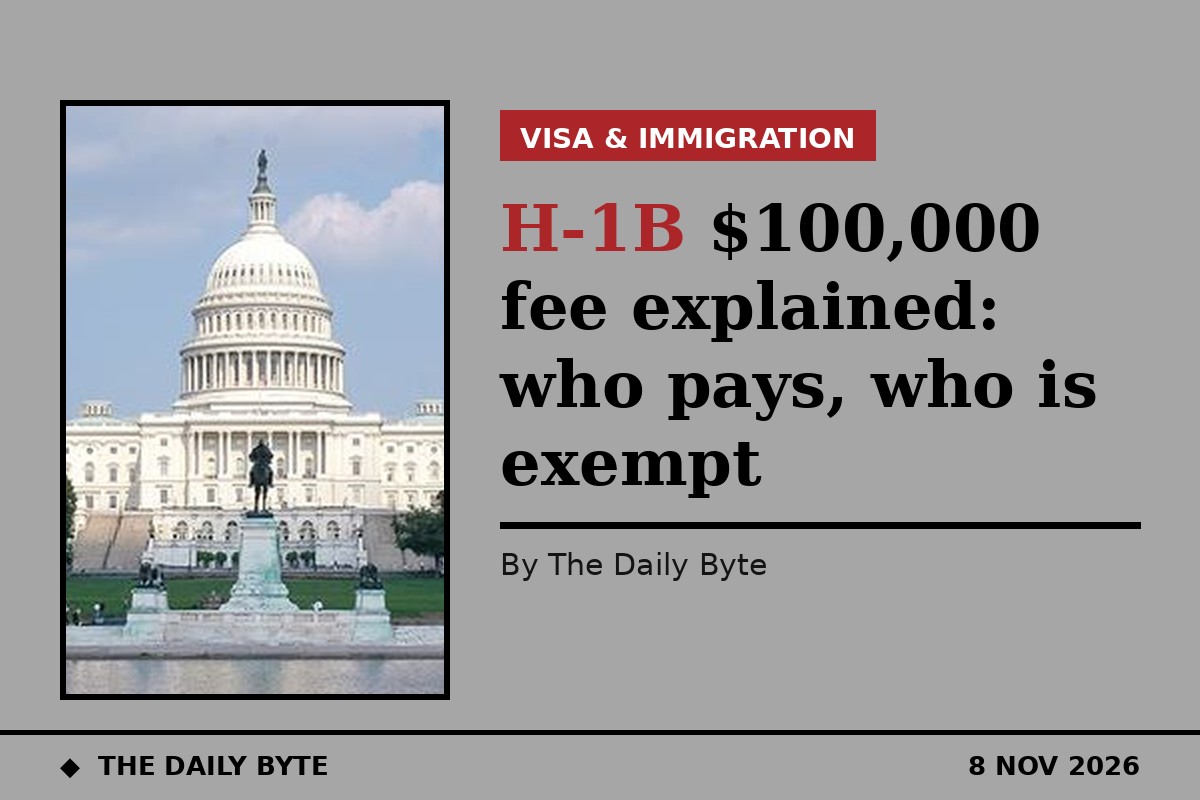
The H-1B visa has not been banned, but a $100,000 payment now hangs over some new applications for it. The payment was imposed by a presidential proclamation in September 2025, extended for another year in September 2026, and is currently not being collected because two federal courts have blocked the agency policies used to enforce it. This explainer sets out what the H-1B visa is, who the payment applies to, who is exempt, where the court cases stand, and the separate $103,265 fee proposal that is often confused with it.
This is general information about US immigration law as of November 2026, not legal advice. Immigration rules in this area are changing quickly through litigation, so anyone affected should check the latest guidance from US Citizenship and Immigration Services (USCIS) or speak to a licensed immigration lawyer.
What is the H-1B visa?
The H-1B is a US non-immigrant visa for skilled workers in specialty occupations, typically roles that require at least a bachelor's degree. It is employer-sponsored: a US employer files a petition with USCIS on behalf of the worker. The visa is widely used by technology companies, hospitals, universities and other employers, and it is a common route for international graduates of US universities and for professionals recruited from abroad. There is an annual cap on new H-1B petitions, with an exemption for certain employers such as universities and non-profit research organisations.
What is the $100,000 payment?
On 19 September 2025, President Donald Trump issued Proclamation 10973, "Restriction on Entry of Certain Nonimmigrant Workers", which required a one-time $100,000 payment to accompany certain new H-1B petitions. It took effect on 21 September 2025. The proclamation relied on the president's power to restrict the entry of non-citizens under the Immigration and Nationality Act, rather than on the government's ordinary fee-setting authority.
The payment applies only to "new" H-1B petitions for workers who are outside the United States and do not have a valid H-1B visa, and to petitions that request consular notification, notification at a port of entry, or pre-flight inspection for a beneficiary who is in the United States. In other words, it targets people who need to enter the US in H-1B status on the strength of a new petition. The employer pays it, not the worker, although the cost inevitably shapes hiring decisions. The administration has said that more than 700 petitions have included the $100,000 payment since the original order.
Who has to pay, and who is exempt?
| Situation | $100,000 payment? |
|---|---|
| New H-1B petition for a worker outside the US with no valid H-1B visa | Yes, in principle (currently blocked by court order) |
| Petition requesting consular notification or port-of-entry notification | Yes, in principle (currently blocked by court order) |
| Current H-1B holder, renewal or extension of stay | No |
| Amendment or change of employer for someone already in the US | No |
| Change of status inside the US, for example F-1 student to H-1B | No |
| Worker with an H-1B visa or approved petition filed before 21 September 2025 | No |
The exemptions matter because they cover most of the people already in the US system. Current H-1B holders, renewals, extensions, amendments and change-of-status applications are not affected. Students on F-1 visas who move to H-1B status through the standard change-of-status route are also outside the payment, which is why the measure has hit new overseas hires hardest.
The 2026 extension
On 18 September 2026, the president signed a new proclamation, Proclamation 11069, extending the payment requirement for another 12 months, through 21 September 2027. The extension keeps the same framework: it applies to the same narrow group of new petitions for workers outside the country. On the same day, the president signed a separate executive order directing federal agencies to coordinate more closely and to scrutinise H-1B filings, including looking at whether the sponsoring employer has recently laid off US workers or plans to do so. That layoff screening applies to petitions already filed, not only to new ones, and it could slow processing or create new grounds for refusal even where the fee question does not arise.
Is the fee actually being collected?
As of late October 2026, no. The payment has been blocked by the courts, not repealed. On 8 June 2026, a federal court in Massachusetts vacated the agency policy implementing the $100,000 payment in a case brought by 20 state attorneys general, finding it unlawful under the Administrative Procedure Act. On 30 September 2026, a second federal judge, in the Northern District of California in Global Nurse Force v. Trump, vacated and barred enforcement of the agency policies implementing the payment, including as applied to the September 2026 extension, finding the agencies had skipped required notice-and-comment rulemaking.
The government is appealing. Its appeal in the First Circuit remains pending, and on 9 October 2026 it appealed the California decision to the Ninth Circuit and asked for the order to be paused. A separate case brought by the US Chamber of Commerce in Washington DC is also pending before the DC Circuit. While the litigation continues, employers are not currently required to pay the $100,000 when filing H-1B petitions, but the position could change with little notice if an appeals court reinstates the fee.
The separate $103,265 fee proposal
The $100,000 proclamation payment is often confused with a different measure: a proposed $103,265 fee. On 25 August 2026, the Department of Homeland Security published a proposed rule that would add a $103,265 fee, payable at filing, for all H-1B cap-subject petitions, including those under the advanced-degree exemption and change-of-status requests. The public comment period closed on 24 September 2026. It is a proposal only: no final rule has been published, so nothing takes effect unless and until a final rule is issued, and legal challenges are widely expected. It would not apply to H-1B petitions that are not subject to the cap. Neither measure applies to O-1, L-1, NIW or EB-1A petitions.
Is the H-1B visa banned?
No. The H-1B programme is still open, and petitions continue to be filed and approved. What has changed is the cost and uncertainty around new overseas hires, plus extra scrutiny of employers. For a worker already in the US on an H-1B, or a student changing status to H-1B, the proclamation payment does not apply at all. The practical risk for employers is that a court decision could reinstate the payment quickly, so many are planning as if the fee might return while continuing to file petitions in the meantime.
What should applicants and employers do now?
Workers should check whether they fall inside or outside the payment by asking which category their petition is in, not by the headline figure alone. Employers filing new petitions for workers abroad should keep records of filing dates, because petitions filed before 21 September 2026 are outside the extended proclamation. Both should watch the dockets in the First and Ninth Circuits and the USCIS alerts page, and should not assume the current pause is permanent. Anyone making a decision with a job, a visa or a move on the line should get advice from a licensed US immigration lawyer, because this is general information and the rules are still being litigated.
Frequently asked questions
Is the H-1B visa banned? No. The programme is still open. The $100,000 payment applies only to certain new petitions for workers outside the US, and its collection is currently blocked by court orders.
Do current H-1B holders have to pay $100,000? No. Renewals, extensions, amendments and change-of-status applications are exempt.
Is the $100,000 fee being collected right now? As of late October 2026, no. Two federal courts have vacated the agency policies used to collect it, and the government is appealing.
What is the $103,265 H-1B fee? A separate proposal from the Department of Homeland Security, published in August 2026, that would charge $103,265 on all cap-subject H-1B petitions. It is not final and has no effect yet.
Sources: Mintz: Presidential Proclamation Extends $100K H-1B Fee; Malik Law: Is Your H-1B Visa Banned? 2026 $100,000 Fee Update. This is general information, not legal advice; check USCIS guidance for the latest position.