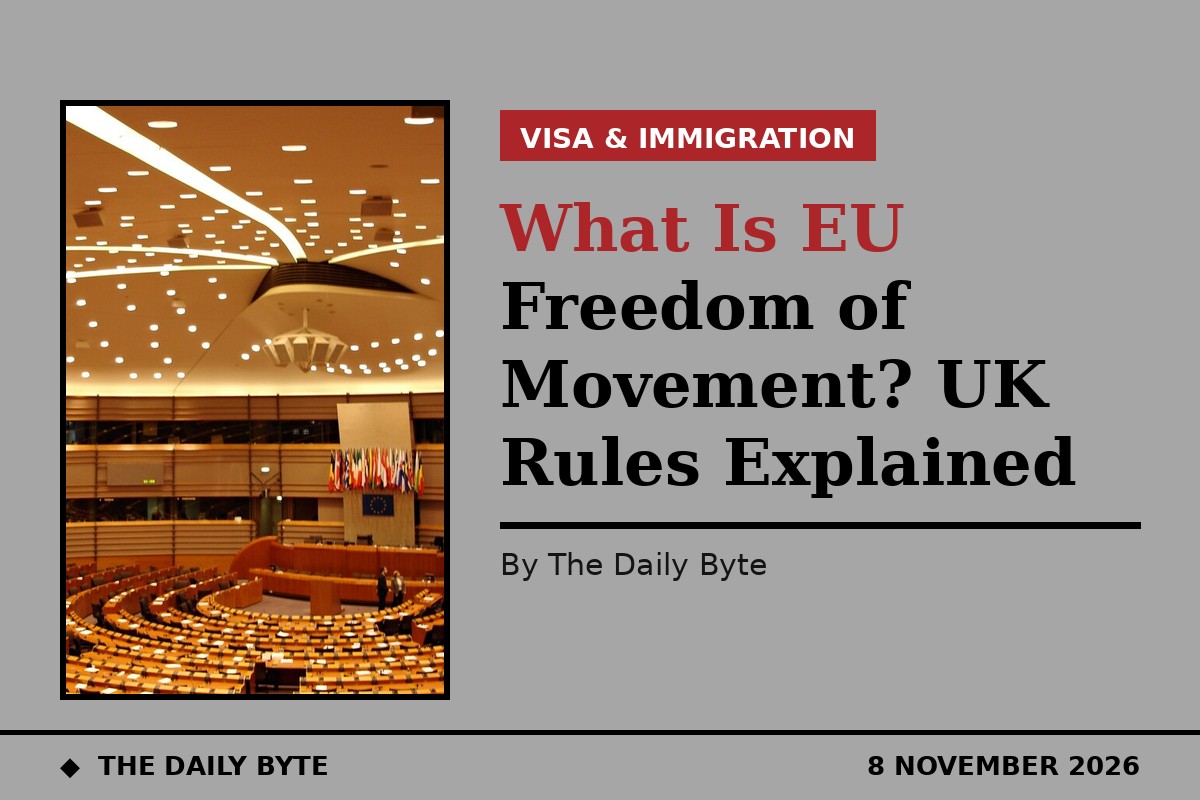
What Is EU Freedom of Movement? UK Rules Explained
EU freedom of movement was the right of citizens of European Union countries to live, work, study and retire in any other EU country without needing a visa or a work permit. For the UK, that right ended on 31 December 2020, when the Brexit transition period finished. Prime Minister Andy Burnham has now said Britain should have an “honest discussion” about it — but Downing Street has stressed that he is not proposing a return to freedom of movement. This explainer sets out what the rules were, what replaced them, and what the Prime Minister has actually said.
What is EU freedom of movement?
Freedom of movement of people is one of the four freedoms of the EU single market, alongside the free movement of goods, services and capital. In practice it meant that a citizen of any EU member state could move to another member state to live, work, look for a job or study, and be treated broadly the same as that country’s own citizens when it came to employment rights and access to public services. No visa was needed, no Home Office permission was required, and there was no application fee. The right came directly from EU law. It also applied to the wider European Economic Area, covering Norway, Iceland and Liechtenstein, and to Swiss citizens under a separate agreement.
Freedom of movement was one of the central issues of the 2016 referendum in which the UK voted to leave the EU. Ending it was a stated aim of the Brexit settlement that followed, and the UK formally left the arrangement when the transition period ended at 11pm on 31 December 2020.
How did freedom of movement work in the UK before Brexit?
Before Brexit, an EU citizen could arrive in the UK, find work, rent a home and register with a GP without first applying for any immigration status. Employers did not need to sponsor them, and there was no salary threshold or skills test. Many EU citizens came for a period and then returned home, a pattern the Prime Minister has described as “revolving door migration”. At its peak, EU migration was a major part of UK population growth, and EU citizens made up a large share of the workforce in sectors including health and social care, hospitality, agriculture and construction.
The system was not entirely without conditions. EU law allowed member states to require people to be working, self-employed, studying or self-sufficient after an initial three months, and to remove people who became an unreasonable burden on public funds. In practice, however, the UK applied few of those controls, and the absence of a registration system meant the government did not hold a central record of how many EU citizens were living in the country.
What replaced freedom of movement in the UK?
Three things replaced it. First, EU, EEA and Swiss citizens who were already living in the UK before the end of 2020 were protected by the EU Settlement Scheme. Those with five years of continuous residence could apply for settled status, the equivalent of indefinite leave to remain, while those with less time received pre-settled status and could upgrade later. The main application deadline was 30 June 2021, although late applications are still accepted where there are reasonable grounds for the delay.
Second, EU citizens arriving after 1 January 2021 are treated the same as applicants from any other country. To live and work in the UK they generally need a visa under the points-based immigration system, most commonly a Skilled Worker visa, which requires a sponsoring employer and a job meeting a salary and skill threshold. There is no general visa route for lower-paid work.
Third, Irish citizens are an exception. Under the Common Travel Area, Irish citizens can still live and work in the UK without a visa, and British citizens have the same right in Ireland. That arrangement predates EU membership and was unaffected by Brexit.
| Before 31 December 2020 | After 1 January 2021 |
|---|---|
| EU citizens could live and work in the UK without a visa | A visa is normally required, usually sponsored by an employer |
| No application, fee or Home Office permission | Points-based system with salary and skill thresholds |
| Rights came directly from EU law | Rights come from UK immigration law |
| EU citizens already here protected by the EU Settlement Scheme | Settled and pre-settled status under the scheme |
| Irish citizens covered by the Common Travel Area | Irish citizens still free to live and work without a visa |
What has Andy Burnham actually said?
In an interview with The Sunday Times on 19 October, Mr Burnham said the issue of freedom of movement could be considered as part of a broader reset of the UK’s relationship with the EU, including data sharing and migration. He said the influx of EU workers before Brexit had posed significant challenges, but added: “But, at the same time, it was a type of immigration that perhaps wasn’t as difficult [as now].” He argued that “revolving door migration where people would come and then go back is different”, and that the balance of migration has changed since Brexit.
He also pointed to what the UK lost when it left EU migration cooperation, saying: “Consider what we’ve lost, which was the ability to be part of Eurodac and all the data collaboration around migration. You’ve got to see it in the round, rather than just looking at freedom of movement on its own.” Eurodac is the EU database of fingerprints used to identify asylum seekers and people crossing borders irregularly. The UK lost access to it on leaving the EU.
The Prime Minister is due to meet senior EU officials at a summit on 20 November, where the future UK-EU relationship will be discussed. Negotiations on a new bilateral agreement are reported to be close to complete, covering areas such as food and drink standards, although the summit is not formally intended to discuss the UK rejoining the EU.
Is the Prime Minister proposing a return to freedom of movement?
No — not according to Downing Street. After days of debate sparked by his Sunday Times remarks, the Prime Minister’s spokeswoman said on 5 November that “the Prime Minister isn’t proposing a return to freedom of movement, or any option”, adding that he was “not leaning either way”. Mr Burnham has also said in broadcast interviews that he has “not proposed freedom of movement coming back”, and he remains committed to the manifesto red lines that rule out a return to the customs union, the single market or freedom of movement during this Parliament.
The distinction matters. Saying a subject should be discussed is not the same as proposing a policy, and the government’s formal position is that there is no proposal on the table. Any change would in any case need a mandate at the next general election, which is due by 2029.
What would a return actually require?
A return to freedom of movement would be a major negotiation, not a single decision. The EU regards freedom of movement as inseparable from single market membership: Michel Barnier, the EU’s former chief Brexit negotiator, has said the UK cannot have single market access without accepting freedom of movement, and that rejoining would mean giving up the UK’s former budget rebate. The UK would also need to accept the wider body of EU rules that go with it, and the EU would need to agree.
There are also smaller steps that fall short of full freedom of movement. A youth mobility scheme, which would let young people live and work in each other’s countries for a limited period, has been discussed in UK-EU talks as a possible compromise. So has closer cooperation on migration data, including some form of access to Eurodac. None of these has been agreed, and the government has not committed to any of them.
How has migration changed since Brexit?
According to the Office for National Statistics, long-term net migration to the UK nearly halved in 2025, falling to 171,000 from 331,000 a year earlier. The mix has also changed: EU migration has fallen sharply, while arrivals from outside the EU have risen, and a larger share of arrivals now settle permanently rather than returning home. That shift is at the heart of Mr Burnham’s argument that the character of immigration, not just the numbers, has changed since freedom of movement ended.
Immigration rules change frequently, and anyone affected should check the official guidance on GOV.UK before acting. This article explains the rules as they stand in November 2026; it is not personal immigration advice.
Frequently asked questions
Is EU freedom of movement coming back? No proposal has been made. The Prime Minister has said the subject should be discussed, while Downing Street says he is not proposing a return, and the government’s red lines rule it out during this Parliament.
Can EU citizens work in the UK now? Yes, but most need a visa. EU citizens who were living in the UK before 31 December 2020 are protected by the EU Settlement Scheme, while new arrivals generally need a sponsored work visa under the points-based system. Irish citizens are exempt under the Common Travel Area.
What is the EU Settlement Scheme? It is the Home Office scheme that protects the rights of EU, EEA and Swiss citizens who lived in the UK before the end of 2020. Settled status gives a permanent right to live and work in the UK; pre-settled status is temporary and can be upgraded after five years of continuous residence.
What is Eurodac? Eurodac is the EU’s fingerprint database for asylum seekers and people who cross EU borders irregularly. The UK lost access to it when it left the EU, and the Prime Minister has cited that loss as part of the case for closer migration cooperation.
Sources: Al Jazeera and ETIAS.