What is the EU Entry/Exit System (EES)? Explained
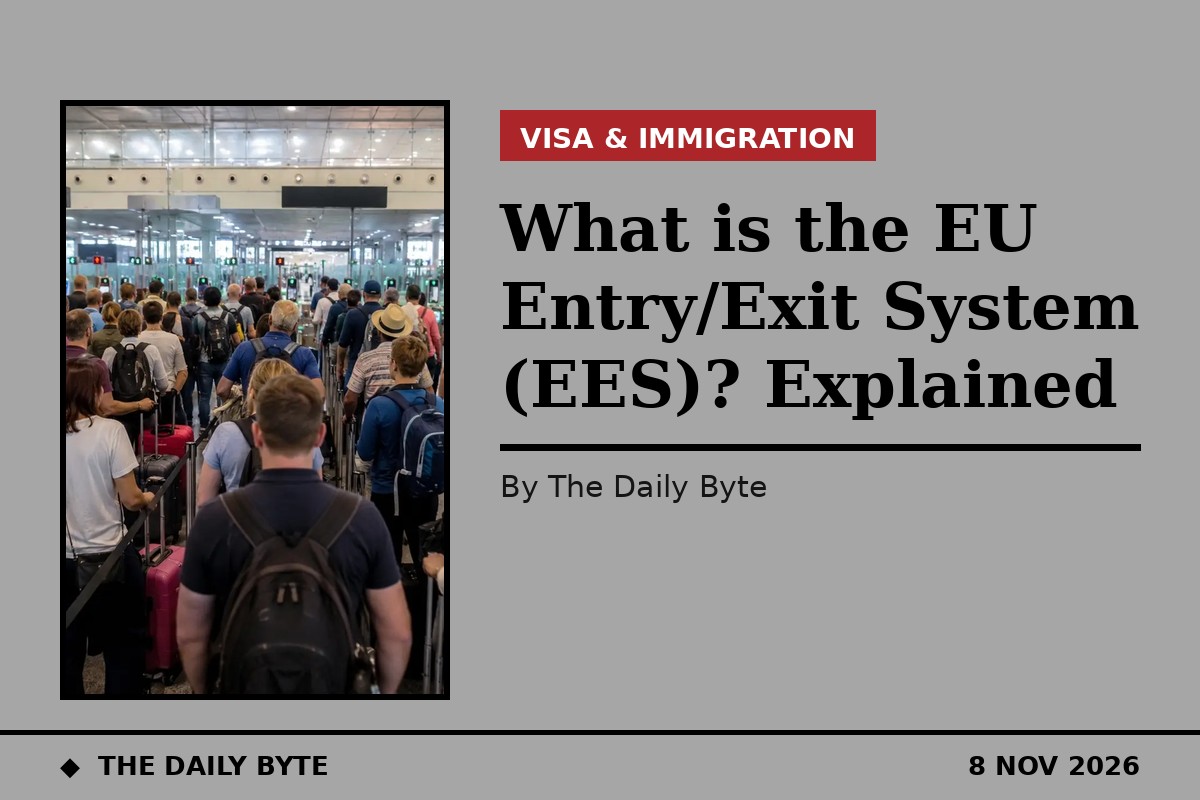
The EU Entry/Exit System (EES) is a digital border system that records non-EU visitors entering and leaving 29 European countries for short stays, replacing the old passport stamp with fingerprints and a facial photograph. It has been fully operational at all external Schengen borders since 10 April 2026, after a phased rollout that began on 12 October 2025. There is no application to make and no fee to pay: registration happens at the border, on your first crossing.
If you are a UK citizen travelling to Europe for a holiday or a short business trip, the EES now applies to you, because the UK is outside the EU. This explainer sets out what the system is, who it covers, what happens at the border, what data it keeps, and how it differs from the separate ETIAS travel authorisation, which is not yet running.
What is the EES?
The EES is an automated IT system run by the EU agency eu-LISA. Each time a non-EU national crosses an external border of one of the 29 countries using the system for a short stay of up to 90 days in any 180-day period, the system records their name, travel document details, fingerprints, a facial image, and the date and place of entry and exit. Refusals of entry are recorded too. The European Commission says the system was built to modernise border checks, detect people who overstay their authorised visit, and combat irregular migration and identity fraud.
The most visible change for travellers is the end of the passport stamp. Instead of an officer stamping your passport, your entry and exit are logged electronically, and the system counts your days for you. That matters because the 90-days-in-any-180 rule still applies exactly as before: the EES simply enforces it automatically, and overstays are now flagged by the system rather than spotted by an officer flicking through inked pages.
When did the EES start?
The system was years in the making. It was originally planned for 2022, then delayed repeatedly. The timeline that matters for travellers is as follows.
| Date | What happened |
|---|---|
| 12 October 2025 | Progressive start of operations at the external borders of 29 European countries |
| 10 April 2026 | EES fully operational at all external Schengen border crossing points; passport stamps replaced |
| 6 September 2026 | Temporary relaxations that let busy borders pause biometric collection came to an end |
| October 2026 | Airports and airlines reported waits of up to five hours at some peak-time borders |
By the time the Commission declared the system fully operational in April 2026, it had already logged more than 52 million entries and exits and recorded over 27,000 refusals of entry, according to figures reported at the time.
Who does the EES apply to?
The EES applies to every non-EU national travelling for a short stay to the 29 countries using it, whether or not they need a visa. The 29 are the EU member states except Cyprus and Ireland, plus Iceland, Liechtenstein, Norway and Switzerland. That includes UK citizens, US citizens, Canadians, Australians and many others. It does not apply to EU citizens, or to people travelling on long-stay visas or residence permits for those countries.
Children under 12 are registered in the system, but they do not give fingerprints; only their facial image is taken. Travellers who refuse to give their fingerprints or facial image will be refused entry. There is no way to opt out of the system while still entering one of the 29 countries for a short stay.
What happens at the border?
On your first crossing after the system began, registration takes a few extra minutes. You hand over your passport, your facial image is captured, and four fingerprints are scanned, usually at a self-service kiosk or at the officer's desk. Your details are then stored in the system. On later trips, the check is shorter: the system confirms your identity against the file it already holds and logs the new entry or exit.
Travellers can also pre-register some of their data using the EU's "Travel to Europe" mobile app within 72 hours before entering a European country, which is intended to speed up the border check. Pre-registration does not replace the border check itself, and fingerprints and a photo are still taken at the border on the first crossing. Implementation has been gradual at some crossings used heavily by UK travellers: at the Port of Dover, car passengers were initially given an EES file without fingerprints or a facial image, while coach passengers gave some biometrics at police desks, and Eurostar kiosks at London St Pancras were still being tested in August 2026. Check your operator's latest advice in the days before you travel.
What data does the EES store, and for how long?
Your EES record holds your passport data, your facial image, your fingerprints, every entry and exit date and place, and any refusal of entry. Under the EES rules, the record is kept for three years after your last recorded exit. The data is held in a central EU system managed by eu-LISA and is accessible to border, visa and immigration authorities in the participating countries, under data-protection rules. The Commission says the system meets high standards of data and privacy protection.
What about the 90-day rule?
Nothing about the underlying rule has changed: non-EU visitors may spend up to 90 days in any 180-day period across the Schengen area. What has changed is enforcement. Because the system logs every crossing centrally, it can calculate exactly how many days you have used and flag an overstay automatically. Travellers who previously relied on patchy stamping should assume their days are now counted precisely, and should keep track of their own travel dates.
EES versus ETIAS: do not confuse them
The EES is often confused with ETIAS, the European Travel Information and Authorisation System, but they are different systems. The EES registers you at the border and is running now. ETIAS is a pre-travel online authorisation for visa-free visitors, expected to cost 20 euros, and as of October 2026 it is not in operation and no start date has been announced. Press reports point to 2027. You do not need to apply for anything before you travel under the EES, and any website offering to sell you an ETIAS authorisation now is not genuine: the only official sites end in europa.eu.
Delays and problems one year on
The rollout has not been smooth. On 12 October 2026, exactly one year after the EES began, the airport trade body ACI Europe and the airline body Airlines for Europe jointly called for urgent fixes, warning that waits of up to five hours at Schengen borders remained unacceptable. They asked for an end to double verification, upgrades to the "Travel to Europe" pre-registration app, faster automated border gates, and a permanent mechanism to pause biometric checks during overload. The temporary flexibility that let border posts scale back biometric capture during congestion expired on 6 September 2026, and industry groups have asked for it to be restored. Travellers should allow extra time at the border, particularly on a first crossing, at peak times and at busy Channel ports.
Frequently asked questions
Do I need to apply for the EES before I travel? No. There is no application and no fee. Registration happens at the border on your first crossing.
Does the EES apply to UK citizens? Yes. The UK is outside the EU, so UK citizens travelling for short stays to the 29 participating countries are registered like other non-EU nationals.
Will my passport still be stamped? No. Since 10 April 2026, passport stamps have been replaced by electronic records at the external borders of the participating countries.
What is the difference between the EES and ETIAS? The EES is a border registration system that is already running. ETIAS is a separate pre-travel authorisation that has not started and has no launch date yet.
Sources: European Commission: Entry-Exit System; Time to Travel: EES Explained. Rules can change: check the official EU page before you travel.