HMS Vengeance ends record 217-day Trident patrol
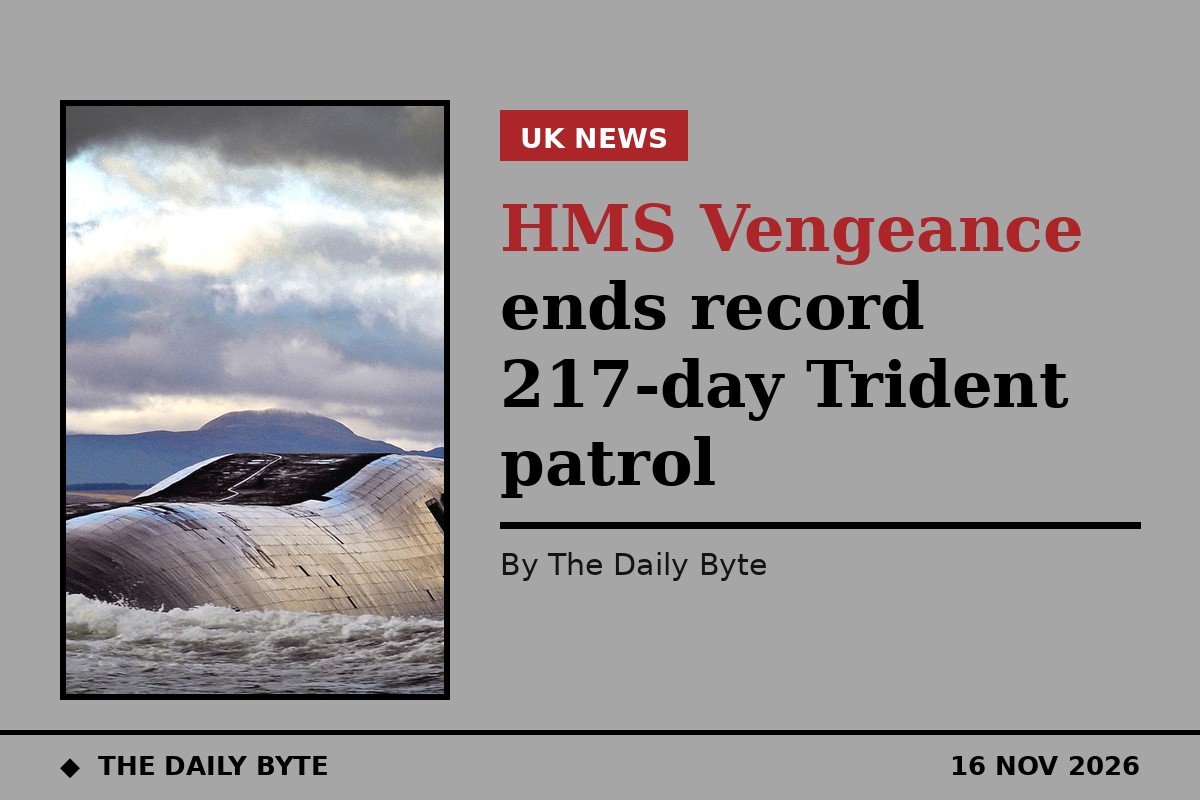
A Royal Navy submarine carrying Trident nuclear missiles has returned to its Scottish base after a record-breaking 217 days spent submerged on patrol, the longest undersea deployment at sea for a British vessel.
The 140-strong crew of HMS Vengeance spent the tour in almost total isolation beneath the surface after setting out from Faslane, near Helensburgh in Argyll and Bute, on 12 April. The submarine returned to HM Naval Base Clyde on Sunday 15 November, with crew members standing on deck as it travelled up Gare Loch, accompanied by smaller naval support vessels and tug boats.
Defence Secretary Wes Streeting was at the base to welcome the crew home. He said it “doesn’t sit lightly” with him that crews were being asked to serve longer than intended, adding: “I think the whole country can be extraordinarily proud of our submariners and of our nuclear deterrent.”
Patrols have more than doubled in length
The previous record for a Royal Navy continuous undersea patrol is reported to have been set by HMS Vanguard, which returned to Faslane in April after 205 days at sea. The typical patrol length for the UK’s Vanguard-class ballistic missile submarines has more than doubled in recent years, with six-month durations now routine because of a shortage of seaworthy vessels.
HMS Vengeance had been expected back at Faslane the previous weekend, but its return was reported to have been delayed when the submarine due to replace it on patrol had to return to base to fix a technical fault.
The head of the navy, First Sea Lord Gen Sir Gwyn Jenkins, praised the dedication of submariners in keeping Nato safe at a conference last week in Oslo, but said the UK must do better at maintaining the fleet.
Life beneath the waves
To avoid detection, the submarines remain submerged and in radio silence throughout their patrols, because a transmission could give away their position. They can rise to shallower depths and receive encoded messages through a floating wire antenna or communications buoy.
Crews have little contact with loved ones apart from the “Familygram”, a 120-word message that arrives weekly and which they are not permitted to answer. Messages are vetted, and bad news from home can be withheld if it might affect a crew member’s operational effectiveness. Most of the crew work in shifts of six hours on and six hours off, sleeping in narrow bunks, sometimes nine to a cabin.
Submariners returning from long patrols are said to find the outside world smells strange or even overwhelming after months breathing filtered air, and they are advised not to drive for a few days while they adjust.
An ageing fleet
The four 492ft (150m) Vanguard-class submarines can carry up to 16 Trident missiles, each capable of delivering multiple warheads. Since 1969 the UK has always had at least one ballistic missile-armed submarine patrolling at sea to provide a nuclear deterrent.
The Vanguard-class boats were commissioned in the 1990s with an expected service life of 25 years, but they are now expected to serve for up to 40 years before the first Dreadnought-class submarines start replacing them in the early 2030s. Streeting said that programme was “on track” and that it was important to get those vessels out “as soon as possible”.
A major overhaul of HMS Vanguard at Devonport Dockyard in Plymouth dragged on for seven years before it returned to service in 2022. HMS Victorious is currently in dry dock undergoing a £560 million deep maintenance programme that began in 2023, leaving only Vengeance, Vigilant and Vanguard operational.
Read the full report on the Bucks County Tribune report.


