How Patriarchy Shapes Life Inside Pakistani Families
By Rania Malik Awan
·10 Jul 2026
·7 min read
·Mansehra, Khyber Pakhtunkhwa
Patriarchy:
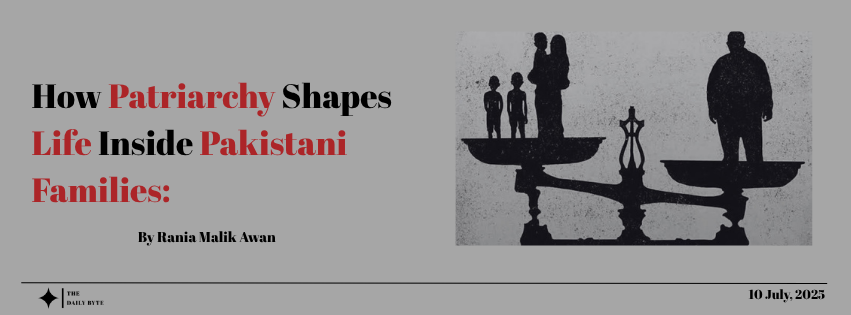
Definition: Patriarchy is a social system in which primary power, authority, and leadership roles are predominantly held by men.
Explanation: It means a world where men hold most of the power and make most of the rules, instead of everyone sharing and leading together.
In Pakistan patriarchy is a norm. In Pakistan patriarchy is being promoted because men believes that as they are labelled as providers in Islam and hence they6 hold all the authority
WHILE THE QURAN TOTALLY CONTRADITS THE PATRIARCHY
The believing men and believing women are allies (awliya) of one another. They enjoin what is right and forbid what is wrong..." (Quran 9:71)
Awliya means protectors, equal partners, and close allies.
By this it is quite clear that Islam totally denies patriarchy
Global Standing Of Pakistan In Case Of Gender Gap: In the World Economic Forum's Global Gender Gap Report 2025, Pakistan ranked 148th out of 148 countries, placing last globally for overall gender parity with a score of 56.7%.
The World Economic Forum’s Global Gender Gap Index calculates how evenly resources, opportunities, and power are split between men and women. A score of 100% means complete equality, while 0% means total inequality. Pakistan's score of 56.7% means the country has only closed about 56.7% of its overall gender gap, leaving a massive 43.3% deficit. Because every other surveyed nation scored higher, Pakistan ranked 148th out of 148 countries.
Patriarchy in Pakistan begins the moment a child is born, as families heavily favour boys to carry on the family name and inherit property. From a very young age, boys are given the best food and served first, while their mistakes are laughed off and excused instead of corrected. At the same time, young girls are forced to clean up after their brothers and are sometimes not even allowed to eat until the men of the house have finished.
This unequal treatment breaks a girl's spirit early in life, as she is constantly told that she is weak, dependent, and that her only purpose is marriage and bearing children. This systematic brainwashing destroys the big dreams of young girls who wanted to conquer the world, leaving them feeling like they are just a woman. They are denied an individual identity and are never recognized for who they truly are or who they wanted to be. Instead, society labels them strictly through their relationships to men, viewing them only as someone's daughter, wife, or mother.
Many men cannot tolerate working under a woman or seeing the women of their house earn more money and live independently. To satisfy their male ego, they try to control and overshadow women by crushing their ambitions, stealing their decision-making power, and reducing them to child-bearing machines. In the most extreme cases, they go as far as killing women in the name of honour just to maintain this dominance.
Women are not anyone's property, and they have the potential to be leaders, travellers, warriors, and scholars. They do not want to compete with men or defeat them; they simply want the freedom to have a life and an identity of their own. A woman must be recognized as an individual person first, before she is seen as a mother, wife, or daughter. Women are the true superheroes of society, but they have been overshadowed and held back by men for far too long.
Quranic References:
The Quran praises and honours strong women for qualities that are rarely found in Pakistan today because patriarchal culture suppresses them.
1. The Ultimate Leader: The Queen of Sheba (Surah An-Naml, 27:32-35)
The Quran introduces Bilqis, the Queen of Sheba, as a powerful monarch who possesses immense wealth, a mighty throne, and an army. When threatened with war by King Solomon, her leadership is praised for its caution, strategic diplomacy, and democratic nature:
She said, "O chiefs, advise me in my affair. I would never decide a matter until you are present with me." (Quran 27:32)
The Praise: The Queen chose peace and talking instead of war, unlike her all-male advisors who wanted to fight. The Quran shows her smart, careful leadership and her choice to believe as a great example of how to rule for everyone.
2. The Praised Travelers: The Muhajirat (Surah Al-Mumtahanah, 60:10)
During the early years of Islam, leaving one's home and traveling across the dangerous desert to seek religious freedom (Migration/Hijrah) was the ultimate act of faith. The Quran explicitly singles out, protects, and validates women who took this dangerous journey alone:
"O you who have believed, when the believing women come to you as emigrants, examine them..." (Quran 60:10)
The Praise: These women traveled very far, leaving their male-dominated tribes to join the community in Medina. The Quran does not blame them for traveling. Instead, it commands the male leaders of Medina to protect them, check their faith, and give them a safe place to live.
3. The Intellectual Scholar: Maryam / Mary (Surah Ali 'Imran, 3:37):
While Maryam is deeply respected for her devotion. The Quran also shows that she studied and worshipped completely alone.
"...Every time Zechariah entered upon her in the prayer chamber (Mihrab), he found with her provision. He said, 'O Mary, from where is this to you?' She said, 'It is from Allah...'" (Quran 3:37)
The Praise: The Mihrab was a private room for deep prayer, study, and thought. At that time, women were completely banned from holy spaces and religious education. However, the Quran states that God placed Maryam in this private space. This made her an independent receiver of divine knowledge, which completely amazed the high priest Zechariah
4. The Critical Inquirer: Khawlah bint Tha'labah (Surah Al-Mujadilah, 58:1):
In tribal Arabia, a custom called Zihar let a husband leave his wife without a divorce. This left her with no rights or social support. Khawlah refused to accept this custom. She went directly to the Prophet Muhammad to argue her case.
"Allah has indeed heard the speech of the woman who pleads with you concerning her husband and complains to Allah..." (Quran 58:1)
The Praise: Khawlah acted as her own lawyer. She did not stay quiet. Instead, she used logic and justice to argue her case. God supported her challenge so much that He revealed holy verses to change the law for the whole nation forever. This proves that a woman's voice can directly change legal systems.
5.. The Fierce Defender: Nusaybah bint Ka'ab at the Battle of Uhud (Surah Al-Anfal, 8:17 / Historical Exegesis)
Nusaybah first went to the Uhud battlefield to help by carrying water and treating the wounded. However, her mission changed completely when the defense lines suddenly fell apart. When the army broke and enemies rushed forward to kill the Prophet Muhammad, she dropped her water container, picked up a sword and bow, and stepped directly into the danger to protect him
The Prophet later remarked on her bravery, stating, "Wherever I turned, whether to the right or to the left, I saw her fighting to defend me." [1]
How it Denies Patriarchy: In ancient tribal Arabia, fighting and physical protection were the main symbols of male power. By staying to fight when many male soldiers ran away, Nusaybah proved that women are not weak or dependent on men for protection. The early community recognized her as a true military hero. Her bravery proved that women have the full strength, courage, and right to defend their leaders, faith, and community on the front lines.
Source
World Economic Forum's Global Gender Gap Report 2025 — https://www.weforum.org/publications/global-gender-gap-report-2025/