Iran, China, Russia, Belarus, Cuba Slam Space Arms
Iran, China, Russia, Belarus and Cuba have jointly condemned any attempt to place weapons in outer space, warning that the United States' acknowledgement that it possesses so-called "on-orbit space control weapons" marks a dangerous step towards an arms race beyond Earth.
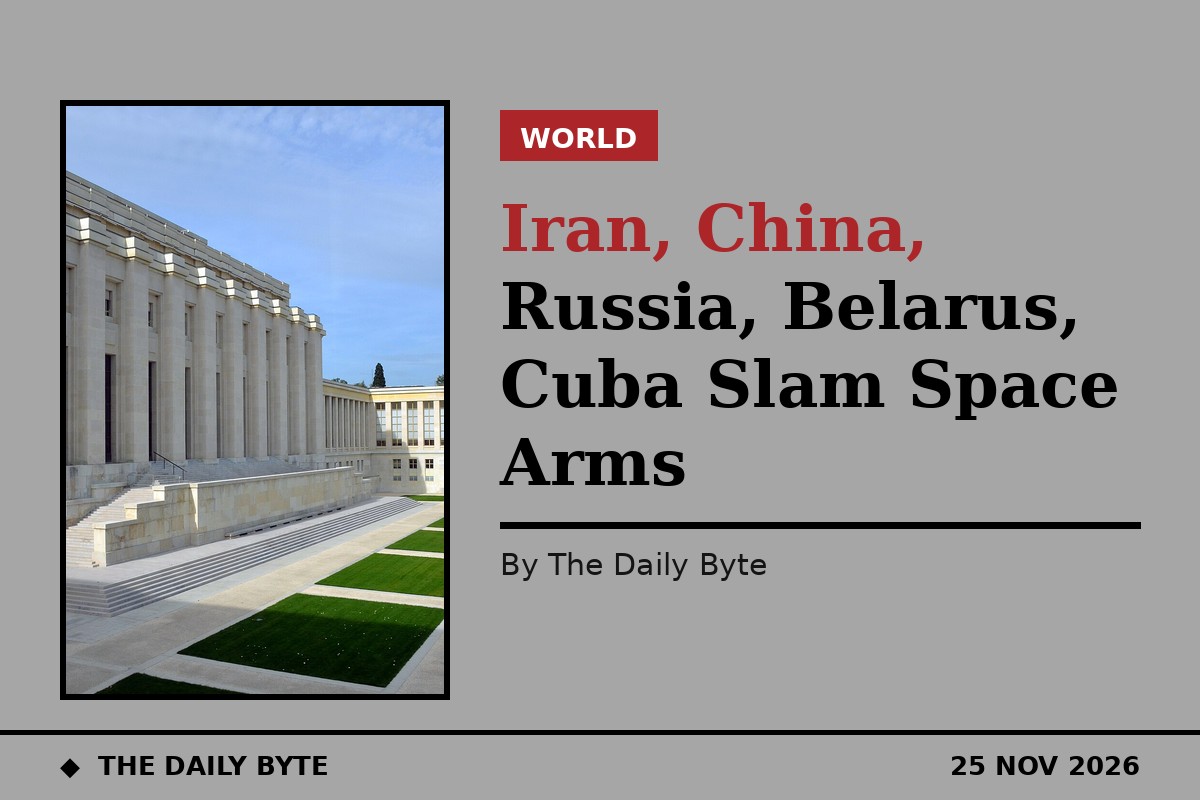
The warning came in a joint statement delivered by Iran's representative at the fourth session of the United Nations-mandated Open-Ended Working Group on the Prevention of an Arms Race in Outer Space, known as PAROS, which met in Geneva on Tuesday, 24 November. The text of the statement was published by Iranian media on 25 November.
In the statement, the five countries said they were gravely concerned by Washington's acknowledgement of the weapons, describing it as an escalation that threatens international peace and security and undermines longstanding efforts to keep space free of arms.
They reaffirmed what they called an unwavering commitment to keeping outer space for peaceful purposes only, and urged all countries to refrain from deploying weapons in orbit or taking steps that could trigger an arms race.
What the five countries are calling for
The statement called for negotiations on a comprehensive and legally binding international instrument that would prohibit both the placement of weapons in outer space and the threat or use of force against objects in space.
It also backed a revised draft treaty on the subject, the Treaty on the Prevention of the Placement of Weapons in Outer Space, the Threat or Use of Force against Outer Space Objects, which was submitted by China and Russia. The draft, known by its initials PPWT, has been promoted by Beijing and Moscow for years as the basis for a binding ban, but it has never been adopted.
The five countries said they strongly condemned any activity aimed at placing weapons in outer space and rejected attempts to normalise such practices, according to the published text.
A dispute with a long history
Arguments over weapons in space are almost as old as the space age itself. The 1967 Outer Space Treaty, which has been signed by more than 100 countries including the United States, Russia and China, bans the placement of nuclear weapons and other weapons of mass destruction in orbit, but it does not prohibit conventional weapons in space.
Russia and China have long argued that the gap should be closed with a new treaty, while the United States has argued that a ban would be unverifiable and has instead favoured voluntary norms of responsible behaviour. The disagreement has left the issue deadlocked at the United Nations for years, with repeated resolutions and working groups producing statements rather than binding rules.
The joint statement was delivered by Iran's representative on behalf of all five countries. Its text was carried by the Tasnim news agency and by Press TV, both Iranian outlets. No response from Washington to the statement had been reported by the time of publication.
Why it matters now
The statement comes as rivalry in space intensifies. The United States, China and Russia are all expanding military space programmes, and warnings about anti-satellite weapons and the vulnerability of the satellites that underpin communications, navigation and early warning have grown sharper in recent years.
For Iran, the statement also fits a wider diplomatic pattern. Tehran has repeatedly sought to align itself with China and Russia at the United Nations on questions where the three countries share an interest in constraining American military power, and the inclusion of Belarus and Cuba gives the group a broader, if largely symbolic, coalition.
Whether the statement changes anything in practice is doubtful. The PAROS working group can recommend, but it cannot compel, and the major space powers remain far apart on whether a binding treaty is desirable or even workable. But the statement is a reminder that, even as attention focuses on the wars in the Middle East and Ukraine, the contest over the rules of outer space is continuing in Geneva.