Iran warns France over Israeli 'false flag' cyber claim
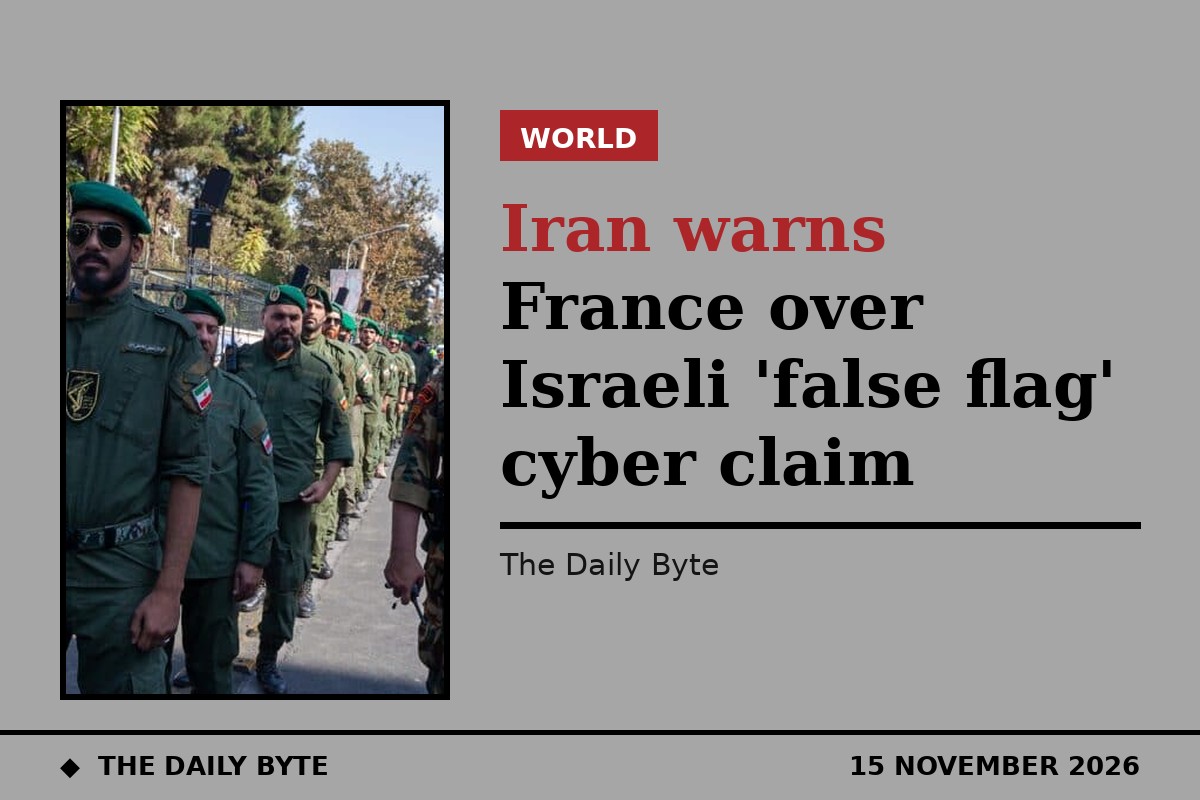
Iran’s Islamic Revolutionary Guard Corps has warned France against falling for what it called an Israeli “false flag” trap, after Paris accused an Iranian cyber unit of sabotaging supermarket refrigeration systems. The warning, issued on Saturday, adds a new diplomatic front to the dispute over the October attacks on French shops.
Revolutionary Guard spokesman Hossein Mohebbi dismissed the French allegation as “ridiculous” and accused Israel of being behind it to fuel hostility towards Iran and rally European support. “Paris should beware of the Zionist regime’s false flag trap,” Mohebbi wrote on X, according to Anadolu Agency.
Mohebbi also said that, unlike the United States and Israel, the Revolutionary Guard does not target civilians. The claim that Israel staged or planted the evidence has not been supported by any public evidence, and France has stood by its attribution.
What France alleges
On Monday 9 November, the French government attributed the cyberattacks to Shahid Kaveh, a unit it says belongs to the Revolutionary Guard’s electronic warfare and cyber defence organisation. The attacks, overnight on 11–12 October, targeted refrigeration control systems at more than 700 retail locations across France.
According to the French Foreign Ministry, the hackers drove temperatures inside refrigeration units to as high as 50°C, causing extensive damage, fires and food losses worth tens of millions of euros. Paris described the incident as the first large-scale cyber sabotage on French soil carried out purely for destruction rather than theft or espionage.
France summoned Iran’s ambassador, prosecutors sought international arrest warrants for the unit’s leader and two deputies, and Paris said it would seek sanctions at European Union level against the Iranians allegedly involved. Iran’s Foreign Ministry rejected the accusations on Tuesday as baseless and vowed to protect its national interests and security.
A dispute with wider stakes
The row comes at a sensitive moment for Iran’s relations with Europe. Tehran is already under intense pressure from the United States, which is enforcing a naval blockade of Iranian ports in a war that began on 28 February, and European governments have grown increasingly vocal about what they describe as Iranian hostile activity on their soil.
France’s case rests on what its interministerial Cyber Crisis Coordination Center called a bundle of converging indicators, including Farsi traces in the attack infrastructure and infrastructure previously used to reconnoitre Schneider Electric systems. Reuters has reported that it could not establish how France reached its determination, and no forensic detail, such as IP addresses or file hashes, has been published.
That gap is what Tehran is now trying to exploit. By framing the attribution as an Israeli deception, the Guard is seeking to drive a wedge between Paris and its European partners and to cast doubt on the evidence without addressing the technical claims in detail.
Whether the warning changes anything in Paris is doubtful. France has already moved to the courts and to Brussels, and the Guard’s intervention is more likely to harden the dispute than to resolve it. But it shows that the fridge attacks, which began as a domestic French criminal investigation, have become a point of contention between Iran, France and Israel, with each side now publicly accusing the other of deception.
Sources: Anadolu Agency via Daily Imroz; Europe Says.