Leasehold Bill Ends Feudal System for 5 Million Homes
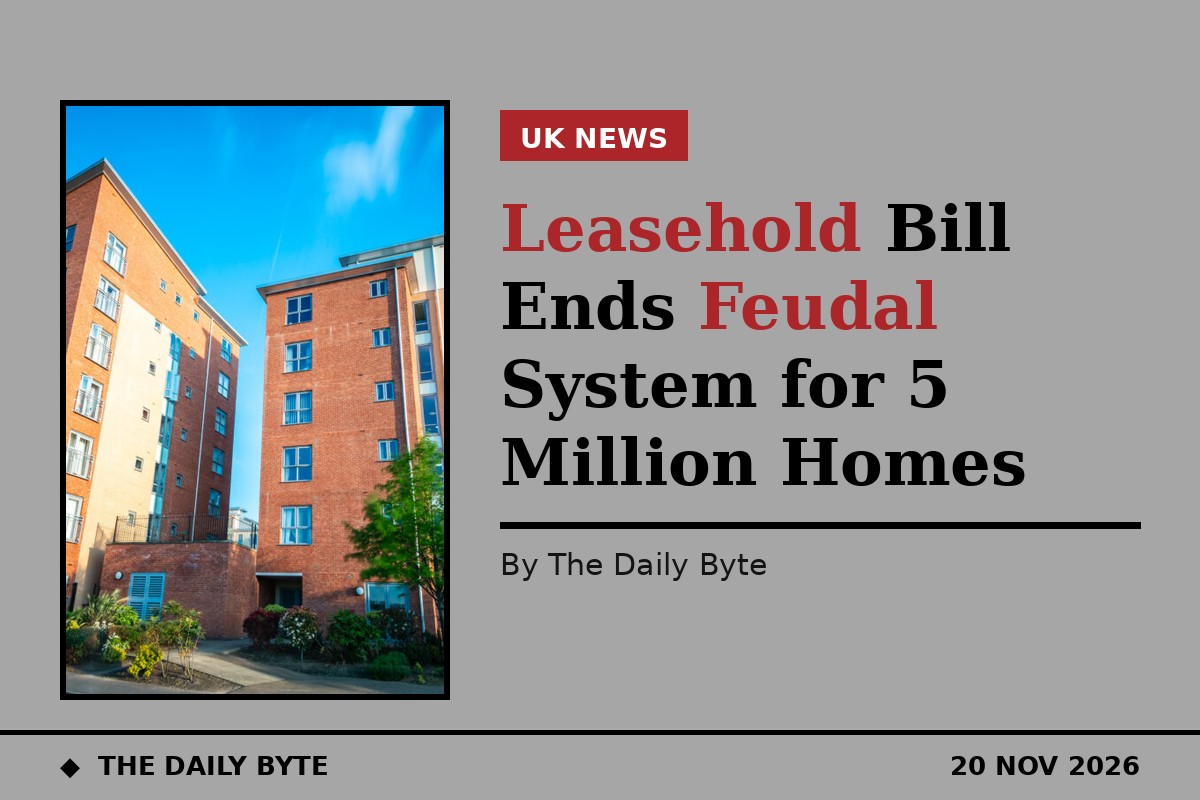
The government has introduced a Bill to Parliament that would end the sale of new leasehold flats in England and Wales and make commonhold the standard way of owning a flat, in what ministers describe as the biggest shake-up of homeownership in a century.
The Commonhold and Leasehold Reform Bill was introduced on Thursday 19 November. It delivers a manifesto commitment to end what ministers call the feudal leasehold system, and it affects an estimated five million leasehold homes across England and Wales.
Under commonhold, flat owners own their home outright for ever and jointly own the shared parts of their building with their neighbours. There is no ground rent and no third-party landlord. The Bill would make commonhold the default tenure for most new flats and homes, with narrow exceptions such as shared ownership properties.
Ground rents capped at £250 a year
For existing leaseholders, the Bill caps ground rents at £250 a year from 2028, with rents falling to a peppercorn — effectively nothing — after 40 years. The cap builds on the Leasehold Reform (Ground Rent) Act 2022, which limited ground rent to a peppercorn in most new leases, and extends protection to older leases that predate that Act.
Ministers will also gain powers to cap administration and permission fees. Leaseholders have been charged £1,422 for enquiries about double glazing and £252 for permission to keep a pet, and the Bill is intended to stop charges of that kind.
Lease extensions and freehold purchases would become cheaper and easier. The standard lease extension would lengthen from 90 years to 990 years, and marriage value — the charge that pushes up the price sharply when fewer than 80 years remain on a lease — would be scrapped.
Forfeiture scrapped and conversion made easier
The Bill abolishes forfeiture, under which leaseholders can lose their home and the value built up in it after breaching a lease, in some cases over debts as small as £350. It replaces that with a fairer, court-led enforcement system.
Existing leaseholders would also find it easier to take control of their own building. At present, every leaseholder in a block must agree before it can convert to commonhold. Under the Bill, only half would need to consent, allowing neighbours to club together, buy the freehold and convert.
The reforms would also protect up to 1.75 million freehold homes on so-called fleecehold estates, removing powers that allow management companies to take over families' homes because of unpaid estate charges.
Ministers hail the beginning of the end
Housing minister Matthew Pennycook said the publication of the Bill marks the beginning of the end for the feudal leasehold system. He said the government was laying the foundations for a commonhold future and giving existing leaseholders greater rights and protections, with easy and effective escape routes from leasehold.
Professor Nick Hopkins, chair of the Leasehold Advisory Service, called the Bill a significant step towards giving homeowners stronger protections against some of the most damaging features of leasehold. He described the move towards commonhold, with an easier route for existing leaseholders to convert, as the most significant change to home ownership for a generation.
What happens next
The Bill is not yet law. It must pass through both Houses of Parliament and receive Royal Assent, and some measures will need further regulations before they take effect. The ban on new leasehold flats is expected to start around 2031, and experts say existing leaseholders are probably looking at 2029 before conversion to commonhold becomes a realistic option.
There are also warnings that the reforms could face legal challenge. James Carpenter, a senior associate at law firm Forsters, said the proposed abolition of ground rents under existing leases looks ripe for a judicial review challenge, and warned that removing specialist landlords could leave residents carrying the full responsibility of managing complex buildings. The Bill applies to England and Wales only, as property law is devolved in Scotland and Northern Ireland.


