London Cocoa Holds Premium as EU Rules Near
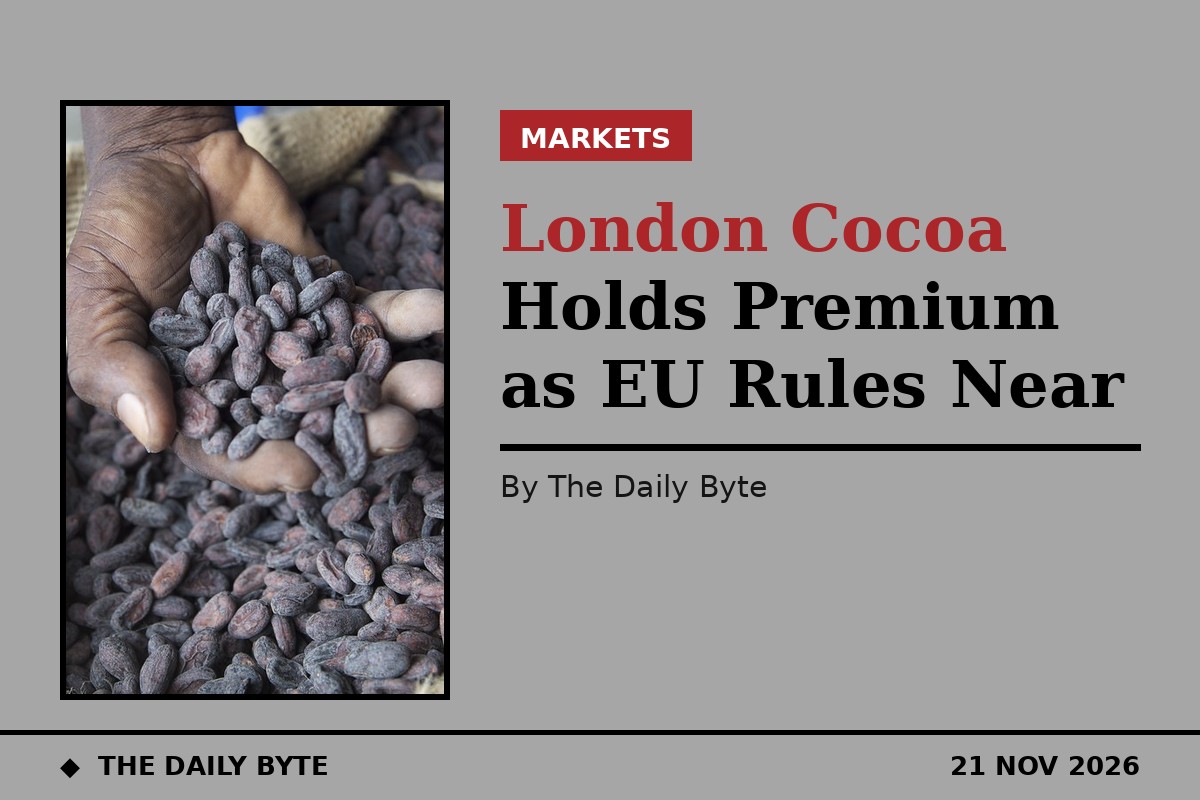
London cocoa held a premium over New York this week as traders positioned for European Union deforestation rules that take effect on 30 December, even as the figures pointed to ample short-term supply rather than a shortage.
London cocoa rose 4 per cent to £4,042 a tonne on Thursday, while New York gained 3.7 per cent to $5,188, according to Reuters' daily softs report. By Friday, price trackers showed London cocoa at £4,066 a tonne, leaving cocoa priced for delivery in Europe above the New York contract.
Bloomberg, in a report on the move, said London futures were commanding a widening premium over New York as traders braced for the rules, which apply to large and medium-sized operators from 30 December after two postponements. The regulation requires the company that first brings cocoa into the EU market to trace the beans to the plots where they were grown and to show the land was not deforested after 2020. Penalties can reach 4 per cent of a company's annual EU turnover.
How wide is the London premium?
On Reuters' snapshot, London at £4,042, converted at the day's sterling rate of about $1.31, was worth roughly $5,300, against New York's $5,188 — a premium of about $110 a tonne, or 2.1 per cent. Barchart's settlement figures for the two December contracts implied a gap closer to $35, or 0.7 per cent.
The premium has been wider. London's edge over New York climbed to $150 a tonne at last week's settlement, and the spread is widest on March 2027 futures, the first contracts to expire after the regulation takes effect. StoneX broker Vladimir Zientek said West Africa did not look fully ready for the regulation, and that shortcomings in technology and traceability could tighten supply.
Thursday's jump was not only about the rule
Barchart attributed Thursday's jump to flooding in Ecuador and short covering, with port arrivals in Ivory Coast down 46 per cent so far this season. Cocoa is still down about 10 per cent over the past month, and at roughly $5,200 it is about 60 per cent above the $3,200 level it traded at in April, close to June 2023 lows.
The physical market, on the available figures, does not yet show a shortage. StoneX estimated the 2025/26 season would end with a surplus of 494,000 tonnes, and ICE warehouses held 3.85 million bags on Thursday, a two-and-a-half-year high, according to Barchart. Europe's third-quarter grindings rose 3.2 per cent, Asia's jumped 29 per cent, and North America's fell 2.5 per cent. On Wednesday, before the jump, London cocoa had fallen 2.4 per cent to £3,902 a tonne, with exchange stocks at 100,610 tonnes, nearly three times the level a year earlier.
What the rule costs, and who pays
Reuters reported in August that compliance was estimated to cost $30 to $70 a tonne for West African exporters — the same order of magnitude as the premium itself, which looks on current evidence like a cost being passed through rather than a shortage. West Africa grows about 70 per cent of the world's cocoa and ships about two-thirds of it to the EU, Reuters reported, so any filter on that flow matters. Hedgepoint Global Markets cocoa analyst Carolina França said the region provides more than half of world cocoa and that the 2026-27 season had already started slowly.
Others see a sharper squeeze ahead. Nicko Debenham, a former global cocoa trader, told Reuters there was "a distinct possibility" that EU importers would not get enough compliant cocoa in the early days of the law. More than half of Nigeria's beans could fail to qualify at first, and StoneX expects a 64,000-tonne deficit in 2026/27 because of El Niño.
Chocolate makers are already feeling it
Swiss-listed Barry Callebaut, one of the world's largest cocoa processors, reported a 17.6 per cent drop in revenue for its fiscal year to August, to CHF 12.19 billion, almost entirely because cocoa prices were lower than a year earlier. Volumes slipped 0.7 per cent and net profit fell 16.3 per cent to CHF 157.7 million. Its shares rose about 9 per cent on the day, after guidance that assumes cocoa at £4,000 a tonne and volume growth of 1 to 3 per cent. Hershey's North America confectionery revenue rose 1.6 per cent in the third quarter despite an 11-percentage-point drop in volume, and Lindt has raised prices 19 per cent in 2025 and 12 per cent more in the first half of 2026.
The test arrives after 30 December. If the London premium holds above roughly 5 per cent — well beyond the cost of the paperwork — and due-diligence refusals start appearing at the border, the shortage case will have evidence. If the spread collapses once the deadline passes, it was anticipatory positioning.