SoftBank Explored $1 Trillion SK Hynix Buyout
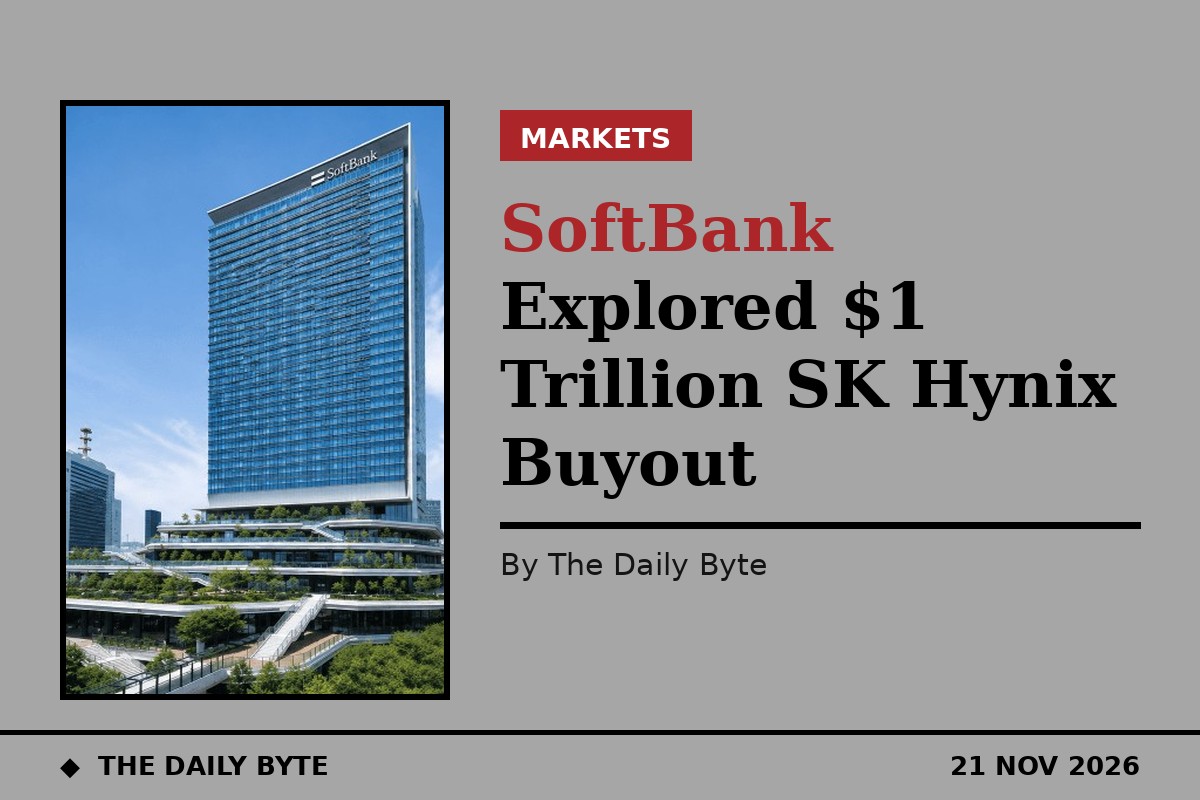
SoftBank Group chief executive Masayoshi Son recently approached Wall Street institutions about financing a possible trillion-dollar buyout of South Korean memory-chip maker SK Hynix, Reuters reported on 21 November 2026, citing a report by The Information. The idea has since been shelved: a SoftBank spokesperson told The Information that the deal was "no longer under active consideration".
The report, citing people familiar with the matter, said Son sounded out investment banks on how such a deal could be funded. SK Hynix said in a statement that it had no knowledge of the matter described in the report, and added that any foreign acquisition of the company would require prior government approval under Korean law.
A trillion-dollar idea, at an early stage
The price tag of up to 1 trillion dollars was floated during the talks, which The Information describes as having stayed at an early conceptual stage. As ad-hoc-news reported, the figure reflected SK Hynix's peak market value at the time plus a 40 per cent control premium, and the discussions with lenders centred on funding rather than on terms.
Investors should read the number as the scale of a deal that was examined, not as an agreed purchase price or a fresh payment obligation. Nothing was agreed, no offer was made, and the exploration never moved past the sounding-out phase.
Why SK Hynix
SK Hynix ranks among the three suppliers of high-bandwidth memory used in AI accelerators, the fast memory that sits next to the chips powering artificial intelligence. Buying it would have placed SoftBank alongside its existing stakes in Arm, Ampere Computing and Intel as a manufacturer of that memory, a different slice of the AI supply chain from its holding in OpenAI.
It would also have been a deal of extraordinary scale. At a trillion dollars it would have dwarfed every previous technology takeover, and it would have needed a financing package assembled from banks and investors at a moment when markets are openly questioning whether the huge spending on AI infrastructure will pay off quickly enough.
The OpenAI bet it already holds
That holding, unlike the chipmaker idea, has already been funded. An additional 10 billion dollar tranche in October lifted SoftBank's total investment in OpenAI to 64.6 billion dollars, giving it roughly 13 per cent of the company. Even before that payment, the stake was already worth more than the capital committed: as of 30 September, the position was valued at 99.6 billion dollars against 54.6 billion dollars invested.
Son told listeners on Wednesday that he regretted passing up the chance to back Anthropic, the OpenAI rival whose record stock-market debut in New York this week failed to calm doubts about AI valuations. Anthropic's listing gave investors a new, richly valued reference point for generative AI, and made existing bets such as SoftBank's stake in OpenAI look less certain by comparison.
A bruising backdrop
The market turmoil lands on top of a swing to losses. For the second quarter of fiscal 2026, SoftBank reported a net loss attributable to shareholders of 1.12 trillion yen, reversing a 2.50 trillion yen profit in the same quarter a year earlier. In its half-year report, the group put the loss stemming from revised procurement plans for power-supply equipment at US AI data centres at 597.25 billion yen.
SoftBank's shares fell 16 per cent in Tokyo on Friday 20 November, caught in the sell-off in Asian technology shares, with its large OpenAI commitment and its Arm stake leaving the shares especially exposed to any pullback in AI names. The SK Hynix exploration, had it gone ahead, would have widened SoftBank's reach into yet another corner of the AI economy. Instead it never moved past the sounding-out phase, leaving OpenAI as the group's defining, and most scrutinised, bet.