Peers Call for Paid Leave to Train for Crises
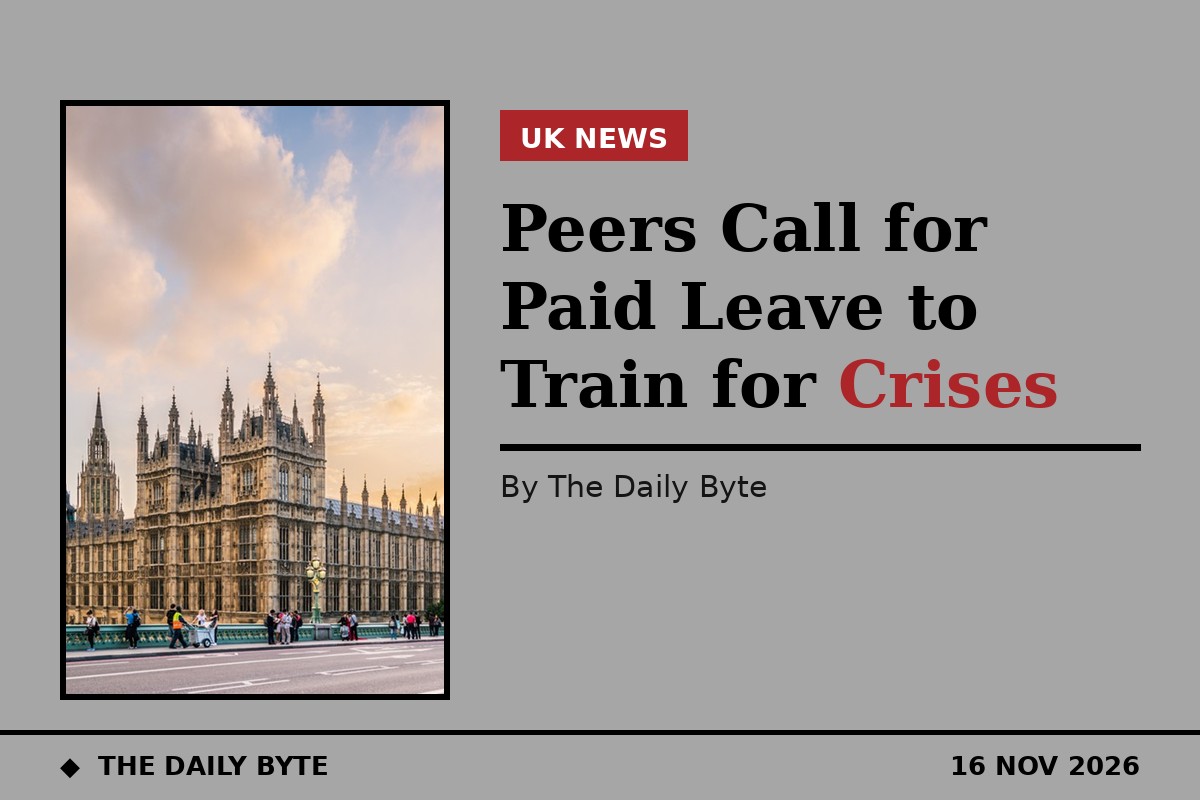
Workers should be able to take paid time off to prepare for national emergencies, a House of Lords committee has recommended, warning that the United Kingdom is seriously underprepared for crises ranging from war to power cuts and cyber-attacks.
The National Resilience Committee, which spent nine months examining Britain's readiness, published its report on Monday 16 November 2026. Its central proposal is a new "civic resilience leave" entitlement that would let employees undertake approved emergency training and volunteering without losing income. Rather than fixing a number of days, the peers want ministers and employers to agree "proportionate arrangements" for the leave.
The committee, chaired by Baroness Coussins, said the public remained largely uninformed about emerging threats and that the government had not shown enough urgency. "One of our main concerns is that the Government hasn't got a sense of urgency or leadership from the very top about what's already happening," Baroness Coussins said. She named threats to communications and energy infrastructure, cyber-attacks and proxy violence involving Russia, China and Iran, and said ministers had been "very wary and unnecessarily coy about being straight with the public".
What workers get now
Existing protections are limited. Although some employers voluntarily support emergency volunteers, people involved in coastguard rescue, firefighting and St John Ambulance activities have no general legal entitlement to paid leave. Army reservists can claim up to £400 a day when mobilised, but employers are not legally required to give them time off for training.
The peers also want every local council to draw up a register of volunteers with relevant emergency skills, alongside a list of buildings that could serve as temporary shelters, and a nationwide recruitment drive modelled on the NHS volunteer responders programme from the Covid pandemic.
Booklets, medicines and television
On household preparedness, the committee welcomed the government's "Be Ready" campaign, which encourages people to keep three days of essential supplies, but it rejected an approach that relies mainly on online information. Instead, it recommends sending printed emergency guidance booklets to every household, following the examples of Sweden and Denmark, and a multilingual preparedness app that gives official advice and lets users share their location with the emergency authorities, drawing on Finland's 112 Suomi system.
The report also calls for investment in rebuilding domestic production of life-saving medicines, starting with antibiotics. Baroness Coussins said Britain's antibiotic supply chains were "completely dependent on China", noting that the UK imports 80 per cent of the active ingredient used in penicillin production and that Britain's last domestic antibiotic manufacturing facility closed in 2025, leaving Europe with only one such plant.
The committee further questioned government plans to phase out digital terrestrial television from the mid-2030s in favour of internet-based services, warning that relying on broadband could leave vulnerable households without access to essential information during major emergencies. Traditional television broadcasting is protected under legislation until 2034, with a managed transition potentially running to 2044.
Government response
The Cabinet Office said it would "carefully review" the committee's findings. A spokesman pointed to the national preparedness campaign, a major home defence exercise planned for 2027, investment of more than £1 billion in pandemic security, updated departmental contingency documents known as the "war book", and new measures to protect undersea internet cables. The committee also recommended a Cabinet minister responsible for resilience, a Chief Resilience Officer at Permanent Secretary level, resilience education in schools and workplaces, and expanding the Armed Forces' Gap Year pilot to young people not in education, employment or training. For more detail, see BBC News and Demokratis.