House of Lords Warns Childhood Vaccination Rates in England Must Be Reversed
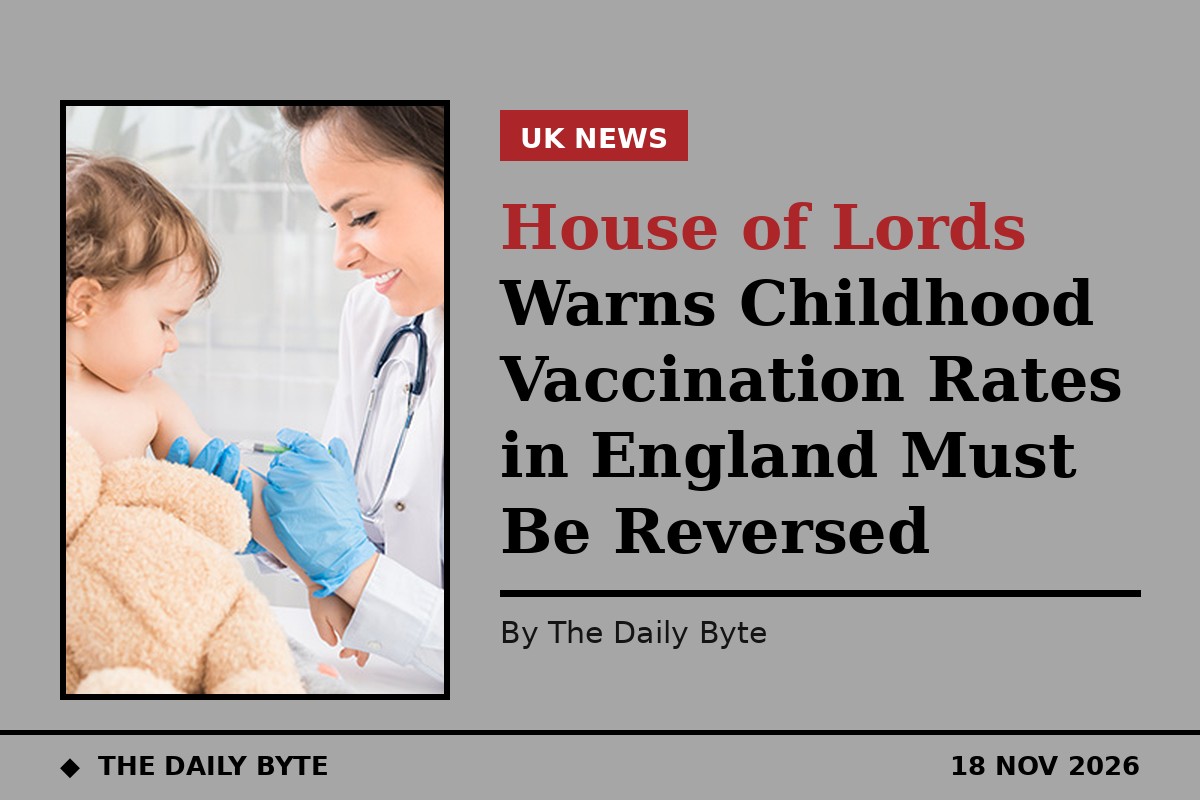
The Government must act urgently to reverse the decline in childhood vaccination rates in England, a House of Lords committee has warned in a report published on 18 November 2026. The report, No time to lose: reversing the decline in childhood vaccination rates, says failure to act will leave more children, young people and adults exposed to avoidable disease, disability and death.
The House of Lords Childhood Vaccinations Committee found that childhood vaccination rates have fallen for more than a decade. Pre-school coverage has dropped below the World Health Organization's 95 per cent standard, while adolescent vaccination rates sit below the 90 per cent target. The report estimates that childhood vaccination prevents more than 200,000 hospitalisations and 5,000 deaths in England every year.
Measles has already returned
The consequences are already visible. The UK lost its measles elimination status in January 2026, and by October an estimated 4,403 measles cases and three deaths had been recorded during the year. The committee also warns that falling take-up of the human papillomavirus (HPV) vaccine threatens England's ambition to eliminate cervical cancer by 2040.
Committee chair Baroness Walmsley said: "Families want to keep their children safe and value having the time to talk with trusted healthcare professionals about getting vaccinations."
The gap between rich and poor areas is widening
The decline has not affected all communities equally. The gap in MMR vaccination coverage between the most and least deprived areas widened to 7.7 percentage points in 2024/25, compared with broadly similar rates in 2016/17. MMR rates have fallen more than 30 times faster in the most deprived areas than in the least deprived, and the gap for HPV vaccination has grown to more than 22 percentage points. Only around half of girls in the most deprived local authorities are being vaccinated against HPV.
The committee says there is no single explanation for the fall. Its report notes that 84 per cent of parents surveyed by the UK Health Security Agency said they trusted vaccinations, but that growing barriers to access and fewer chances to build confidence are putting families off. Inflexible appointments, limited time to discuss concerns with healthcare professionals and difficulties navigating booking systems can all discourage attendance.
Health visitor numbers have halved
The report also points to structural changes to the NHS and public health system since 2013, which it says have fragmented responsibilities, increased pressure on GPs, nurses and health visitors, and weakened continuity of care. Health visitor numbers have halved over the past decade, despite their important role in supporting parents and discussing childhood vaccinations.
Responding to the report, the Royal College of Paediatrics and Child Health said the vast majority of parents want to vaccinate their children, yet many are being let down by a system that makes it increasingly difficult to access appointments and services. Dr Helen Stewart, the college's Officer for Health Improvement, welcomed the committee's call for a concrete plan to improve uptake.
What the committee wants the Government to do
The committee is calling for a new national plan, clearer accountability across the NHS and local authorities, and investment in the children's public health workforce. It also wants more flexible GP appointments, stronger coordination between GP practices and school vaccination teams, improved call-and-recall systems and sustained outreach in communities with the lowest uptake. Other recommendations include restoring the 95 per cent pre-school coverage target to NHS planning guidance, introducing stepped improvement targets and improving vaccination education in schools.
The committee also considered whether community pharmacies could help close gaps in access. Pharmacies have been commissioned to provide flu vaccinations for two- and three-year-olds in 2025/26 and 2026/27, and to deliver a one-off MenB vaccination offer for 17- and 18-year-olds. The report concludes there is some evidence that supplementary providers could improve access, but says the Government should evaluate such provision carefully so that it reaches children who are missing vaccinations rather than simply offering families another choice.
The full report, HL Paper 80, was ordered to be printed on 2 November 2026 and published on 18 November 2026. It is available from the House of Lords Childhood Vaccinations Committee, with further coverage from Pharmacy Business and the Royal College of Paediatrics and Child Health.


