Maggie Oliver case: High Court reserves judgment
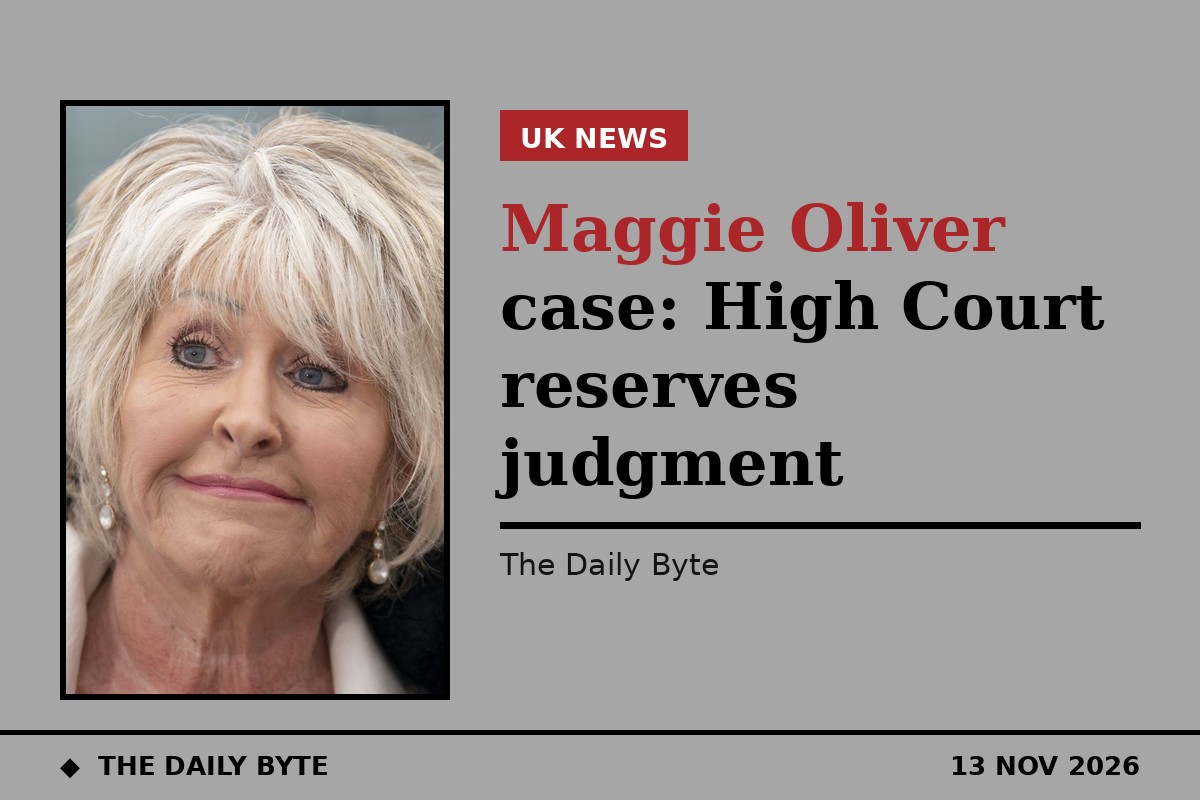
The High Court has reserved judgment in a landmark legal challenge over the Government's failure to implement the recommendations of the seven-year Independent Inquiry into Child Sexual Abuse (IICSA), after a three-day hearing in London.
The judicial review, brought by the Maggie Oliver Foundation against the Home Secretary, was heard by Mr Justice Mansfield from 10 to 12 November 2026. A written decision is expected at a later date. The charity argues that repeated ministerial assurances created a legitimate expectation that the inquiry's 20 recommendations would be honoured, and that the failure to implement them was unlawful.
Maggie Oliver, a former Greater Manchester Police detective who resigned from the force in 2012 over its handling of organised child sexual exploitation in Rochdale, founded the charity in 2019 to support survivors and campaign for institutional accountability. She has described the Government's defence in court this week as "toe-curlingly horrific" and said public inquiries were being used as a convenient political tool to deflect criticism without implementing real change.
The case against the Government
IICSA was established in 2015 and concluded its work in October 2022, after examining institutional failures to protect children across England and Wales. More than 7,000 victims and survivors contributed evidence, and the inquiry's recorded expenditure to March 2023 was approximately 190 million pounds, a figure commonly rounded to 200 million pounds in reporting.
The inquiry produced 20 principal recommendations intended to better protect children, covering areas including mandatory reporting of child sexual abuse, the removal of time limits on civil claims, and professional registration for staff working in children's homes. Four years after the final report, the Maggie Oliver Foundation maintains that only seven of the recommendations have been implemented, although different assessments apply different standards of completion and legislation passed during 2026 has changed the position.
Stephanie Harrison KC, representing the Foundation, told the High Court that child sexual abuse continued at what she described as near-industrial levels, and rejected the tendency to discuss the scandal principally as a historical issue. She argued that repeated assurances by ministers had created a legitimate expectation that the recommendations would be implemented, and that the Government's failure to honour those commitments amounted to an abuse of power.
Permission for the full judicial review was granted on 5 March 2026 by Mr Justice Kimblin, who described the application as a "paradigm example of public interest litigation" and accepted that the arguments about legitimate expectation and pain-inducing restraint techniques in children's custody were sufficiently arguable to warrant examination.
What the Government argued
The Government's barrister, Jack Anderson, told the court in written submissions on 10 November that the recommendations were "no more than recommendations and do not carry any legal force", and that ministers could not be compelled to implement them. He argued that the recommendations lacked the precision required to create the enforceable expectation alleged, and that even if some expectation had arisen, departing from it would not necessarily be unlawful.
He also argued that reliance on certain ministerial statements made in Parliament would offend parliamentary privilege, and that the court could neither compel the executive to introduce legislation nor require Parliament to enact it. The Government has said it is investing 100 million pounds in preventing and prosecuting child sexual abuse and is pursuing its programme for implementing the inquiry's recommendations.
The Foundation also says the Government challenged its standing to bring the claim and argued that unfulfilled commitments had caused "no detriment", a submission Oliver and her supporters have strongly criticised. Some reforms remain unresolved years after they were first proposed: professional registration for children's home staff was first recommended in IICSA's interim report of April 2018, yet nearly eight years later an independent register had still not been established.
Judgment reserved
Mr Justice Mansfield must now decide whether the Government's conduct breached the legal obligations alleged by the Foundation. The result cannot be anticipated, and the decision will be given in writing at a later date.
The case has wider significance beyond its own outcome. The Statutory Independent Inquiry into Grooming Gangs, set up last year, is scheduled to open its first national public accountability hearings in December, examining why recommendations from previous reviews were not consistently implemented. For survivors who gave evidence to IICSA, the judgment will test whether the promises made to them when they were asked to relive their experiences carry any legal weight at all.
The Times reported Oliver's reaction to the Government's defence and that only seven recommendations had been implemented, while PA Media reported the Foundation's argument that the Government had abused its power by failing to adopt the reforms.


